🛸 𝗧𝗵𝗲 𝘁𝗿𝘂𝘁𝗵 i𝘀 𝗼𝘂𝘁 𝘁𝗵𝗲𝗿𝗲 – and we’re ready to share it.
Introducing: 𝗧𝗵𝗲 𝗔𝗜 𝗙𝗶𝗹𝗲𝘀, a half-day virtual summit showcasing what 1.5M production alerts uncover, candid rollout stories, and a former regulator on defending AI in an exam.
For believers and skeptics both.
Register 👇 https://t.co/dUduEBgi0i
Coffee’s on in San Francisco next week. ☕
We’re joining @FirstCitznInnov for SF Fintech Coffee, a relaxed breakfast for fintech founders, investors, and operators. There’s no agenda, so come for a coffee and stay for the conversation.
Thank you to First Citizens Innovation Banking for having us.
🗓 Tue, Nov 10 | 8:30 to 11:00 AM
📍SVB Experience Center, San Francisco
Spots require approval, request yours here →
https://t.co/u7lN8ai4Wb
AI Task Spotlight, Edition 12: metrics on demand with the Unit21 MCP. 📊
Ask your AI assistant about your alerts, cases, and SARs in plain English and get the numbers in seconds. Nothing to install, and it runs on your existing permissions.
Watch the demo → https://t.co/DDBkbmabqB
5/ You’ll leave with:
→ Where the real cost of building sits
→ What moves the math: data, eng capacity, regulators, scale
→ How teams draw the build/buy line
→ Signs a build has outgrown you
Tue, Nov 3 · 12:05pm PT
Save your seat: https://t.co/n4vHwErT6I
The most requested topic for The AI Files: build, buy, or both?
Every team putting AI into fraud and AML hits this fork, and nobody answers it the same way.
On Nov 3, @DattaKunal sits down with @sidtalreja of @circle to work through it ↓
4/ What’s actually worth owning?
If UI and workflows are getting commoditized, where does your advantage live: your data, your signals, your own playbook?
Most sanctions hits aren’t risk. They’re someone who happens to share a name with a person on a list.
Analysts know that, but they still have to prove it, one search tab at a time.
On Oct 27, Cross Lawn and Nicki Willi are running a quick live session on adverse media and sanctions screening. They’ll cover why screening gets so noisy, how to tell a real match from a coincidence, and they’ll demo our Online Search Agent doing the research live so your team only has to make the call.
It runs 15 to 30 minutes, and you don’t need any Unit21 experience.
Register today: https://t.co/AeXwHviPXE
Unit21 is at Jack Henry Connect. Come find us at the booth.
See how banks and credit unions clear the fraud and BSA queue with AI Agents that keep every decision defensible, plus same-day detection rules and fraud + AML in one platform.
Book a meeting (and grab a hat) → https://t.co/s785mWOzOI
Getting an AI agent live is a big milestone. But when agents are handling real alert volume every day, a new set of decisions comes up.
Two financial crime leaders have lived that difference, and they’re comparing notes at The AI Files on November 3.
→ Robert Fenner, Global Deputy Head of Financial Crimes Compliance, Rippling
→ Zaheer Jassat, VP Product, Zepz
Save your seat → https://t.co/fLiWeRBoiU
A $9,400 deposit looks harmless. So does $9,100. And $9,800. And $9,300.
Each one sits under the $10,000 reporting line. Together, they are the problem.
Structuring is the oldest trick in financial crime, and one of the hardest to prove. So we ran it through Unit21 twice.
Rule Writer Agent: plain English in, deployable rule out. Three or more transactions between $8,000 and $9,999, over $10,000 combined, inside a rolling three-day window. Edit it, validate it, go live.
AI Investigation Agent: 174 transfers to a single recipient over 25 days, 17 of them in one day, with 4 larger transfers hidden among 169 small ones. Traceable findings, an editable narrative and a full audit trail.
Want to see it live? We’re covering structuring in today’s AI in Fincrime Masterclass at 10:00 AM PT:
https://t.co/IVlNHSziSD
Read how it works → https://t.co/8HVdOs3uBY
We’re proud to announce Unit21 is integrated with Corelation KeyStone 🚀
Credit unions on KeyStone can block cards, stop payments, and place holds straight from the Unit21 investigation, with a full audit trail from alert to SAR.
See how it works → https://t.co/RlDiVpN9A0
We’re proud to announce Unit21 is a @alkamitech Alliance Partner 🚀
Banks and credit unions using Alkami + Unit21 can stop fraud in the digital banking session and run their AML program on one platform:
- Pass, step-up, or block decisions before the action completes
- Rules your own team writes, tests, and ships the same day
- Investigations, case management, and FinCEN filing in one workspace
Kinecta Federal Credit Union runs Unit21 alongside Alkami and now catches twice as many true positives with half the alerts.
Want to see how it works? Join us on October 22 for a live demo of Unit21 + Alkami.
See the demo live: https://t.co/VlXM9PWVUW
The new model risk guidance left AI out. Your examiner won't.
SR 26-2 puts generative and agentic AI out of scope. The agencies haven't said what's next, but examiners are already asking about AI, usually in the request list after the entry letter.
At The AI Files on Nov 3, we're putting that exam on the record with a panel that's sat on every side of the table:
🔹 Kirsten Muetzel, former Fed examiner
🔹 Kevin Oden, model risk validator, ex-Wells Fargo risk exec
🔹 Marc Rehberger, built AI inside banks and took it through exams
🔹 Michael Fasanello, BSA Officer at Bakkt, former FinCEN attorney
🔹 Moderated by @mikulaja, Fintech Business Weekly
Register: https://t.co/070BFvwih7
One case: a sponsor bank's partner wants AI to auto-close 40% of its alerts, exam 90 days out. What goes in the file? What accuracy is good enough?
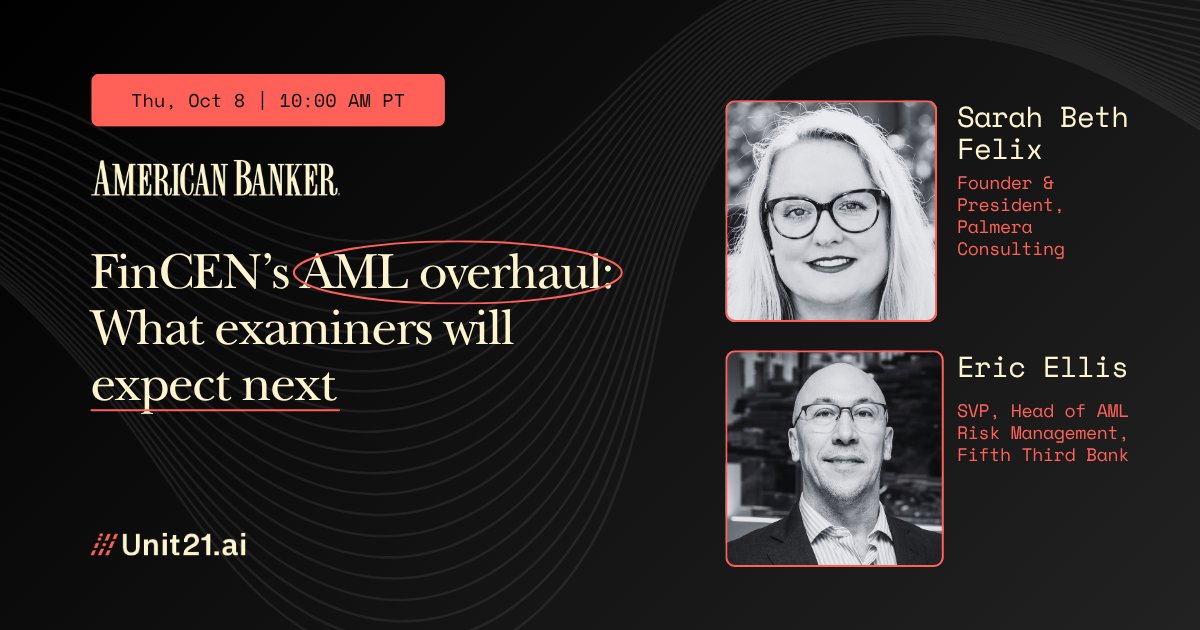
Last call: @FinCENnews changed the standard your AML program gets judged against, from "does it look reasonable" to "does it actually work." Sarah Beth Felix and Eric Ellis, a practitioner and a former examiner, argue out what that means for your next exam.
🗓 Oct 8
🔗 Register: https://t.co/l1iF4TT1iD
🛸 Announcing the keynote for The AI Files: 𝟭.𝟱 𝗺𝗶𝗹𝗹𝗶𝗼𝗻 𝗹𝗶𝘃𝗲 𝗔𝗜 𝗮𝗹𝗲𝗿𝘁𝘀, and the truth about what AI actually does in FinCrime. 𝗜𝗻 𝟭𝟱 𝗺𝗶𝗻𝘂𝘁𝗲𝘀.
Register → https://t.co/gQEuqLq8Vq
A 𝗳𝘂𝗹𝗹 𝘆𝗲𝗮𝗿 𝗼𝗳 𝗽𝗿𝗼𝗱𝘂𝗰𝘁𝗶𝗼𝗻 𝗱𝗮𝘁𝗮 on how AI performs on live financial crime work.
On November 3, our CEO Tyler Allen opens the summit with the findings, straight to what the data says. Then the rest of the day to dig in.
FinCEN's AML/CFT National Priorities put cybercrime, including virtual currency, on every institution's radar.
Buried inside that priority is an exact laundering pattern: a DFIR or cyber insurance carrier (CIC) customer receives funds, then shortly after sends an equivalent amount to a virtual currency exchange.
We ran that pattern through @unit21inc twice. 🎥
→ 𝗔𝗜 𝗜𝗻𝘃𝗲𝘀𝘁𝗶𝗴𝗮𝘁𝗶𝗼𝗻 𝗔𝗴𝗲𝗻𝘁 works a flagged alert end to end — prior activity, account risk, travel, adverse media — and recommends escalation.
→ 𝗥𝘂𝗹𝗲 𝗪𝗿𝗶𝘁𝗲𝗿 𝗔𝗴𝗲𝗻𝘁 takes the advisory's own language, plain English in, and returns a deployable trigger condition, ready to review and approve.
One alert. Two directions. Investigation and detection, from the same regulatory language.
Watch it happen in the video below, then read the full breakdown on our blog → https://t.co/ecTLCACe2i
Fraud and compliance teams are under more pressure than ever. Come meet the Unit21 team at @acams_aml Vegas, booth 602.
See how configurable AI agents run the full loop, from detection to a regulator-ready filing, with audit trails you can defend. And grab a limited edition tee. 👕
Book a time with us → https://t.co/zpw9VsKuD5