Kansas was once one of the most fusion-friendly states in America.
Long before our modern political divisions hardened, Kansans regularly built coalitions across party lines. Republicans, Populists, independents, and reformers often united behind common candidates and common causes. Even Abraham Lincoln’s rise to the presidency depended on fusion politics, bringing together anti-slavery voters from different political movements who understood that principles matter more than party labels.
By the 1890s, fusion politics was thriving in Kansas. It gave voters more choices, encouraged cooperation, and allowed political movements to grow without forcing people into one of two boxes.
Then, in 1901, Kansas banned it.
For more than a century, Kansans have been denied a political freedom that previous generations exercised openly. Voters can support multiple causes. Citizens can belong to multiple organizations. Groups can work together on shared goals. Yet political parties are uniquely restricted from jointly supporting the same candidate.
That restriction remained largely unquestioned until 2024.
Today, a legal challenge is asking a simple but important question: Does the Kansas Constitution protect the right of political association strongly enough to allow fusion politics once again?
This is not really about Democrats or Republicans. It is not about left versus right.
It is about whether Kansans are free to organize politically in the way they choose.
The Kansas Constitution recognizes that political power originates with the people. Political parties are voluntary associations of citizens. If citizens wish to work together across traditional party lines, government should have a very good reason before telling them they cannot.
Fusion voting is not a radical idea. It is not new. It is part of Kansas history.
For decades, it helped shape our state. It encouraged coalition building, rewarded consensus, and gave voters more meaningful choices.
Whether you agree with fusion voting or not, the constitutional question deserves serious consideration. Rights that disappear for 125 years are still rights worth examining.
Sometimes progress is not about inventing something new.
Sometimes it is about restoring something we lost.
🌻 Kansas once trusted its citizens to build political coalitions as they saw fit. Perhaps it is time to ask whether that trust should be restored.
@FusionVoting #KsLeg #KsCourts
Ezra Klein and I talk gerrymandering, proportional representation, and all kinds of madness.
This is an episode of the Ezra Klein Show you won't want to miss!
(link below)
At no moment in American history has our winner-take-all districting system worked particularly well. There is no golden age of “fair districts.”
The problems have been different at different times. The antiquated voting system that produces them has been there from the start.
Reinstating fusion voting is a common-sense way to fight polarization and open up our democracy:
✅ Voters: Support a candidate and a party that matches your values—no spoilers, no wasted votes.
✅ New Parties: Gain real influence by shaping major party platforms.
✅ Candidates: Build broader coalitions and earn more votes.
#FusionVoting #Democracy #ElectionReform
Under fusion voting, a moderate party has real leverage—able to reward compromise and back candidates from both sides. Unlike extremes that pull from one camp, the middle can shape outcomes by swinging either way. @leedrutman@newamerica@PolReformNA
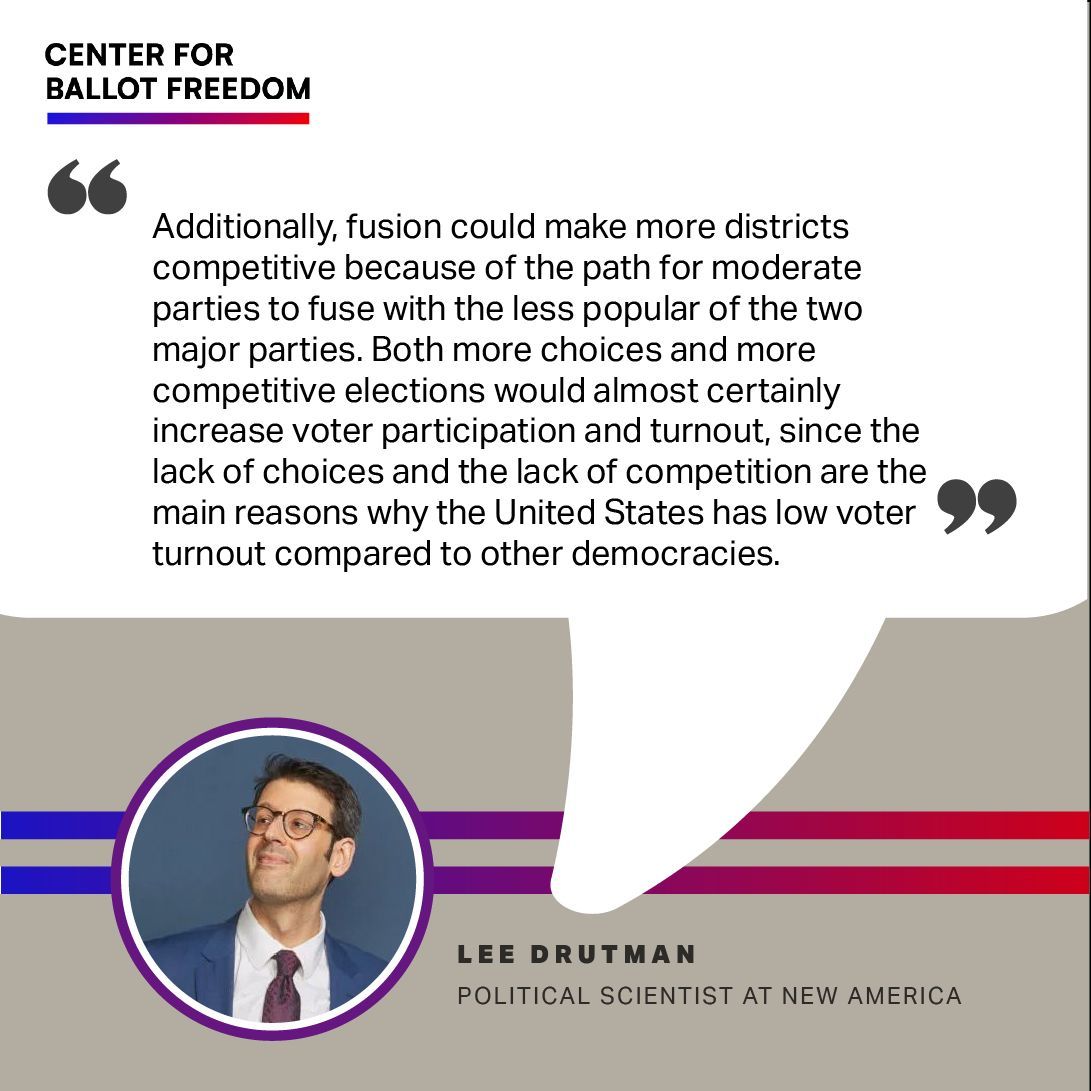
Fusion voting could make more districts competitive—giving moderate parties a path to back the less popular major party. More choices + tighter races = higher participation, addressing a key reason U.S. turnout lags other democracies. @leedrutman@newamerica@PolReformNA
Fusion voting lets a candidate be nominated by multiple parties—often a major + a minor—appearing on the ballot under each label. Votes are counted by party, then combined for the final total: principled, practical coalition-building in action. @leedrutman@newamerica@PolReformNA
Without a moderate party line, voters are stuck choosing D or R with no clear signal. Fusion voting changes that—giving the political middle a way to show up, organize, and wield real influence in close elections. @leedrutman@newamerica@PolReformNA
Fusion voting lowers the temperature in politics by encouraging coalition-building over combat. When parties can share candidates, voters get more choice—and less noise. 🌡️🗳️ #FusionVoting#DemocracyReform#ElectionReform
The @UnitedKansas Party is pushing to bring back fusion voting—allowing multiple parties to nominate the same candidate, so voters can support who they prefer without being locked into the two-party system. @TimVCarpenter@KansasReflector
What made it all possible was fusion voting—it let emerging parties grow by allying with sympathetic candidates inside major parties. Without that flexibility, none of it would have happened. @LisaDisch1
Honestly, the endorsement of A Connecticut Party was pivotal. I got 365K votes on the Democratic line, 125K on theirs—and won by just 2,237. Without fusion voting and that support, I wouldn’t have been elected. It made a huge difference. @MilesRapoport
Fusion voting, in particular, is often cited as one of the most historically rooted but least understood reforms, allowing multiple parties to nominate the same candidate and giving voters a more expressive choice at the ballot box. @JohnAvlon@BulwarkOnline
Reviving fusion voting would be a small step back to a 19th-century American innovation—one that let people organize as broadly as they wanted and bring that full coalition power into real elections. @UnitedKansas@russellafox9
If the Kansas Supreme Court reopens fusion voting, Kansans could gain greater electoral rights and freedoms—and set the stage for broader change, potentially influencing the U.S. Supreme Court as well. @UnitedKansas@russellafox9
Want to prevent spoiled elections? Here are some strategies to combat vote-splitting. Every ballot matters; make sure yours counts toward real change. 📢
Kansas has a long history with fusion voting. In 1864, nearly 80% of voters backed the Lincoln–Johnson “National Union” fusion ticket, and for decades parties teamed up to win elections. Coalition politics—not rigid parties—was once the norm in Kansas. @UnitedKansas