America’s political system is broken. We are a cross-partisan nonprofit project that protects and strengthens American democracy by reviving #FusionVoting 🗳️
Fusion voting gives smaller parties another option: support a viable candidate without giving up their own identity, message, or ballot line. @jefftimmer
That means voters can back a candidate who can actually win and vote for the party that best reflects their values. In short, fusion voting lets people say more with their vote—without “throwing it away.”
America’s democracy doom loop won’t end with “better maps” alone. Solutions like proportional representation AND fusion voting could give voters more real choices, stronger coalitions, and a way out of permanent polarization. @gelliottmorris@leedrutman https://t.co/ViU4Yt3buK
An election result isn’t the heart and soul of a country. People’s views keep evolving.
The real story? Many Americans are frustrated with rising costs and are looking for solutions that make life more affordable and secure. Voters want results, not just rhetoric.
@Mlsif@hmcghee
Fusion voting isn’t about helping third parties spoil elections—it’s about reducing the spoiler problem. @jefftimmer
Instead of splitting votes, fusion allows coalition-building: multiple parties can support the same candidate while still giving voters a way to express their values and priorities at the ballot box.
Fusion voting gives voters more meaningful choices, strengthens coalition-building, and breaks the rigid two-party binary without acting as a spoiler system. More choice. More competition. More democracy. @rickhasen@electionlawblog@jefftimmer@markbrewer@lpmi
"When you hear a politician promise to “ban gerrymandering,” ask them how. Ask which metric. Ask what happens when the metrics disagree. Ask what happens when the mapmakers game it."
(As long as we have single-member districts, we cannot have fair maps. Period.)
Fusion voting has a deep history in American politics. After the Civil War, it was one of the few mechanisms that allowed Black voters and white working-class voters to build electoral coalitions across party lines and challenge entrenched political power. @Mlsif@hmcghee
Fusion voting is simple: multiple parties can nominate the same candidate, and voters can support that candidate on the party line that best reflects their values. The votes are then combined toward the final total.
That means elections don’t just show who won—they also show which coalitions, communities, and constituencies helped carry them to victory. @jefftimmer
New polling shows people are desperate for major change, but deeply skeptical that political leaders can actually deliver it. Nearly 9 in 10 say democracy is broken, and more than a third don’t trust either party to fix the system. People want transformation, not just messaging tweaks. We can move forward with fusion voting! @NavigatorSurvey https://t.co/BfakpzTWOg
When the richest people in the world can wield enormous influence over public institutions, research, public lands, and social programs, it reinforces a zero-sum worldview: that what belongs to all of us is less important than private power. The challenge is rebuilding faith that public goods and shared prosperity are worth investing in. @hmcghee@Mlsif
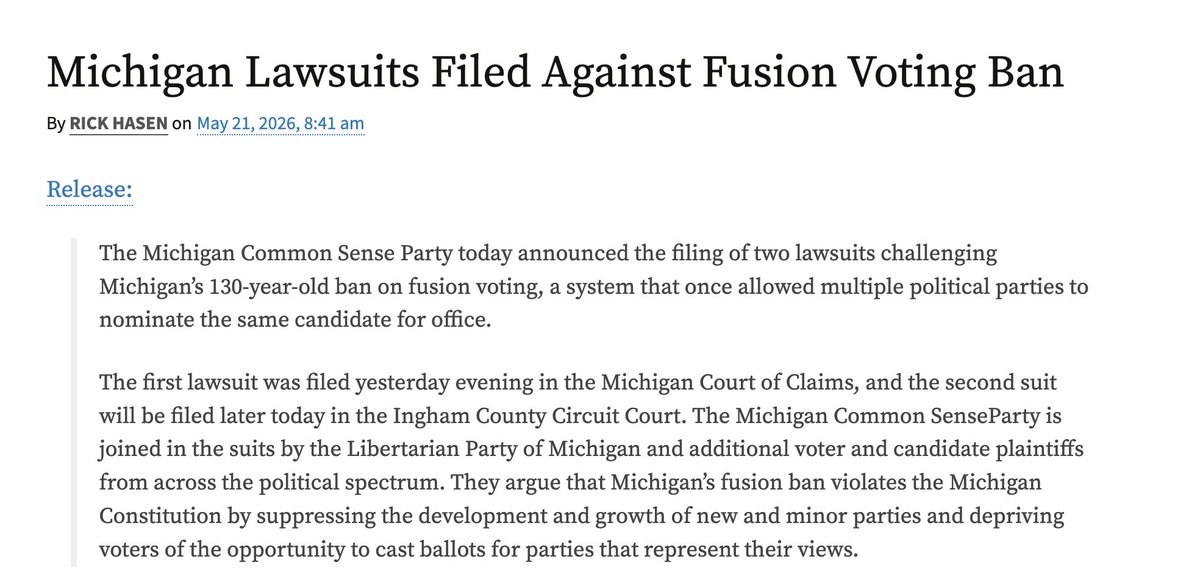
Michigan politics doesn’t suffer from a shortage of noise. It suffers from a shortage of meaningful choices. @jefftimmer
That’s the core argument behind the push to restore fusion voting in Michigan: should voters continue being forced into a rigid two-party box, or should people, parties, and candidates have the freedom to build coalitions and organize around what they actually believe?
Gerrymandering traps voters in a never-ending partisan doom loop. One way out? Multi-member districts, proportional representation—and yes, fusion voting. Let voters build coalitions instead of forcing everything into a rigid two-party binary where politicians choose their voters first. @ezraklein@leedrutman@NYTOpinion@NewAmerica@PolReformNA https://t.co/kQLUU95VGT
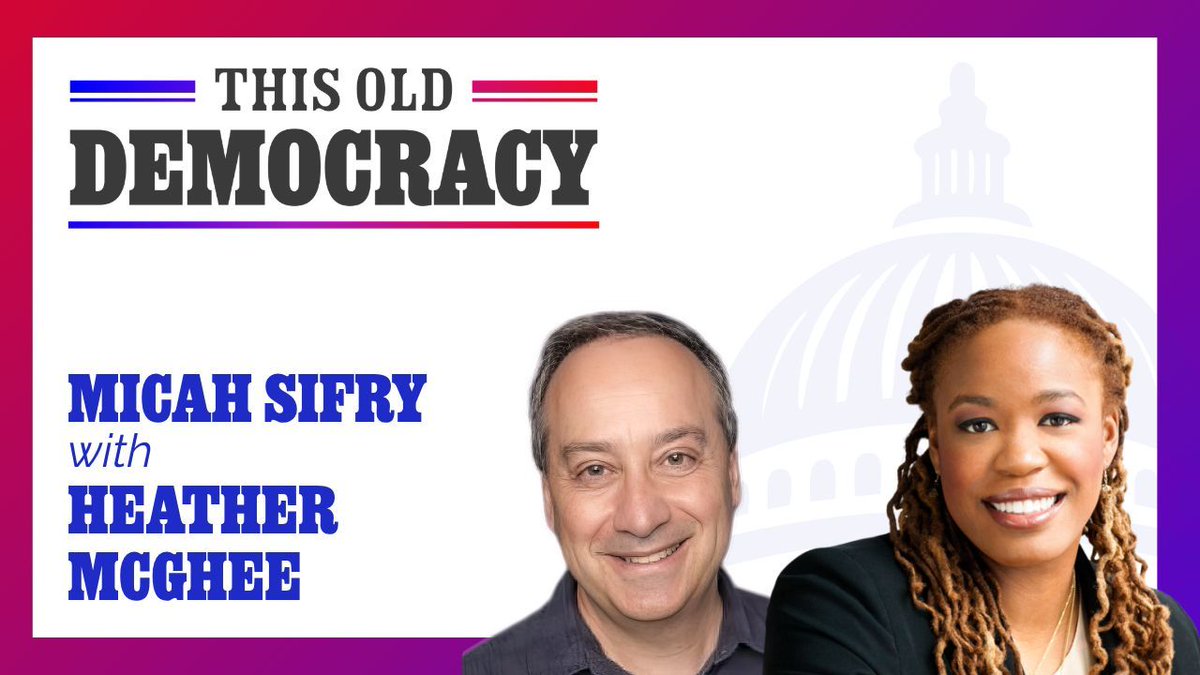
In the conversation with podcast host @Mlsif, @hmcghee connects the dots between the racial politics she chronicled in The Sum of Us and the authoritarian moment we're living through, and she doesn't let the two-party system off the hook.
The twentieth episode with Heather McGhee launched on Monday, June 1st.
Watch now: https://t.co/hTgjYHba1K
A healthy democracy should not fear new parties, new political labels, or voters organizing in new ways. It should not fear candidates building cross-constituency support—or voters having better tools to express what they actually believe at the ballot box. @jefftimmer
What gives us hope? Movements that expand democracy instead of shrinking it. We are fighting for reforms like fusion voting that give voters more choices, encouraging coalition-building, and creating a politics that’s less polarized and more representative. Hope grows when people organize for a better system. @Mlsif https://t.co/ShhLLfjRCd