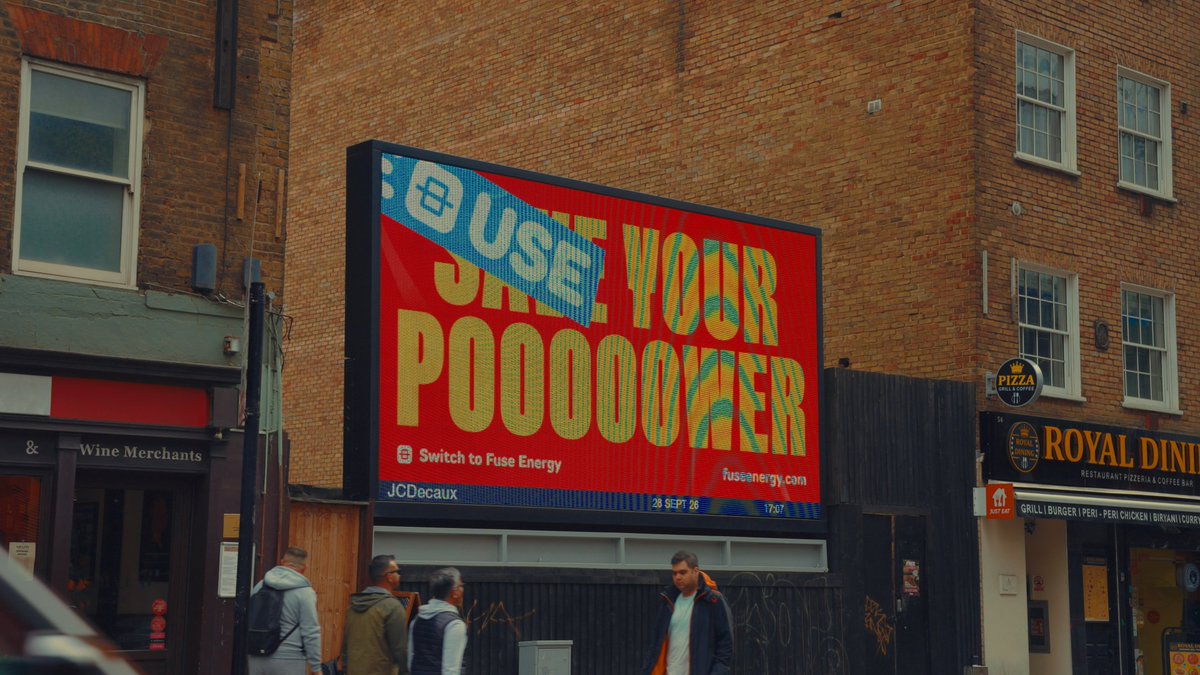
Turning down a Jane Street offer for @fuseenergy, for less than a quarter of the pay, was the FIRST real decision of my life.
Until then, I’d been an automaton: best school I could get into, job that paid most.
But I wanted to build something from nothing (apparently office chairs included 🪑).
Fuse had about 20 people, and I believed in @alanchanguk and @charlesorr, who’d helped build Revolut. Having done it before is the best predictor of winning again.
I’d accepted a remote role but practically moved into the office for full immersion, working every day to help get Fuse off the ground. Now I lead engineering here.
Seeing us on a billboard makes me glad I went all in with them.
I banned PhD stories from my interviews.
It’s the one you’ve told the most, and rehearsal washes out the signal. You’re on autopilot, saying what you said last time instead of thinking about my questions.
I’ve done 955 interviews for Fuse, 350 of them problem-solving. We pick a technical problem you’re proud of, go deep into how you weighed each choice, then start asking what if. How deeply you understood the problems you’ve already solved is one of the best signals of how well you’ll solve them here.
In this case, past performance does predict future returns 📈
Most energy companies don’t build things.
The company on your bill is mostly a wrapper. It licenses its billing engine. Another company collects your meter readings. Another owns the meter and just collects rent on it. Another sends a man in a van when it breaks. Your power changes hands about seven times before it reaches your kettle.
We built all of it ourselves. Our engineers wrote the billing engine and the trading desk, and taped out the circuit boards inside Jules, our battery and solar system.
Now, with Fuse Compute, we’re integrating all the way up to the token. Truly full stack, with unrelenting ambition.
No engineer has ever read the code I order my matcha through.
A member of our ops team vibe coded our office café app. You pick a drink on the page, the barista makes it, the app pings you when it’s ready, and now a robot brings it over. One day it pinged me seven times 🍵😅
Our AI reviewer read every change and left 179 comments. No engineer looked at it. Risk based approach.
I signed the letter to bring @JensenHuang back to @nvidia for the same reason I work for a founder no investor can fire.
Jensen built Nvidia for 33 years. There would have been no AI revolution without him. This week he resigned while Nvidia’s board was weighing whether to remove him. He deserves due process.
The founder I work for is @alanchanguk. At @Revolut, before he started @fuseenergy, an investor tried to get him fired for being too hardcore. Revolut’s founder, @NStoronsky, called him his best person and refused. At Fuse, the constitutional documents say VCs can’t fire him.
It truly matters who built the thing. Whoever inherits has to guess, and people who guess slap new things on blind. I built the engineering function at Fuse. I know what can be changed, what makes it tick and what can be deleted, because I was there for every decision.
The investor who tried to get Alan fired later admitted he was wrong. Nvidia’s board has time to do the same.
Like one labrador video and your feed is 🐕🐕🐕 for a month. AI evals have the same shortcoming.
Our AI code reviewer has it too. Engineers run it locally over MCP and iterate until it approves. Those PRs become our eval set, so everything we grade it on is already in its distribution. It's all exploit and no explore, and we're stuck in a local minimum.
Recommenders escape by exploring: they slip a cat into the labrador feed. A candidate I interviewed last week posed a thought experiment:
"What if we take a random AGENTS.md from a different repo and apply it to your pull request?"
At 12:33 on 28 April 2025, mainland Spain’s grid fell from 25 gigawatts to zero.
That night our Head of Finance wrote to us from Spain: “its been crazy, no traffic lights, no phone signal, no power anywhere for 10hr”.
That grid is fragile, and it is full. In 2024, half the businesses that asked to plug into it were told no. So we are buying, and rebuilding it.
This summer we bought the first piece, a transformer centre in La Barona and the lines that run from it. Power comes in at 20,000 volts and leaves at the voltage in your socket. Within weeks it becomes the first piece of that grid we have rebuilt, starting with its switchgear. Our design for that switchgear alone runs to 108 pages. We’ll write the grid’s billing software too. In the UK we get that bill, and in La Barona we send it.
We’ll do the same to every grid we buy, then build generation and storage beside it, so it can carry far more. The usual answer to a full grid is to ask people to use less. Ours is abundance, because every data centre we connect makes power cheaper for the homes on the same cables.
Data centres can’t find power. We’ve got the opposite problem.
In June, Fuse Compute was an idea. We had the hard part, because the sites where we export power already had import connections. We didn’t have compute. Yesterday our first B300 arrived on a pallet.
The team that connects our solar farms and gas engines to the grid is connecting our data centres. An engineer who spent a year on our trading infrastructure wrote the software that boots our GPU servers and routes every request to them.
We’ll put those GPUs next to our gas engines. A gas engine sits idle about 80% of the year, because wind and solar are cheaper. With GPUs beside it, it will have a customer every hour. The quants who buy power for more than 450,000 homes will choose, half hour by half hour, whether the GPUs run on the grid or on the engine.
Our engineers & researchers use the tokens first. What we don’t need gets sold, the same way we sell spare power from our solar farms. We’re closing the loop: energy → compute → product factory → more energy.
Energy is taxis before Uber.
Data centres alone will more than double their electricity use by 2030.
Almost nobody has priced in the size of the opportunity yet.
Proof of human is VERY important.
I caught an LLM in a job interview recently. It had already beaten two of our interviewers.
They’re getting crazy good. The usual trick of asking them to turn around doesn’t work anymore. Bad camera quality still makes me suspicious, and so does LLM sentence structure.
This guy was sloppy. The face on the call didn’t match the picture on his LinkedIn, and he’d applied for three very different jobs: firmware engineer, database engineer and applied AI.
Brave new world.
Degrowth mindset.
I own our token bill, and I'm betting on us.
We'll more than double it next year. We bought our own B300s. No cap per engineer.
We're building a product factory for the fastest energy supplier expansion the world has seen!
NEW: Apple is cutting employee AI spending budgets even as it pushes workers to use the technology more. Engineers have seen daily limits cut from $300 to $200, with further reductions to $100 planned. Other teams could see limits fall to $25. https://t.co/4tnOIaxpDz
I got to be the ambitious kid because of my mom.
She drove me to swimming, guitar and English lessons. I slept through most of it in the back of her car.
Last week she drove me to the airport, the first stretch of the 1,449 km back to London, where I get to work on energy abundance.
Thank you, Mom. You backed me before I knew who I wanted to be.
Thiel’s right. Regulation pushed a generation of engineers out of atoms and into software.
But walls that keep everyone out are now an opportunity.
A researcher I interviewed recently asked: what if regulation walls you in like everyone else?
Energy is a walled garden. The walls are a licence, months of industry testing before you can switch a single customer, and enough collateral to buy power long before anyone pays you for it.
Inside, the garden never runs dry. A country can’t function without energy, so supplying it has to stay profitable.
So for decades, the fat kid has sat in there eating the fruit. Nobody’s made him run.
We got over the wall in 2023, with engineers from trading firms. Three years later:
1. We supply over 450,000 homes, with operating costs already 17% below other suppliers.
2. A few weeks ago we started training our own transformer. It already forecasts tomorrow’s demand off by 1% on average. Our previous classical ML model missed by 3.5%.
3. So now we know what our customers will use. With Jules, our plug-in battery and solar system, our trading desk will decide when each home draws from the grid, co-optimised against live power prices.
The rules that kept engineers out of energy also kept the fat kid from ever having to compete. Now we’re over the wall, our costs keep falling, and we’re coming for his lunch.
The biggest mistake I've seen CTOs make is handing exceptional engineers ordinary problems, people and process. That's how those engineers leave.
How I avoid it at Fuse:
Problems
The ambition has to be big enough. We’ll have the fastest (energy supplier) expansion the world has ever seen. We’ll print countries: a product factory where tokens go in and new energy markets come out. Energy abundance. And our own inference powered by it.
People
I've spent 794 hours interviewing engineers for Fuse. I hold the bar high on every engineer. Mediocre can't slip through.
Process
In 2023 four backend engineers were split across Python and Kotlin repos. The system was split before anyone knew where the interfaces were. So I deleted Kotlin from the backend.
Remove friction to build.
1. Today, all of Fuse is one monorepo, so one engineer cuts across the whole system in one PR.
2. Our AI reviewer already approves some kinds of PR on its own, and we'll do 80% by year end. Additionally, humans will review what a change should do, not every line.