Who's stacking $SOL here? Because the list of payment giants building on Solana right now is getting hard to ignore.
Just yesterday, MoneyGram joined the Solana Developer Platform as an infrastructure partner and active validator.
It joined Mastercard, Worldpay, and Western Union, all already there.
Western Union went further, launching its USDPT stablecoin on Solana, issued by Anchorage Digital Bank, built for 24/7 global settlement across 40+ countries.
Visa now settles in USDC over Solana with Cross River and Lead Bank.
Stripe added Solana support for crypto payments. PayPal's PYUSD lives on it. Even Google Cloud launched Pay sh on Solana for AI agents to pay per API call using stablecoins.
Here's what I think. Forget the price noise for a second.
The biggest names in global payments, Visa, PayPal, Western Union, MoneyGram, Mastercard, Stripe, are all building on the same chain.
This is bigger than another partnership headline.
The payment industry is slowly treating Solana like real infrastructure.
$SOL is sitting under the rails.
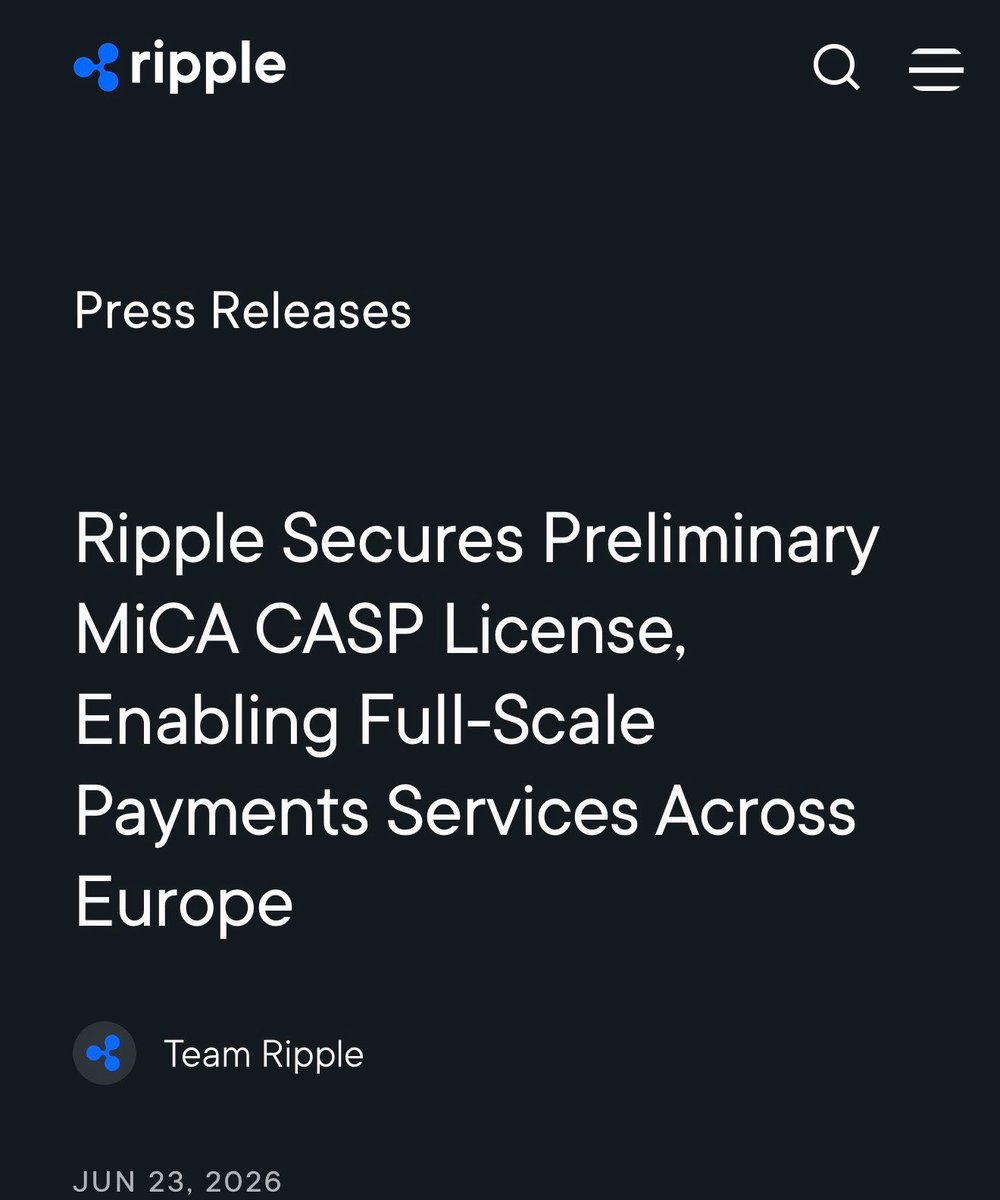
🚨IT'S OFFICIAL: @Ripple stands out as one of the first crypto companies to receive a legal MiCA license in Europe.
This license allows Ripple to offer regulated stablecoin and digital asset payment services across ALL 30 countries in the European Economic Area. #XRP
BREAKING 🚨🚨🚨 THE WAR COULD END TODAY?
Team Trump just arrived in Switzerland for Iran peace talks.
If a deal gets done, markets could move fast.
Relief rally or sell the news?
https://t.co/InnlsymT4S
Good morning ☀️
You can feel when an industry is getting too big to ignore.
Crypto is reaching that point.
I’m staying patient before everyone calls it obvious.
You?
🚨Stellar $XLM changed everything🚨
Franklin Templeton ran 50,000 transactions that cost $75,000 on legacy rails.
On Stellar? $1.13.
Read that again.
Seventy-five thousand dollars down to one dollar
That's not an upgrade
That's a revolution in cost
These new AI technologies will change everything. 👇
And while everyone argues about Bitcoin, three projects are quietly building the infrastructure for the entire AI economy.
$TAO. $RENDER. $VIRTUAL.
$TAO is Bittensor.
Think of it as a decentralized marketplace where AI models compete to be the best, and the winners earn rewards.
Over 128 specialized subnets now operating. The first halving hit in December 2025, cutting daily emissions from 7,200 to 3,600 TAO.
A supply squeeze meeting growing demand.
Grayscale and Bitwise both filed for spot ETFs. Max supply capped at 21 million, just like Bitcoin.
$RENDER solves a simple problem.
AI needs massive computing power, and most of the world's GPUs sit idle. Render connects them. Over 25 million rendering jobs processed across 300,000+ GPUs.
It expanded from 3D rendering into AI compute. Backed by OTOY with advisors including J.J. Abrams and Beeple.
$VIRTUAL is building the AI agent economy.
Tokenized AI agents that work, negotiate, and transact on their own.
Over 18,000 agents deployed. Reported on-chain GDP over $470 million.
A published Google Cloud case study using Gemini. More than $700 million migrated to Chainlink CCIP for cross-chain infrastructure.
Here's my honest take.
AI is the biggest technological shift of our lifetime.
These three give you exposure to the decentralized side of it.
The compute.
The intelligence.
The agents.
They're volatile and early. But they're building the rails for a world that's arriving faster than anyone expected.
You bullish?
The machine economy is coming and $XRP Ledger was built for it before anyone realized.
AI agents making autonomous payments need exactly what XRPL offers.
This is the catalyst hiding in plain sight. 👀
Here's why it matters.
When an AI agent transacts, it can't deal with uncertainty.
A human can wait and check if a payment went through. An autonomous agent running thousands of operations needs deterministic finality.
On XRPL, transactions either confirm or expire in 3-5 seconds. No ambiguous pending state. The agent moves to the next task instantly.
It needs predictable costs too. No gas wars. No fee estimation.
The price of every operation is known in advance, which is essential for an agent managing a budget autonomously.
And the security is non-negotiable. XRPL has run continuously since 2012 with zero transaction rollbacks. Fund movements happen at the protocol layer, not through arbitrary smart contract code. The exploit surface that drained billions from other chains doesn't exist here.
A single XRPL transaction can send one currency and deliver another through the native DEX.
No bridges.
No swap contracts.
Exactly what an autonomous agent needs to operate cleanly.
I want every holder to feel the weight of this. We're not waiting for adoption to be invented.
The infrastructure for the AI payment era already exists, already works, and already has a 14-year track record.
The agents just need to arrive. And they're arriving now.
$XRP isn't hoping for a use case.
It's positioned for the one that's about to define the next decade.
🚨Remember this. The CLARITY Act opens the floodgates to $XRP.
Ripple's CEO confirmed they serve banks, payment providers, and corporates.
Those enterprises are sitting on trillions, waiting for legal certainty before they lean in.
THIS IS THE CATALYST
🚀 Want to get paid just for clipping streamers? 🎮
💰 Payouts are instant via **PayPal** or **Crypto**! 💸
Join my team and start earning:
👇👇👇
https://t.co/dWjOyVXsLz
$30 Cash / $SOL Giveaway
To enter:
✅ Follow @beaudenison
✅ Tag 2 friends
✅ Repost this and my pinned 📌
1 winner will chosen in 7 days!
I can send you cash or SOL, up to you.
#cashgiveaway#solgiveaway#giveaways
Banks won't lose deposits. They'll gain digital asset capabilities.
Sen Lummis told the banking lobby exactly that.
Once the CLARITY Act passes, community banks will integrate $XRP, $XLM, and utility assets into their offerings.
Not replace. Coexist.