Teller has launched its @Base rewards incentive program, paying 22% compounding yield on all your favorite Base tokens.
Earn the same token you deposit. No impermanent loss. Withdraw anytime.
https://t.co/EOzD2PTExT
A new report from @Citi projects the tokenization market to reach $2.7 trillion to $8.2 trillion by 2030.
91% of that projected market is driven by tokenized stocks and bonds.
Even the bear case is bullish.
Teller is now live on the XDC Network (@XDCNetwork), enabling $XDC backed lending with no margin-calls 🌲
For holders, you can use $XDC to access stablecoin liquidity, or earn yield in ethereum:0xa0b86991c6218b36c1d19d4a2e9eb0ce3606eb48 by lending.
With the integration, Teller has introduced a new way for the XDC ecosystem to help increase TVL and strengthen the network economy around XDC.
Check it out:
https://t.co/AQu8RzQ67v
XDC masternodes earn rewards per epoch and monthly.
Instead of selling those rewards, holders can borrow USDC against them.
They keep their XDC exposure, access liquidity, and help grow real usage around the network.
That is how XDC becomes more than an asset to hold.
XDC Holders show up here and leave a comment🫡
The agentic economy isn't the future, it's the now
Agents will transact more than humans, and we're already seeing this entirely new economy alive and growing on Base
If you read one thing today - make it this ↓
many things to be optimistic about right now:
- tokenized stocks adoption / expansion
- privacy development and more use cases in general
- stablecoins getting integrated everywhere
- perps adoption up only
- crypto still the best way to store/send money
people focus too much on price
global access to every market will bring trillions of dollars onchain
we're already seeing it with stocks, bonds, commodities, etc
tokenization is the solution the world has long needed
Big day today.
Looking forward to some news that will be very beneficial for the industry, and a major step toward solving the token vs equity issue.
Yes, this is an announcement of an announcement.
Not a good take.
DeFi infra today is materially more resilient than in prior cycles (partially also thanks to AI).
Also DeFi has improved across the board over the years:
- better risk engines + lending market structures
- formal verification, audits, bug bounties
- better cap management, oracle improvements
- automated monitoring and security operations inc. circuit breakers
- far better tooling for smart contract security (including AI-assisted analysis)
Ironically, a lot of the remaining attack surface now comes from web2-type opsec, which is why many DeFi teams are investing heavily into better processes (inc. SOC2-based), infra hardening, and internal controls.
DeFi is constantly evolving, but pretending the industry hasn’t matured significantly or that AI is only a net negative for DeFi security is simply not true. The same AI capabilities attackers use are also increasingly used by security researchers, auditors, and whitehats to strengthen protocols.
DeFi Will Win.
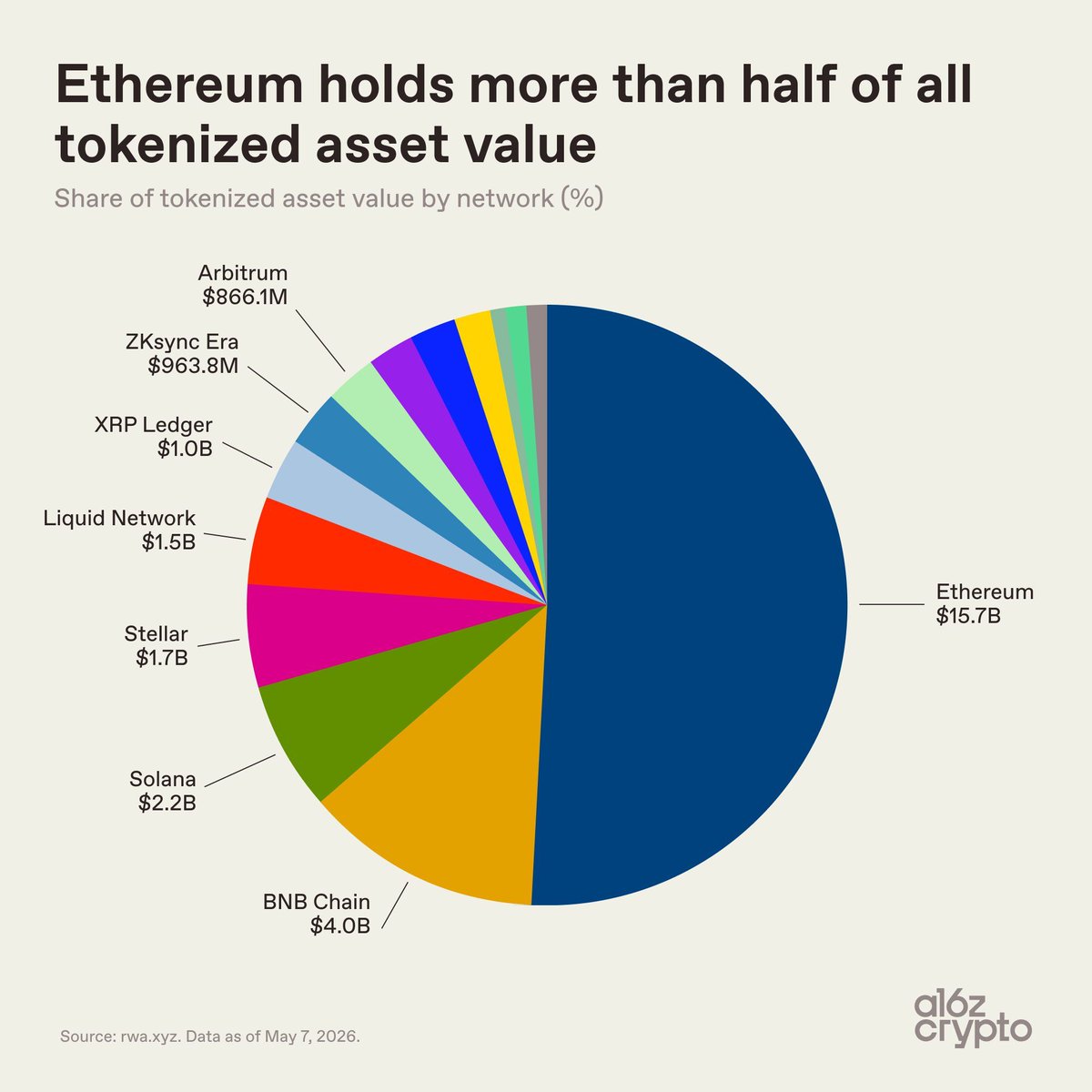
Not every tokenized asset is equally onchain.
Bonds are by far the largest tokenized asset category with $15.2 billion in market cap. But only about 5% of that supply is being used in DeFi. Precious metals look similar: they’re onchain, but mostly just sitting there.
Smaller categories look different. Reinsurance tokens have 84% of their supply deployed in DeFi, while private credit sits at 33%. This makes sense: The categories with the highest DeFi usage were built for DeFi from the start, through protocols like Nexus Mutual and Maple Finance.
Much of what gets called “tokenization” today is actually closer to digitization: moving records onto blockchains without unlocking much more new functionality. This matters because one of the core value propositions of onchain financial systems is composability.