How to become AI engineer in next 6 months:
By the end, you want to be able to:
- build LLM apps end-to-end
- use APIs from OpenAI / Anthropic / open-source stacks
- design prompts and context properly
- add tool calling and structured outputs
- deploy real projects
So, let’s discuss your roadmap month by month
Month 1: Get solid enough in coding and fundamentals
What to learn:
- Python really well
- Git + GitHub
- CLI / terminal basics
- JSON, APIs, HTTP, async basics
- basic SQL
- basic data handling with pandas
- virtual environments, package management, error handling
- FastAPI or Flask
Month 2: Master LLM app development
What to learn:
- prompting fundamentals
- system vs user instructions
- structured outputs / JSON schemas
- function/tool calling
- streaming responses
- conversation state
- cost / latency / token basics
- failure handling
- prompt injection awareness
Month 3: Learn RAG properly
What to learn:
- embeddings
- chunking
- vector databases
- metadata filtering
- reranking
- retrieval quality issues
- hallucination reduction
- citations and grounding
Month 4: Agents, tools, workflows, evals
- agent loops
- tool selection
- state management
- retries
- when NOT to use agents
- multi-step workflows
- evaluation harnesses
- task success metrics
Month 5: Deployment, product thinking, and reliability
What to learn:
- FastAPI production patterns
- Docker
- background jobs
- queues
- auth + API key security
- logging
- observability
- prompt/version management
- eval dashboards
- cost monitoring
- rate limits
- caching
Month 6: Specialize and become hireable
these knowledge and skills you gained can be applied in three directions
you need to choose one of them and focus on practice
although everything mentioned above is also best learned purely through practice
Direction 1: AI product engineer
Best if you want startup jobs fast
Focus on:
- LLM apps
- RAG
- agents
- deployment
- product UX
Direction 2: Applied ML / LLM engineer
Focus on:
- fine-tuning
- when to fine-tune vs prompt
- evaluation
- inference optimization
- open-source models
- training pipelines
Direction 3: AI automation engineer
Focus on:
- workflow orchestration
- business process automation
- multi-tool systems
- CRM, docs, email, support, ops use cases
This roadmap will help you go through a practical path, and the key is to study each of these points and then test them in real work
By month six, you will already have several built products or examples of completed tasks
And it will be much easier to get a job as an AI engineer
Save it so you don't lose it and can return to study later
JUNE 2028.
The S&P is down 38% from its highs. Unemployment just printed 10.2%. Private credit is unraveling. Prime mortgages are cracking. AI didn’t disappoint. It exceeded every expectation.
What happened?
https://t.co/JzzwCrbJgS
Pretty wild how 8 months ago I was the only analyst who turned bearish on $BTC.
Since then we’re down over 50% from highs.
So much time to take profits in the 100k area. I really hope you took the advice!
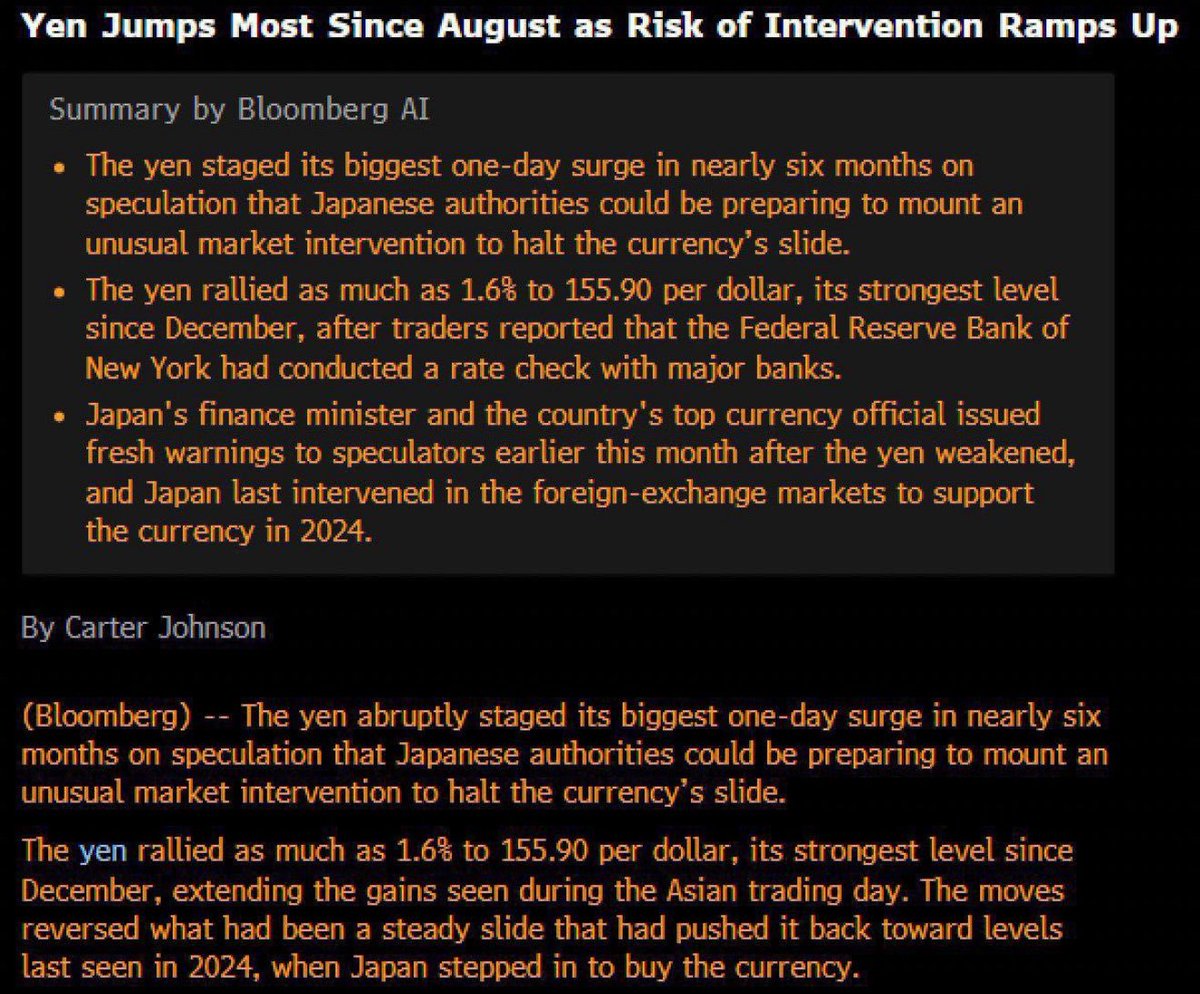
🇺🇸 THE FED IS PREPARING TO SELL U.S. DOLLARS AND BUY JAPANESE YEN FOR THE FIRST TIME THIS CENTURY.
The New York Fed has already done rate checks, which is the exact step taken before real currency intervention. That means the U.S. is preparing to sell dollars and buy yen.
This is rare. And historically, when this happens, global markets surge.
Japan is under heavy pressure. The yen has been weak for years, Japanese bond yields are at multi decade highs, and the Bank of Japan is still hawkish. Together, this creates stress not just for Japan, but for global markets. That is why central banks are now taking the situation seriously.
Japan has already tried to defend its currency many times on its own. But it failed in 2022 and 2024. Even the July 2024 intervention only worked for short time.
History is very clear on this: When Japan acts alone, it does not work. When the U.S. and Japan act together, it does.
We saw this in 1998 during the Asian Financial Crisis. Japan’s solo interventions failed, but when the U.S. joined, the yen stabilized. We saw it even more clearly in 1985 with the Plaza Accord, when coordinated action pushed the dollar down nearly 50% over two years.
That changed everything: The dollar weakened. Gold, Commodities, Non US markets all pumped.
If the Fed intervenes, this is how it'll play out :
- The Fed creates dollars, sells them, and uses those dollars to buy yen.
- That weakens the dollar and increases global liquidity.
- And whenever the dollar is intentionally weakened, asset prices usually surge.
Now look at crypto.
Bitcoin has one of the strongest inverse relationships with the dollar and one of the strongest positive relationships with the yen. Right now, BTC yen correlation is near record highs.
But there is a catch.
There is still hundreds of billions of dollars tied into the yen carry trade. People borrow cheap yen and invest in stocks and crypto. When the yen strengthens suddenly, they are forced to sell those assets to repay loans.
We saw this in August 2024: A small BOJ rate hike sent the yen higher. Bitcoin crashed from $64K to $49K in six days. Crypto lost $600B in value.
- So yen strength creates short term risk for crypto.
- But dollar weakness creates long term upside.
Now, why is this bullish for crypto ?
Because Bitcoin is still well below its 2025 peak. It is one of the few major assets that has not fully repriced for currency debasement.
If coordinated intervention actually happens and the dollar weakens, capital will look for assets that are still cheap relative to the macro shift. Historically, crypto benefits strongly from that environment.
This may become one of the most important macro setups of 2026.