A 3B active model beats Opus 5 at memory. We open-sourced the full stack — model, engine, and app.
Hy Memory handles chat, work, and code memory in one layer, and it's first on all four benchmarks we ran, leading MemoryArena by 10.2 points while cutting memory volume 51.8% and recall tokens 39.3%.
The model isn't tied to our engine. Drop Hy-Memory-30B-A3B into Mem0, MemOS, or EverMemOS and it still comes out on top, even on the one system it never trained on. It's already running in our own products, where one assistant's multi-hop recall went from 50% to 90%. It also unifies memory across Codex, Cursor, WorkBuddy, and more.
Repo: https://t.co/M7PkOJVyE5
Weights: https://t.co/U04mNgmVuS
Questions welcome in the replies.
Yesterday in office, a few of us were talking about Navratri and Durga Puja. Somehow it went to food.
Couple of guys from northern part were proudly sharing how strictly they fast. No onion, no garlic, full nine days.
Then everyone looked at the Bengali guy in the group, from Tripura.
I felt a little awkward. I know Bengali culture a bit and didn't want him put on the spot.
He smiled and said calmly,
"For us Bengalis, Maa Durga is our daughter. She comes home once a year. When your daughter comes home, you don't fast. You feast."
you don't need a 128GB MacBook for Qwen3.8-Flash-Next anymore
Strata runs the 125B model on a 12GB gaming GPU + 32GB RAM.
RTX 5070: 94 tok/s at Q2, 53 tok/s at IQ3_S
Q2 is a heavy quant, so check quality on your own tasks before you trust it. still wild. 25K stars on GitHub already
HERE IT IS. The Next Generation Roadster developed by SpaceX and Tesla!
There is a fan-suction system at the bottom of the car that can pull up to 2 gs allowing it to stick upside down.
It just flipped UPSIDE DOWN with cold gas thrusters and landed. HOLY SHIT.
Today we’re releasing Muse Spark Open, the most capable US open-weight model to date.
Built for coding and agentic work, it excels at long-horizon tasks, complex software engineering, and multi-step reasoning.
Key Model Specs:
→ 816B total / 42B active parameters
→ 1M token context window
→ Natively multimodal across text, image, video, audio
We are releasing Ultramarine 1 Flash, a frontier-class model built for knowledge work. It is open-source and achieves similar performance to Fable 5, while being 60x cheaper.
It was post-trained by a team of 5 for ~$300k all-in. Available on API now, with weights releasing in 2 weeks.
🚀 Introducing Next-Concept Modeling (NCM): our new paradigm for fast, parallel, coarse-to-fine text generation.
Compared to strong diffusion language models (DLMs) at similar parameter size, NCM achieves:
⚡ Up to 31× faster generation on downstream tasks like summarization and machine translation with comparable or better quality.
🏎️ 10–21× faster unconditional generation across TinyStories, LM1B, and OpenWebText, with comparable or better generative perplexity and using 3–5× fewer training tokens.
🧩 Better performance on reasoning tasks like Sudoku, outperforming both AR and diffusion baselines with fewer sampling steps.
With @ishanskhare, @IddahMlauzi, @ekellbuch, @simran_s_arora, @Azaliamirh, and @HazyResearch.
More details in the thread 🧵👇
What happens in we unfreeze some of these weights and actually train them? Well you can apply existing neural net techniques to it, losses and backprops and all, and now the UI becomes a bit more “learned”
Here’s a photo gallery where on the left I edit the rectangles and the right side gives me a new view where the photos learn to align themselves, training in real time as you drag (because the param count is so tiny).
This demo done fully in JavaScript, with JS looping through them numbers and backpropping. Stupid but fun! I’ve exposed the loss param slider you can play around with
My dear friends, I’d like to show you my latest toy project
Introducing Handwired: turn your regular JavaScript code into a neural net!
- no training
- exact outputs vs the JS program
- fully differentiable
All runnable in a browser, without GPU
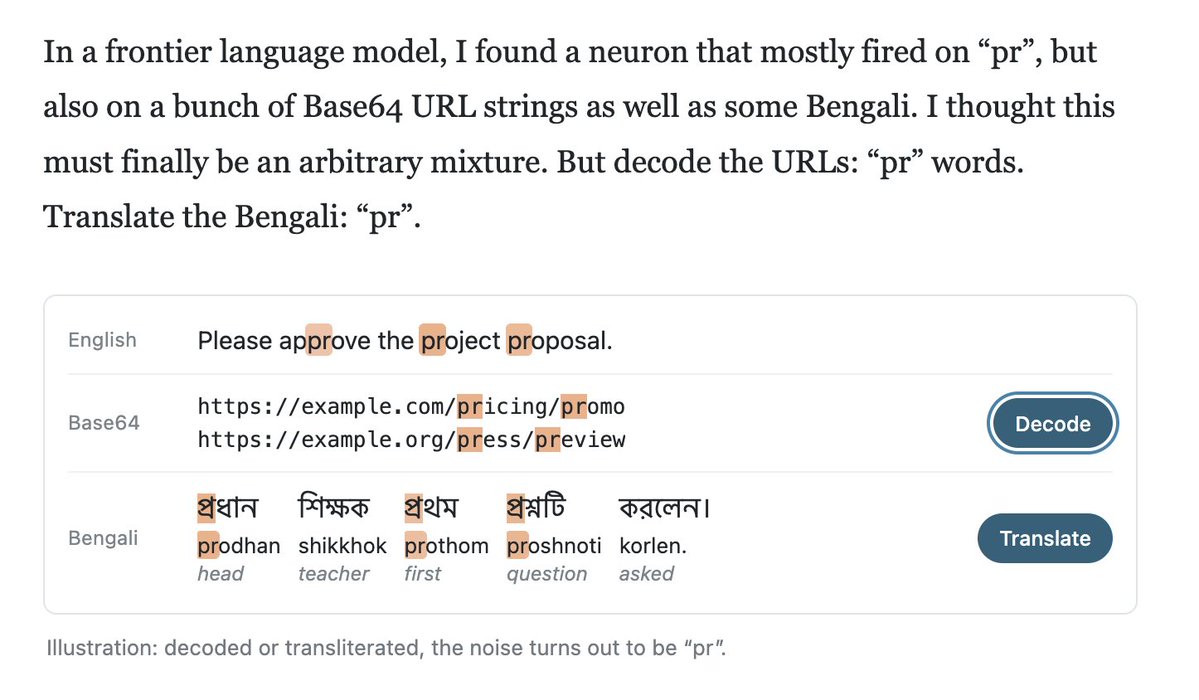
interpretability might be the most important scientific problem in the world right now, as I don't think we can solve alignment if we don't know what we're building. I think I have good news about it. I co-authored early work in mechanistic interpretability at OpenAI and came away pessimistic, because neural networks appeared to fold into arbitrary tangled knots. years later, I started openai's first large-scale automated interpretability project, finding about 2% of neurons legible with the primitive tools we had
with modern agentic tools and a much closer look, the picture looks totally different. the vast majority in models up to trillions of parameters are legible, and their circuits beautiful. many famous examples of tangled neurons turned out to be misunderstood. The roadblocks I expected mostly aren't there. I now think ambitious interpretability will be solved by the time we need it most, and possibly quite soon, as automated scientists keep improving. it may be a bitter lesson for interpretability: the simple thing, at absurd scale, works
https://t.co/zHij5zwKGT