Buying a house that faces the right way is an absolute game changer.
We wanted:
- big windows in our kitchen/great room and clear space facing east to catch the sunrise when we wake up
- big windows in the bedrooms facing west to catch the sunset
- a back deck in the east so when the sun was hot in the afternoon we would have shade
It all worked out perfectly. Think about these things before you buy. Simple stuff that makes a huge difference.
K.I.S.S. (Keep it simple stupid)
If Memory holds up have to own at least 1 of following- $MU $SKHY $SNDK
If Semis holds up have to own at least 1 of following- $INTC $AMD $MRVL $NVDA others I like but wilder $CBRS $ALAB $TER
If software holds up have to own at least 1 of following- $NOW $OKTA $PLTR
If AI Hardware holds up have to at least own 1 of following- $DELL $SMCI
"That's been one of my mantras — focus and simplicity. Simple can be harder than complex: You have to work hard to get your thinking clean to make it simple.” ~ Steve Jobs
Selling into strength is another topic we've gotten tons of questions around.
Hopefully this 10 minute video answers them for you:
—
Main takeaways:
1) Stage 1 & 2 traders should have hard rules about when to sell stocks at different % gain levels.
For example, you should be selling 1/3 at your average gain, another 1/3 at x multiple of your risk, and the final on a break below the 21-sma (2 closes below).
2) You always need to be on the lookout for extensions from key moving averages
@OliverKell_ has done a lot of work on daily & weekly extension counts, and using this to guide when he sells into strength.
Some other guidelines to think about:
→ 10% from 10-day
→ 20% from 21-day
→ 50% from 50-day
→ 100% from 200-day
Of course, these levels are highly dependent on the stock's character. If it's normal for the stock to extend 20% of the 21-day, there's no need to sell. But if it's 50% above, and it hasn't done this in 10 years, then it's probably smart to lock some in and take advantage of the strength.
3) When it feels "too easy".
This is not a tangible sell rule, but is one you can follow when you're up a ridiculous amount in a short period of time — ultimately when you're making so much money that it doesn't feel sustainable.
These types of runs happen from time to time, and locking in gains when this is the case will only help your equity curve.
4) % Up In a single session rules or other technical patterns.
Many traders like @LeifSoreide take advantage of massive upside bars to lock in partial gains. Look for:
→ 10% up in a single session
→ Major earnings reaction bars
→ Upside exhaustion moves (up 12/15 days in a row)
→ Breach of upper channel/trendline
—
At the end of the day, selling is an art that you'll continue to perfect as time goes on.
It'll never be 100% accurate, but implementing some of the rules above, you're better prepared to capture the strength the market is gifting you.
As they say, you either sell into strength or you sell into weakness.
It all comes down to preference. Weekly can help you stay calmer but it should help reinforce your plan on the daily chart, not give you 2 conflicting plans. So for example make sure you don’t have an exit plan based on 1D and then don’t follow it because of 1W. They should compliment eachother. If they don’t compliment eachother then it’s just going to add confusion.
Stan Weinstein uses daily for entry and weekly to manage. A lot of people do so I know it can be beneficial when you can solidify your plans with multiple time frames.
I just choose to stay with weekly myself just because it keeps me consistent and has massively improved my personal trading.
@ameetrai and I also have completely different personalities, so that’s a huge factor.
To sum it up just try using weekly charts on positions u want to manage, and see where the levels coincide with your daily charts. Make sure it promotes clarity and patience for you and doesn’t add confusion!
@nickschmidt Can we see more examples of how piece together a position. I’ve scene all your videos on YouTube, but some pics or quick talk through vids would be amazing. I’m trying to completely throw out the daily but not confident enough yet to use just the weekly
Good thread if you’re interested in trading from VCPs.
Not seeing a _ton_ of actionable VCPs right now, but still in some $COIN and $IBIT.
I did a study of 160 VCP’s that Minervini traded during his championship run in 2021. Insights below and full database here: https://t.co/VYdGHhSNVe
*Subscribers-only post - made public*
Almost infinite money glitch, take your Canada Child Benefit
put it into an RRSP -- now you get a 25-45% extra money because it was never taxed and is not taxable income. youre getting the tax refund back from ANOTHER income source.
AND you get more Canada child benefit next year because you've lowered your family income
Repeat.
@TaPlot At what percentage above the base would you pass on even most orderly pull back? For example if a stock gapped 20% above out a 6 month base and then pulled back to be 10% above it
Join @JPoco722 and myself this Sunday December 15th, 2024 along with @Benzinga to learn more about why incorporating Catalyst & Earnings Reaction Gaps into your stock selection process are an important factor in helping to level up your performance potential.
$ASAN today was a textbook example of a minimal HVC undercut on the day after the earnings gap. Find out what this is all about this Sunday by registering at the link below.
https://t.co/1Z04M7iKEo
My Favorite Weekly Chart Setup: The "Character Change"
This is my go-to setup for getting into new uptrends early, and it’s something I use only on weekly charts.
The CC (character change) is all about patience and waiting for clear evidence that the trend has shifted.
⚠️ If you’re looking for quick trades or need to be active, this might not be for you, because these require you to sit after you get in for a long time and let it do it's thing.
Why Weekly Charts?
Weekly charts smooth out a lot of the noise you see on daily charts. They give you a bigger picture and help you see the trend more clearly.
What Is the "Character Change" Setup?
This setup is about recognizing when a stock is transitioning from a long downtrend to the early stages of an uptrend. It’s all about waiting for specific signals on the weekly chart that show that it is highly likely the long-term trend is now up.
Here’s what I look for:
1. First Higher Low
After a long downtrend, I look for the stock to make a higher low on the weekly chart. This alone isn't enough but it's our first piece of evidence that something might be up.
2. HUGE Volume with a Price Pop
The other thing to look for is a big surge in volume with a strong price move. This shows real institutional interest. This is our second piece of evidence. You have a higher low + it's first massive push. After this I have confidence the birth of a solid new trend is likely in place.
Also the 1st or 2nd above can happen in any order you just want to see both.
3. New 10 Week respect
The way you get a low-stress entry with incredible R/R is by waiting now that you have the evidence of a true CC on your side. The 3rd piece of the puzzle where you can enter with extremely low risk if it doesn't work is when you see the stock start to respect the 10-week moving average for the first time.
Example 1: $APP
Let’s look at APP, which had a huge run after showing this setup and my second best trade of all time.
1. Volume Pop: First, I noticed a big volume spike, but I didn’t jump in just because of that alone, not enough evidence.
2. First Higher Low: After the volume pop, the stock pulled back a bit and made a higher low. That’s when I got interested. As it made that higher low, it started respecting the 10-week moving average.
3. Holding the 10-Week: It then resumes its move being supported clearly by the 10 week again. That’s the final confirmation needed.
APP took time to develop this setup. Even though it might look like dumpster diving, since these are weekly charts, the downtrend is long over before it becomes a buy. From there, it just kept riding the 10-week line up , giving you multiple chances to add to your position if you caught it or many chances to get in.
Example 2: $PYPL (currently developing)
PayPal was dead money for a long time, making lower lows. Then early this year we started developing a CC.
1. Higher Low: This grinded sideways but still ended up being a big higher low.
2. Volume Pop: Here we get a big price push on volume. Technically we had a few before the higher low was confirmed, and an entry could have been established after the higher low because the risk is so low. But this was the clear Volume pop.
3. New 10W Respect: This is final evidence for me, off the volume pop the weakness is supported by the 10W for the first time. Super low risk entry and you can see if this is a real long-term trend then we are still very early.
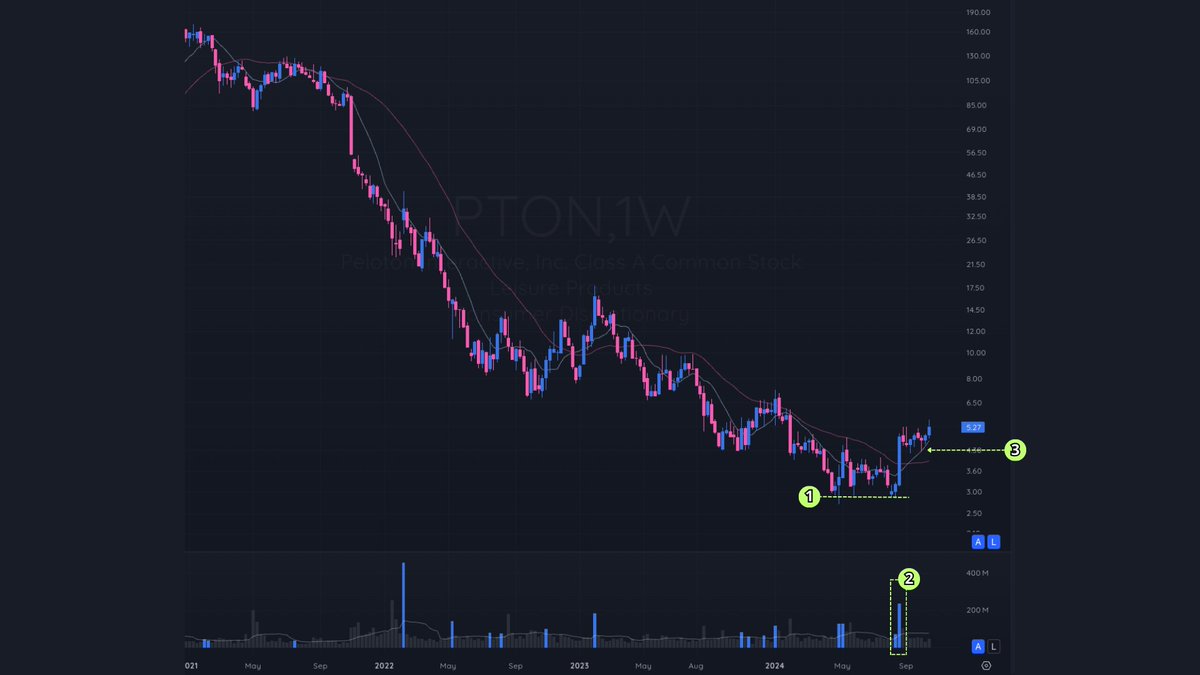
Example 3: $PTON (very early, still developing, and new position)
Peloton had been stuck in a downtrend for over two years, so I didn’t even consider buying until it started showing evidence that the downtrend might be done.
1. Higher Low: Instead of breaking to a new low, it held up at a slightly higher level. It’s subtle, but this is a big clue that the character of the stock is shifting. (It was kind of a retest of the same low, not much of a higher low, so you can argue #3 on the chart is also the first higher low. Doesn't matter, by 3 you have all 3 pieces of evidence.)
2. Volume Pop: Next, a significant volume spike paired with a strong price move. But I don’t buy just because of a volume spike—I need more confirmation.
3. Trading Tight into the 10-Week Moving Average: After the volume pop, PTON started trading tightly near the top of that move and right into the 10-week moving average. This is what really got me interested because even if it fails, I can't emphasize enough.... the R/R for these types of setups is off the charts.
The big thing here is patience. I don’t jump in while a stock is still in a downtrend. I wait until it’s made a higher low, shown a volume surge, and started respecting the 10-week moving average. By the time I get in, the downtrend has usually been over for a while. I’m letting the stock prove itself first.
Quick Recap
Here’s what makes the character change setup work:
1. Higher Low on the Weekly: Signals the stock might be done making new lows and could be shifting to an uptrend.
2. Volume Pop: A big volume spike with a price move. This tells you that there is now real interest in this name and adds evidence to support the birth of a new trend.
3. New 10-Week Respect: This helps add further evidence the momentum is on your side and allows you to get in with really low risk if it doesn't end up working.
Remember, this setup takes time to develop. The hardest part is the patience. It is a lot of hands off and waiting but thats also how I like my trades. Low stress.
Less is more!
If you made it here...drop a reply—I’d love to hear your thoughts and questions.
New Video!📽️
Stay in Your Lane and Stick to Your Strategy. I covered multiple concepts that shape my trading. Run don't walk to watch it. You wont be disappointed!
Used recent setups in $SHOP $ALAB $APP $BROS $RDDT $NFLX $CCJ $PLTR $GEV
⏬⏬
https://t.co/R0qCuNCcvS
@Sabrinamrina @ItwasLuck_@drewdaughdril@joncoopertweets@TonyHinchcliffe@georgelopez@TimWalzGov He was speaking about latinos not just PR.
Falling for the partisan outrage machine.
It’s okay, next time think about why your party has forced you to vote for three idiots since 2016 who couldn’t even beat a lying doofus. It’s not because half the country is racist.
Lots of people trolled me when I bought $PTON
Now that its up 100% since I entered 2 weeks ago maybe you want to revisit the thought process I shared here when I bought it.