हरियाणा में आज फिर खुलेआम शूटआउट का विडियो वायरल है। सीएम नायब सिंह क़ानून व्यवस्था सँभालने में पूरी तरह नाकाम हो चुके हैं।
लेकिन नेशनल मीडिया ये सब नहीं चलाएगा क्योंकि यहां बीजेपी की सरकार है।
#ImportantNews: Within days of 7 AAP Rajya Sabha MPs from Punjab shifting allegiance to the BJP, at least 3 politically sensitive matters connected to some of them came up before the Punjab and Haryana High Court, specifically, Chief Justice Sheel Nagu.
I’ve found that in two of these three cases, the High Court’s own listing process did not follow the ordinary roster. For instance:
1. In Sandeep Pathak’s case:
The case concerned Pathak who approached the High Court apprehending coercive action by the Punjab government.
During the hearing, the State said no coercive action would be taken without intimating the Court, but the written order records it as no coercive action without “prior permission” of the Court. The issue of maintainability was also not decided.
Interestingly, the High Court’s own March 2026 notified roster shows that the MP/MLA criminal matters are before Justice Tribhuvan Dahiya’s bench. However, this matter was listed before Chief Justice Nagu through a special administrative order. And a sweeping relief was granted.
2. In Rajinder Gupta’s case:
Gupta’s petition seeking security cover was somehow specifically listed before Chief Justice Nagu, even though similar matters were pending before Justice Jagmohan Bansal’s bench who also holds the roster. The Main case is CWP 12075-2026.
The High Court's order itself notes that the Ministry of Home Affairs had already provided security cover to Gupta in Punjab and Delhi yet the case was listed before a different bench for reasons unknown.
3. In the Trident case:
The third case is CWP-13613-2026, Trident Limited vs State of Punjab and Anr. This matter concerned a raid conducted on 30 April 2026 by officers of the Punjab Pollution Control Board. Trident, whose Chairman Emeritus is Rajinder Gupta, sought protection from coercive steps and also sought a direction that the seized samples be sent to a Central Testing Laboratory outside Punjab.
Although the roster originally remains with the Chief Justice's bench, the bench went out of the way to grant a relief by observing in the order that Trident’s apprehension that the raid stemmed from political vendetta appeared “reasonably palpable”. The Court ultimately directed that the Pollution Control Board could take coercive steps only after giving Trident 30 days to rectify minor deficiencies, even though the Water Rules only allow a 15-day notice period!
And this, after the bench itself took note of the Pollution Control Board’s objection that Trident had an alternative remedy before the National Green Tribunal. The bench also referred to Rule 32(6) of the Punjab Water Rules, under which prior hearing can be dispensed with where grave environmental injury is likely!
The Larger Issue
Take these three cases together. Three matters connected to AAP-to-BJP defectors reached the Chief Justice within a short span. At least two belonged before other roster benches. The matters were specially listed before Chief Justice Nagu by a Special Administrative Order. And in all three cases, the Court granted some form of protective relief, even sweeping in Pathak’s case which a opposition leader can only dream of getting.
The concern is not simply about the outcome of these cases. It is about the route by which they reached the Chief Justice, and the absence of a TRANSPARENT explanation for why these cases were so special that ordinary roster allocation did not apply!
The Chief Justice is the master of the roster, sure. But precisely because that power determines which judge hears which case, it carries a duty of VISIBLE neutrality. In politically sensitive matters, especially those involving recent defections from one party to another, even the appearance of selective listing can raise serious institutional questions.
The Pathak-Kejriwal Comparison
This is the most important part. Just compare Sandeep Pathak’s case before a High Court of a non-BJP state with Arvind Kejriwal’s case before the High Court of a BJP state, and you will see how different yardsticks apply in each.
In Pathak’s case, the designated roster judge for MP/MLA criminal matters very much existed. Yet, Chief Justice Nagu issued a special administrative order to list the matter before himself and then granted Pathak sweeping protection by converting prior intimation into a mandatory judicial pre-clearance before any action could be taken.
But in Kejriwal’s case before the Delhi High Court, the opposite happens. Despite serious and well-documented concerns of conflict of interest, bias, and unusual judicial attachment to the CBI appeal matter, the Chief Justice remains silent. The case is not withdrawn from that judge. It is not placed before a fresh bench.
The larger context too is hard to ignore. The Supreme Court’s INACTION and DELAY in the AAP vs LG constitutional crisis in Delhi and MVA government toppling in Maharashtra, and its ACTIVE intervention in Bengal’s SIR case, have produced political consequences that have greatly benefited the political fortunes of the same side.
Recently, CJI Surya Kant raised the sensitive issue of Punjab’s drug menace, observing that the “big fish” are not being caught by the State government. Punjab goes to polls in a matter of months. So can the timing be treated as accidental?
Each of these instances, viewed separately, may be explained away with a shrug. But look at them together, and a deeply disturbing pattern emerges.
It is this pattern---of SELECTIVE urgency, SELECTIVE silence, SELECTIVE roster control, and SELECTIVE intervention that corrodes public faith in the judiciary’s neutrality. Unfortunately, soon, citizens will begin to notice the growing weaponisation of the judiciary.
Common people are not the ones wasting fuel. They are struggling just to survive.
It’s politicians who waste fuel with hundreds of cars in election rallies & long VIP convoys.
Time to end this entire VIP culture !
Must watch Dhruv Rathee on The Great Nicobar Project | India's BIGGEST Environmental Disaster | Under a fake cover of defence, the project is a commercial project for the benefit of Modi’s cronies like Adani
https://t.co/qAy3eZWqVQ via @YouTube
This is the Convoy of RSS Chief Mohan Bhagwat.
He isn't a Minister or an MP, not even an MLA or an MLC.
Hasn't contested a single election and yet has 30+ cars in his convoy including a fire truck.
Why should ordinary people save Petrol and diesel while Politicians travel with convoys with hundreds of cars?
Himachal govt installs a charging point in Manali for tourists to charge phones and gadgets, and within hours people turn it into a dustbin. No Swachh Bharat or any scheme can fix this nation, only an iron fist policy can bring change.
The decision of Kejriwal not to participate in the CBI appeal challenging his discharge,before Justice Swarna Kanta Sharma is a correct & justified decision. Undoubtedly,in the facts of this case, he has a reasonable apprehension of bias. I would say his apprehension is justified
Bold call by @ArvindKejriwal to not argue the case before Justice Swarnakant Sharma.
If the outcome already feels predetermined, what’s the point of going through the motions?
It takes guts—and conviction—to take that stand.
@AamAadmiParty#KejriwalKaSatyagraha
Big Breaking
In the court of Hon’ble Justice Swarn Kanta Sharma, Mr. Arvind Kejriwal has filed another affidavit.
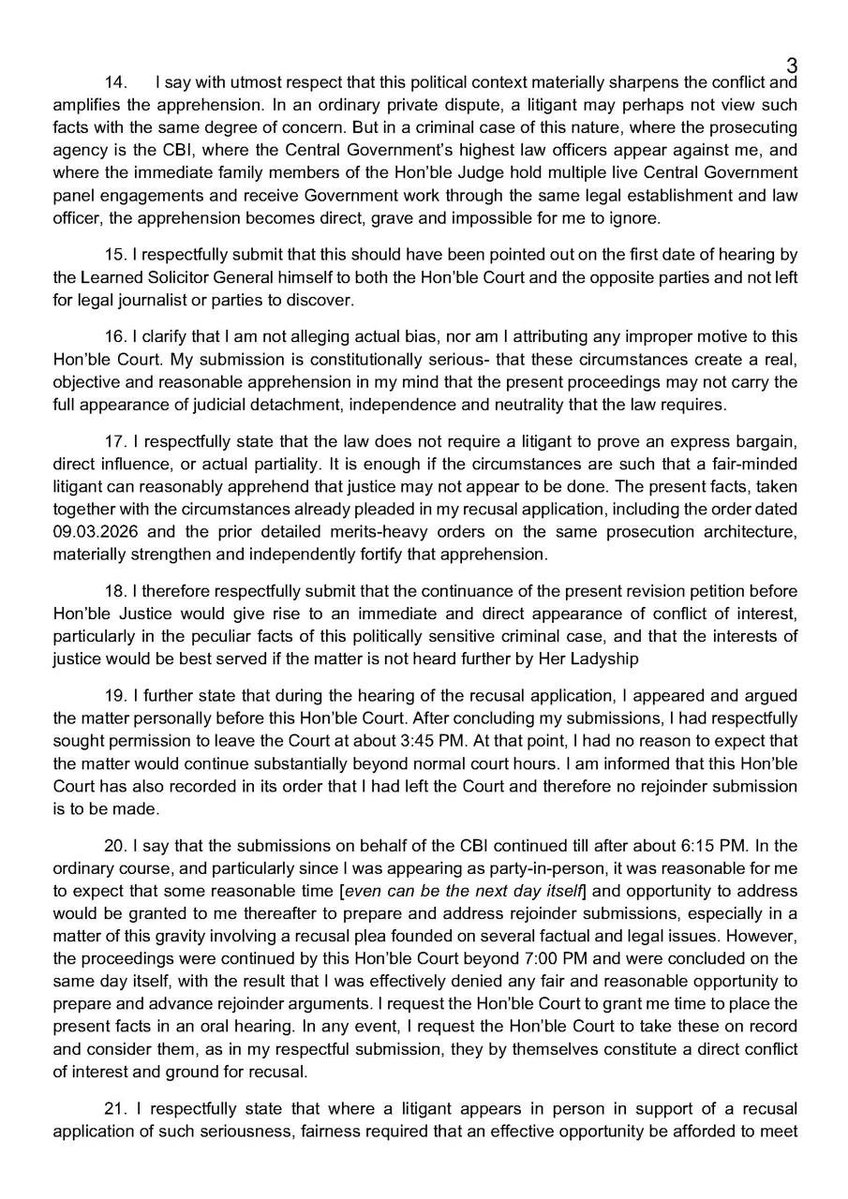
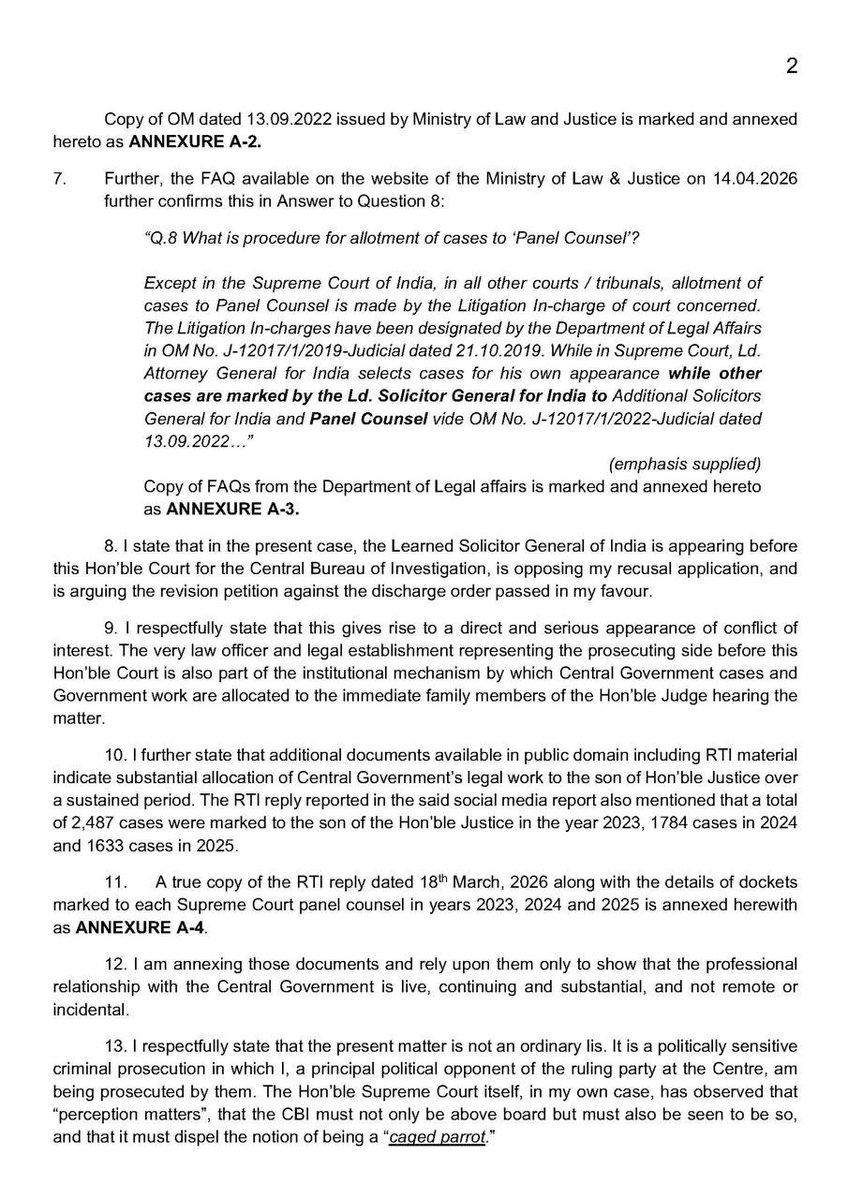
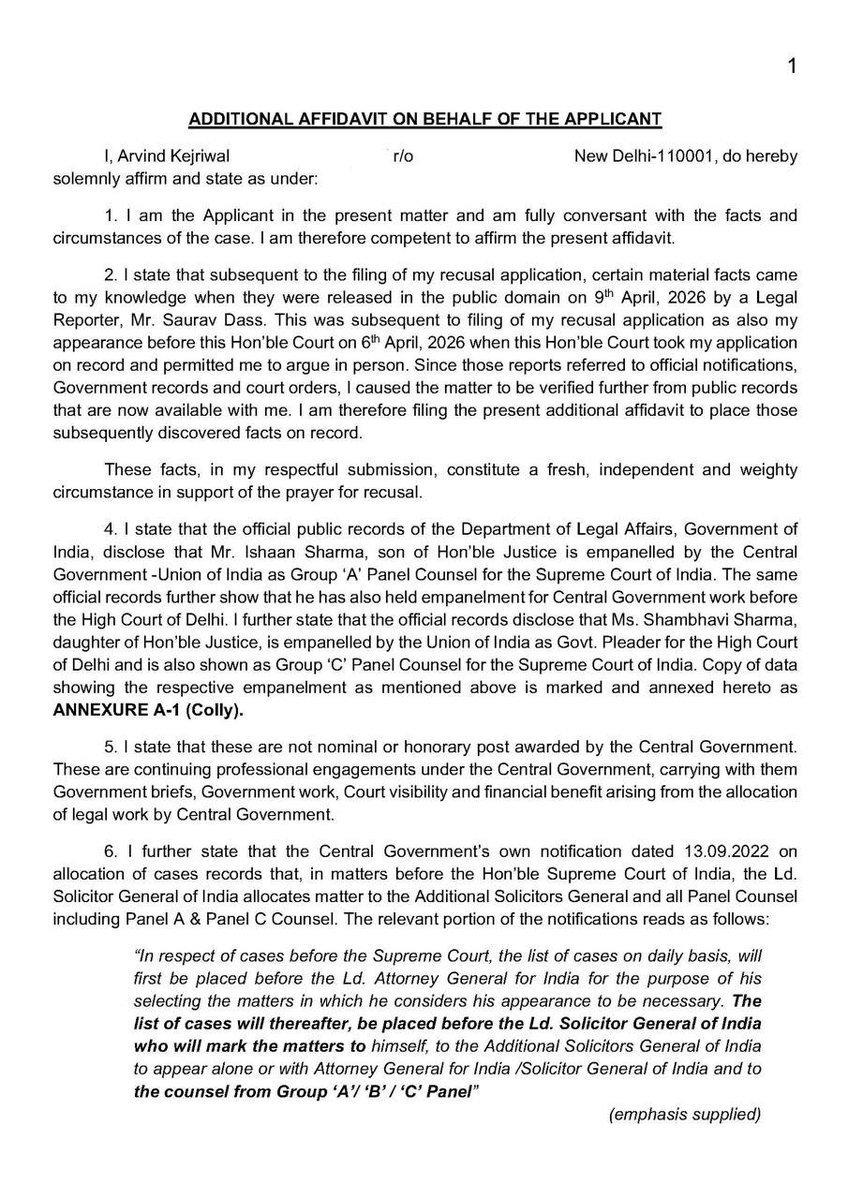
In it, he has stated that both the children of the Hon’ble Judge are working on Central Govt Panels ie under Sr Adv Tushar Mehta. Mr. Tushar Mehta assigns cases to them. In such a situation, it would be difficult for the Hon’ble Judge to pass any order against Mr. Tushar Mehta.
Therefore, along with other reasons, the Hon’ble Judge should recuse herself from the case.
#ImportantNews: The controversy over the alleged Delhi liquor-scam case before Justice Swarana Kanta Sharma is no longer confined to courtroom conduct alone. Now more troubling questions of proximity, patronage, conflict-of-interest, and the appearance of bias have come to light.
Several of the 23 dischargees in the case had formally sought Justice Sharma’s recusal from hearing the CBI’s challenge to their discharge. Even then, the judge has so far resisted calls to step aside, even as former Delhi Chief Minister Arvind Kejriwal himself appears in person to argue the recusal application. Arguments are now scheduled for Monday, 13 April 2026.
In my last Case In Point column for @frontline_india, I had already revealed, through an analysis of all the 165 criminal revision petitions of the same category as Kejriwal’s case, that Justice Sharma clearly departed from her usual pattern of handling such matters and had taken an unusually strange interest in this case. That, along with many other details that if read in singularity can be met with a shrug, but when read together, reveals a troubling pattern and credible fears of apprehension of bias in the liquor case. These by itself had raised serious questions. You may read my piece here: https://t.co/GtqFKFhRYY
What has surfaced now makes those questions HARDER to dismiss.
Justice Sharma’s son and daughter—Ishaan Sharma and Shambhavi Sharma—have both been empanelled by the Union government before the Delhi High Court and the Supreme Court.
According to the empanelment details, both siblings were appointed on the very same days: 11 September 2025 for the Delhi High Court panels and 21 November 2025 for the Supreme Court panels.
1. Ishaan Sharma holds panels before both courts, including the highest Group A panel before the Supreme Court and Senior Panel Counsel status before the Delhi High Court.
2. Shambhavi Sharma, with mere four years of enrolment as advocate, too holds panels before both courts: Group C before the Supreme Court and Government Pleader before the Delhi High Court.
3. Ishaan Sharma also held a panel in the Delhi Development Authority (DDA), under the Union Housing Ministry, till at least 2024 (Check: https://t.co/4DsDonRCyE).
4. He also held a panel in the Delhi State Legal Services Authority since 2021 until at least the end of 2024 (Check: https://t.co/KnfZFVJhCs).
Panel counselship is among the most coveted forms of government legal patronage in the system. Ask any advocate and they will tell you how through these positions, the government allocates litigation, visibility, professional standing, and income. But the more important and troubling part is that they are positions held at the pleasure of the very government whose top law officers are now appearing before Justice Sharma in one of the most politically explosive cases in the country. And that is where the conflict sharpens.
Of course, one need not prove an explicit bargain but justice must also be SEEN to be done, especially when it is a case of public interest. The test for seeking recusal of a judge is whether there exists a reasonable apprehension of bias and whether public confidence in the fairness of the process has been impaired. Like I had explained in my column, Indian law on recusal has long recognised that what matters is not just actual bias, but whether a litigant could REASONABLY FEEL that justice may NOT appear to be done. Here, several of the 23 dischargees feel justice may not be done impartially.
And now this issue of one advocate, who happens to be the son of a judge, accumulating large number of panels within a relatively short post-enrolment period as an advocate. Ask any lawyer and they will tell you how many more accomplished, brilliant persons, with many more years as an advocate have failed to secure a panel through the formal process. The concerns are many.
In this case, the question is whether a judge can continue to hear a politically sensitive challenge brought by the CBI, while her kin hold multiple Union government panels and receive work from the same legal establishment whose top officers allocate cases to them and are now appearing before her?
Note this: as per one RTI reply I received, Ishaan Sharma was allocated 2,487 cases in 2023, 1,784 cases in 2024, and 1,633 cases in 2025. In both 2024 and 2025, he was allocated more case files than even Zoheb Hossain, the top, most publicly visible Enforcement Directorate lawyer—by 91 in 2024 and by 582 in 2025. This of course suggests the sustained and substantial allocation of state work before the son. The allocation is done by the topmost in the legal system.
Also, this is not the first time that such questions of potential conflict of interest have arisen. In September 2024, I had highlighted the case of Padmesh Mishra, whose appointments across multiple union government and Rajasthan government positions drew scrutiny after his father, Justice Prashant Kumar Mishra, was elevated to the Supreme Court. Check: https://t.co/TVr35PmPx3
The unease then was the same as it is now: when the children of sitting judges begin to accumulate government panels and positions in unusual concentration, something a regular lawyer, perhaps much more brilliant and of more history of practice, can only dream of, particularly after or around the parent’s rise within the judiciary, the issue is of institutional credibility.
And no one really needs to state that that credibility is already under strain. Recently, Justice Manmohan of the Supreme Court himself publicly flagged corruption in the appointment of panel counsels by the Union government, questioning whether such appointments are really being made on merit at all. In a system where even a sitting Supreme Court judge is warning that panel-counsel appointments may be infected by extraneous considerations, the appearance of conflict in the present case becomes still harder to shrug away. Check: https://t.co/RGSSDK7ekf
Seen in that light, the present controversy is again not whether Justice Sharma is actually biased. It is about whether the institution can credibly insist that there is nothing to see here. The CBI has just filed an affidavit supporting Justice Sharma. A judge who I have documented, as per her own orders, to show unusual interest in a politically sensitive matter now finds herself in a position where her own kind hold/held as many as SIX government panels between them, while their bosses continue to appear before her. Even if one were to assume the absence of any actual impropriety, does this arrangement augur well for the appearance of judicial independence, especially in this case? The question is whether this not enough evidence of apprehension of bias that should suffice for a recusal.
That is the question the High Court ought to have confronted with seriousness. Instead, by resisting recusal in these circumstances, the judge is unfortunately deepening this very suspicion that it should have avoided at all costs, or at least for the sake of institution.
CBI, or Centre for BJP Inquisition
Let me be absolutely clear: as someone who has headed the CBI, I hold deep respect for its dedicated officers and the professional standards that define the agency at its core. The #CBI is not inherently partisan or flawed; it remains one of India's finest investigative institutions. What we are witnessing in cases like the #DelhiExcisePolicy is not the CBI acting on its own volition or professional judgment, but rather the tragic consequence of its instrumentalisation by the ruling BJP-led Central Government. The complaint originating from the Ministry of Home Affairs, and the sustained pursuit despite glaring evidentiary gaps — all point to political misuse of the agency as a tool against opponents, not any institutional failing. My criticism targets this deliberate weaponisation and abuse of power by the BJP dispensation, not the CBI or its personnel, whom I believe are often caught in an untenable position through no fault of their own.
Having said that, let me take you back to an episode from my early days as District SP — a small but striking parallel to the #DelhiExciseCase.
More than three decades ago, as Superintendent of Police, I was on a routine annual inspection of a rural police station in a remote corner of my district. One case caught my eye: registered under the dreaded NDPS Act, the Narcotic Drugs and Psychotropic Substances Act, that draconian law capable of swallowing lives.
The accused? A young man who had already been behind bars.
The Sub-Inspector in charge — an old-timer promoted from constable after decades of service — stood ramrod straight as I asked the standard question: “Show me the contraband.”
He didn’t produce packets of ganja, no brown sugar, no pills. Instead, with a straight face, he reached into the malkhana and pulled out a simple terracotta smoking pipe — a chillum (in local Odia), the kind smokers have used for generations.
I stared at it, puzzled. “This is the seizure?”
“Yes, sir,” he replied earnestly. “This chillum is for smoking ganja. So if he possesses the pipe, it means he must be smoking ganja. That makes it an offence under the NDPS Act.”
His logic was breathtaking in its simplicity — and its absurdity. Possession of a smoking pipe equalled possession (and consumption) of the forbidden substance itself. No ganja recovered. Just the pipe and a leap of faith so wide it could swallow justice.
The man was sent to jail on that foundation. Of course, we later did the needful to close the case and get him out.
Years later, while reading the Delhi Special Judge’s exhaustive 598-page discharge order dated February 27, 2026, in the #ExcisePolicyCase, that old memory rushed back like a cold wind.
The BJP-led Central Government’s Ministry of Home Affairs filed the complaint with the CBI against its political opponents in the AAP-led Delhi government. That complaint formed the basis for registering the FIR and launching the investigation into #DelhiLiquorPolicy. Then Delhi Chief Minister Arvind Kejriwal, then Deputy CM Manish Sisodia, then BRS leader K. Kavitha (daughter of former Telangana CM K. Chandrasekhar Rao), and 20 others — high-profile names, political heavyweights — were arrested and jailed for extended periods. Their careers were battered, the Delhi government was paralysed, and AAP lost the 2025 election, at least partly due to the shadow this case cast — while BJP emerged victorious. And BJP’s mission accomplished.
The case was built on hearsay, procedural shortcuts, approver statements recorded repeatedly to plug holes, and inferences that crumbled under scrutiny. The court called it out plainly: no prima facie evidence of conspiracy, no material evidence — the entire edifice rested on “surmises, conjectures, and inferential leaps” unsupported by material facts.
Discharged. All of them. The case didn’t even proceed to trial.
While the CBI has filed an appeal in the Delhi High Court, contending the trial court overlooked key aspects, the discharge order's findings — on the absence of prima facie evidence and the reliance on ‘surmises, conjectures, and inferential leaps’ — stand as a stark reminder of flawed pursuits.
Two stories, separated by time and scale, yet eerily alike. One came from a poorly educated old Sub-Inspector in a remote corner of the country; the other from the nation’s premier investigating agency in the national capital, under the vice-like grip of the ruling BJP. In one, a humble chillum became proof of a narcotics empire. In the other, policy decisions and political meetings morphed into a grand corruption conspiracy—until a judge finally demanded real evidence and found none.
As someone who has headed the CBI, I can vouch that the CBI does not, at its core, produce investigations this fundamentally flawed. This was emphatically not the CBI's handiwork — the officers were clearly under extraordinary pressure or duress from outside forces to pursue what the court declared a baseless case with no prima facie evidence of any wrongdoing. The probe's origin in a Ministry of Home Affairs complaint under the BJP-led government only confirms its politically motivated nature.
Whatever the case, both remind us how fragile liberty and reputation become when presumption replaces proof, when a tool or a signature becomes guilt itself, and when draconian powers meet shaky foundations.
The chillum still sits in some old evidence room, a silent witness. The discharge order of the Delhi Special Judge now echoes louder: lives, livelihoods, and careers can be destroyed either through well-meaning absurdity (as with the chillum) or by a ruling party out to wreck political opponents to seize power with nothing more than assumptions dressed up as serious crime.
Justice, when it arrives, is often too late to undo the damage. Who will restore the lost freedom and reputation to the chillum holder?
Who will restore the lost reputation, careers, and government to Arvind Kejriwal, Manish Sisodia, K. Kavitha, and the others?
Before 2013, BJP leaders repeatedly accused the Congress-led government of turning the CBI into the “Congress Bureau of Investigation,” a charge they leveraged effectively to help secure power in 2014.
It pains me immensely that the same BJP, after condemning such alleged politicisation, has now transformed the CBI into what can only be described as a “Centre for BJP Inquisition”.
I end this agonising story by reaffirming my unwavering solidarity with the CBI as an institution and with its committed officers.
#WATCH | Ahmedabad, Gujarat: AAP national convener Arvind Kejriwal says, "For the last 30 years, BJP has been ruling Gujarat. In these 30 years, BJP pushed Gujarat into a ditch. There is fear and corruption everywhere. They scare and threaten people who raise their voices against them, against injustice; they are jailed. They do corruption openly. Nobody can raise a voice against their corruption. People are looking at AAP with great hope. In the last 6-7 months, AAP has been conducting rallies across the entire state of Gujarat. People are turning up in large numbers. We don't even have money; ours is a poor party. But people are coming to AAP rallies at their own expense...I am here on a 3-day visit. I will speak with volunteers and form a strategy..."
On BMC polls, he says, "Despite facilitating such discrepancies, they could not touch the majority mark. So, this clearly shows that the public is against them but they misuse machinery."
Proud to inaugurate 6 badminton courts & 2 volleyball courts in Mohali, Punjab. 🏸🏐
Investing in sports is investing in our youth!
Built using my MPLADS funds across Phase-11, Sec-79, Sec-74 (Ind Area), Village Dhurali & Village Mote Majra.
Sports infra for our youth (urban & rural) means healthier habits and brighter futures. Giving our youth safe spaces to play, grow and dream. That’s what public funds are meant for.