Watching an old Twilight Zone episode where a man becomes obsessed with a devil machine coin fortune teller.
The machine gives generic answers but he becomes paralyzed, unable to make a decision without consulting it.
Anyway, some of these episodes are a bit farfetched.
I view women who do porn the same way as I would view a schizophrenic man walking around punching himself in the head repeatedly.
If I were to say "this man is unwell. He needs to stop being allowed to walk around punching himself in the head” - the response to that would not be "stop infantilizing him!! he has agency!"
Why? Because we recognize that the schizophrenic man walking around punching himself in the head is not normal. He is doing something contrary to sanity. He is harming himself.
The question of his “autonomy" or “agency” or “consent” would be irrelevant. And trying to make it a broad gotcha or commentary about the "autonomy" of the *entire male sex* would be retarded because he is not an example of the average man.
Similarly, (non-trafficked) women who do porn are not the average woman.
They are not normal. They are an outlier demographic riddled with mental illness and that much is apparent simply in the fact they are harming and humiliating themselves publicly, repeatedly.
They’re doing something contrary to sanity, thus demonstrating they have no capacity to make correct decisions in the first place. Their autonomy is irrelevant, and certainly isn’t a reflection of women in general.
This even goes for those women who tell me how much they love doing porn. Literally no different to me than if the schizo man told me how much he loved punching himself in the head.
The ramblings of a crazy person, not meant to be taken seriously.
@bennyjohnson Can't tell how dark it actually is, but my first thought would be some sort of light weight glowing sphere suspended by a normal drone somewhere above it with it's lights disabled.
On #ThisWeek, @JonKarl unaware of Harris’s stance against private health insurance. When @SenTomCotton notes it, Karl: “What do you mean taking away health insurance? What are talking about?” Then: “That is not her position now....clearly making an effort to move to the middle.”
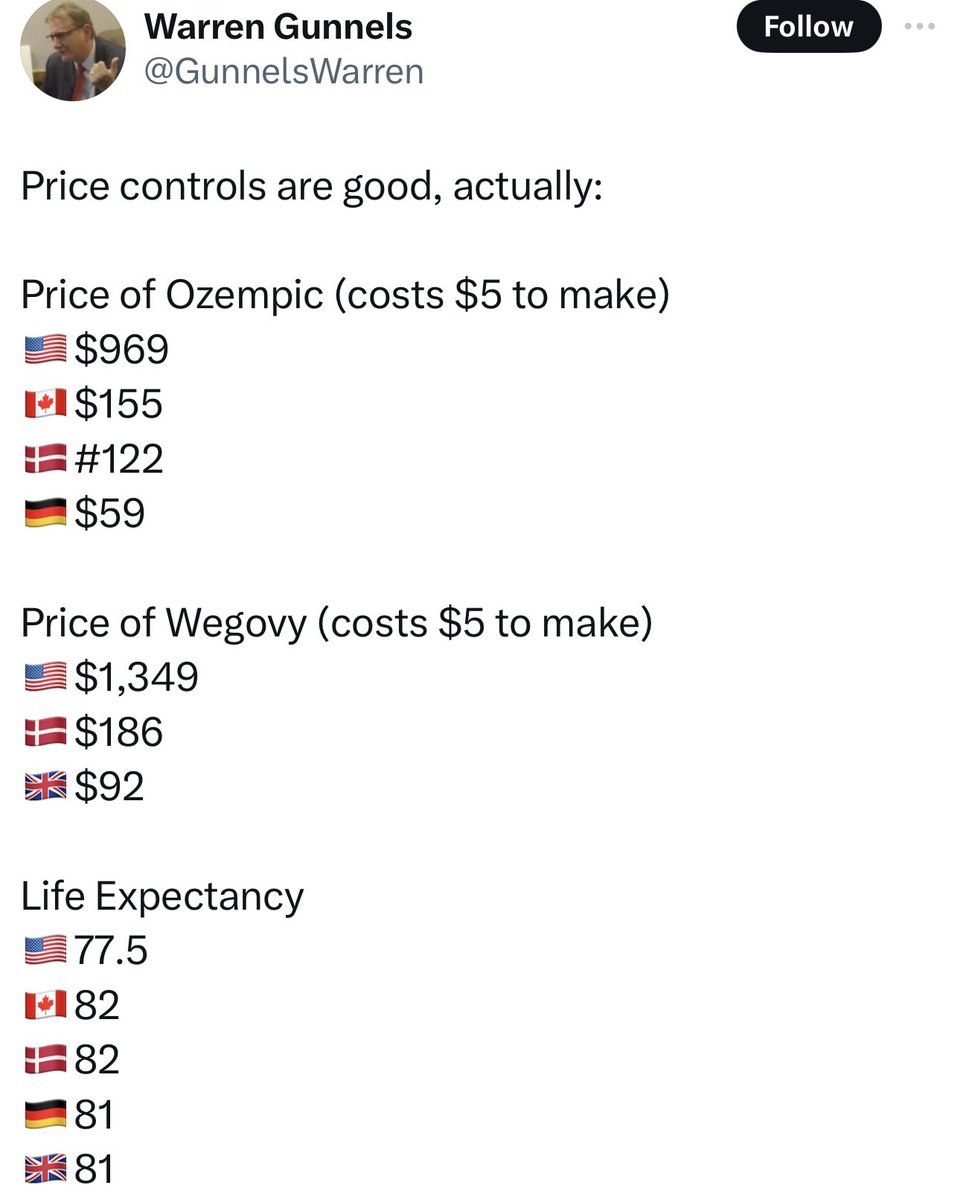
Let’s say a scientist invents a product that costs $5 per unit to mass produce—just five bucks for the raw materials and the direct labor costs of manufacturing it.
What’s a fair price to charge? Should she be allowed to charge $10, for a 50% gross margin? What about charging $500, for a 99% gross margin?
On top of that, what if I told you the scientist expects to sell 1M units per year. Is it equitable that the scientist will generate nearly $500M of gross profit, off of just $5M in direct costs?
Sounds unfair, right? Why should she be allowed to gouge her customers that badly?! Why should we permit her to extract that much surplus value out of her employees? It sure sounds like exploitation!
Before you answer, though: What if I told you the inventor had first invested $1B of her own money to create the product? Would that change your answer, knowing that her gross profit (before overhead) is generating just a 50% return on her invested capital?
What if I also told you that, in addition to the $1B she invested on R&D for this product, she had also spent $1.5B on R&D for products that didn’t work, or which never received regulatory approval? Would your answer change, knowing that her overall return on total invested capital is now 20% at the most?
Lastly, what if I also told you the inventor could have taken her $2.5B and invested it in real estate, for a 15% ROIC? Would you change your answer, knowing that our brilliant inventor could have easily just taken her money, deployed it into passive opportunities, and sat on a beach, rather than investing her funds—in addition to her time and her talents—into a highly risky venture?
If you don’t understand these why these questions are relevant—if you don’t grasp the concept of ROIC, or why investor returns matter more than just product margins, or how dead-project costs factor into pricing for products that do make it to market, or how incentives affect capital-allocation decisions—you might want to put your phone down, log off Twitter, and never again offer such an uniformed opinion about prescription drug pricing.
Milton Friedman on Price Controls:
"It is a device that Governments have repeatedly resorted to in an attempt to cover up the effects of their own policies."
How relevant is this right now…
👏👏👏