Great to see one of the largest banks in the world taking a view on DeFi. Aave compresses the traditional lending cost structure into automated smart contracts, potentially the model could be applied to cater whole $400T finance industry.
mGLOBAL is live on Aave Horizon.
Issued by @MidasRWA, mGLOBAL tracks a strategy from @FasanaraCapital, a $6B institutional asset manager with a 10+ year track record.
Qualified institutions can use it as collateral to borrow stablecoins while keeping the underlying exposure.
mainstreet msUSD went from $1 to $0.09 in hours because a single proof-of-reserves vendor walked. $18m trapped in the morpho msY/USDC market at 100% utilization, borrow rates at 138% APY, and the redstone oracle still showing $1.06 while the token trades at $0.25. borrowers holding worthless msY collateral against USDC loans have a free option to never repay. alphaping curated the vault, put 30% of $60m in deposits into this single market, then discontinued its own collateral verification service before the collapse. "delta-neutral USDC strategy." every layer of complexity you add to a yield product is another way it can kill you. watch utilization on that morpho market, if it stays pinned at 100% past 7 days the $18m is gone
Read the new Morpho paper so you don't have to!
Quick context: @Morpho is one of the biggest lending protocols on Ethereum, with billions in deposits. Their core product, Morpho Blue, lets anyone spin up isolated lending markets with custom collateral and risk settings. Most of DeFi credit gets built on top of it now.
They just released the Midnight whitepaper, a new lending protocol where rates are fixed and loans have a set end date, instead of the floating-rate pools everyone's used to.
Think Aave or Compound: you deposit, your rate moves with utilization, you withdraw whenever. Midnight is the opposite. You lock in a rate and a date upfront, like a CD at a bank.
The pool model worked when liquidity was thin and gas was expensive. With $25B+ in onchain loans now, floating rates and forced pooling are real bottlenecks. A treasury that needs predictable costs can't use a pool that swings 20% overnight.
How it works:
Lenders and borrowers trade "units" that act like IOUs with a fixed payout at a future date. Each market has a loan asset, end date, and collateral. Buy units = lend. Sell units = borrow. The rate is just the discount you trade at: pay $0.95 today, get $1 in six months.
All markets with the same end date pool together, no matter when you entered. So liquidity builds up instead of splitting across a thousand separate loans.
The interesting parts:
• No orderbook. Lenders post signed offers without locking capital. Borrowers find them off-protocol (Telegram, frontend, router) and submit. The protocol just settles.
• Capital stays productive. A lender can keep funds earning on Morpho Blue and quote fixed-rate offers on Midnight at the same time. When someone takes the offer, funds get pulled and the trade settles in one tx. The "idle capital waiting to be matched" problem that broke prior fixed-rate DeFi is gone.
• One pool, many markets. One signature can back offers across dozens of markets at once, like a market maker quoting 30 stocks with $10M total instead of locking $10M into each. Total risk stays capped at actual balance.
• Fairer liquidations. A 1% breach can't nuke your whole position, liquidators only repay enough to fix it. Bad debt is realized instantly. Miss repayment by a few minutes? 15-minute grace ramp instead of instant drain.
• Fee caps locked forever. Settlement fee maxes at 50 bps/yr, lender fee at 1%/yr. Can't be raised.
Morpho's bet: onchain credit should look like fixed income, not money markets. If serious makers can quote across many markets with one pool of capital, fixed-rate lending might finally work at scale.
Aave V4’s modular lending architecture represents the next generation of lending protocols.
Its hub-and-spoke design can support virtually any credit use case.
Through Babylon, users can leverage native Bitcoin as collateral to borrow from Aave.
Aave V4 is designed to power lending markets for native assets, securities, and a wide range of credit use cases, both existing and yet to be imagined.
There's $1.5T worth of BTC and almost none of it is productive in DeFi.
Now, @babylonlabs_io aims to change that by bringing native BTC as collateral to @Aave V4.
Yes. Native. The proposal is currently in Temp Check.
TLDR:
BTC is locked in a Taproot UTXO on Bitcoin. Redemption is enforced by ZK proofs & a fraud-proof window, not by any trusted third party.
On Aave's side, locked BTC is represented as vaultBTC, a transfer-restricted ERC-20 used purely for internal accounting.
Two new Aave V4 Spokes would be deployed for this:
1. Babylon Core Lending Spoke: borrow stablecoins/WBTC against native BTC collateral
2. BTC Vault Swap Spoke: enables permissionless liquidations by swapping seized BTC vaults for WBTC instantly
Babylon already has ~$4B in BTC staked, proving that there's clear demand for trustless, native BTC yield. This extends that same model to Aave V4.
Aave's WBTC reserve sits at ~$5B supplied but underutilized on the borrow side. The implementation of this proposal would change this.
Audits currently underway:
> @coinspect
> @sherlockdefi
> @zellic_io
> @ABDKconsulting
> @zksecurityXYZ
> Formal verification by @rv_inc
If temp check passes, next steps would be:
1. ARFC
2. AIP
3. Implementation
Very exciting times for Aave v4. Will be following this very closely.
The first novel Spoke implementation proposal for Aave V4 by the Babylon team introduces trustless BTC collateral on Aave V4 without Bitcoin ever leaving the Bitcoin network.
Babylon already has over $4B in BTC staked, which is expected to be used as collateral on Aave.
The next step in the rsETH technical recovery plan has been completed with the restoration of WETH LTVs to their pre-incident levels across all affected networks. Users can now once again borrow against WETH on Aave, including through collateral and debt swaps.
The attacker’s rsETH on Arbitrum has been burned. As the last step is to refill the rsETH bridge lockbox. Meanwhile withdrawals for rsETH into ETH will start within the next 24 hours to normalize the markets.
The past few weeks, including weekends, have been incredibly intense. None of this would have been possible without the entire team working around the clock on this recovery effort. We're building a new level of resiliency and a post mortem will follow with new learnings.
Update on the rsETH recovery.
Judge enabled the Arbitrum recovered funds to be moved to Aave LLC address.
Next steps of the recovery starts by backing the rsETH bridge.
ETH LTV moving back to normal.
Aave never stops fighting for the users and for DeFi.
DeFi United.
As part of the technical implementation plan for rsETH recovery, the attacker’s position has now been liquidated on both Ethereum and Arbitrum.
This was an incredible technical effort by all contributors involved. Following up with the next steps shortly.
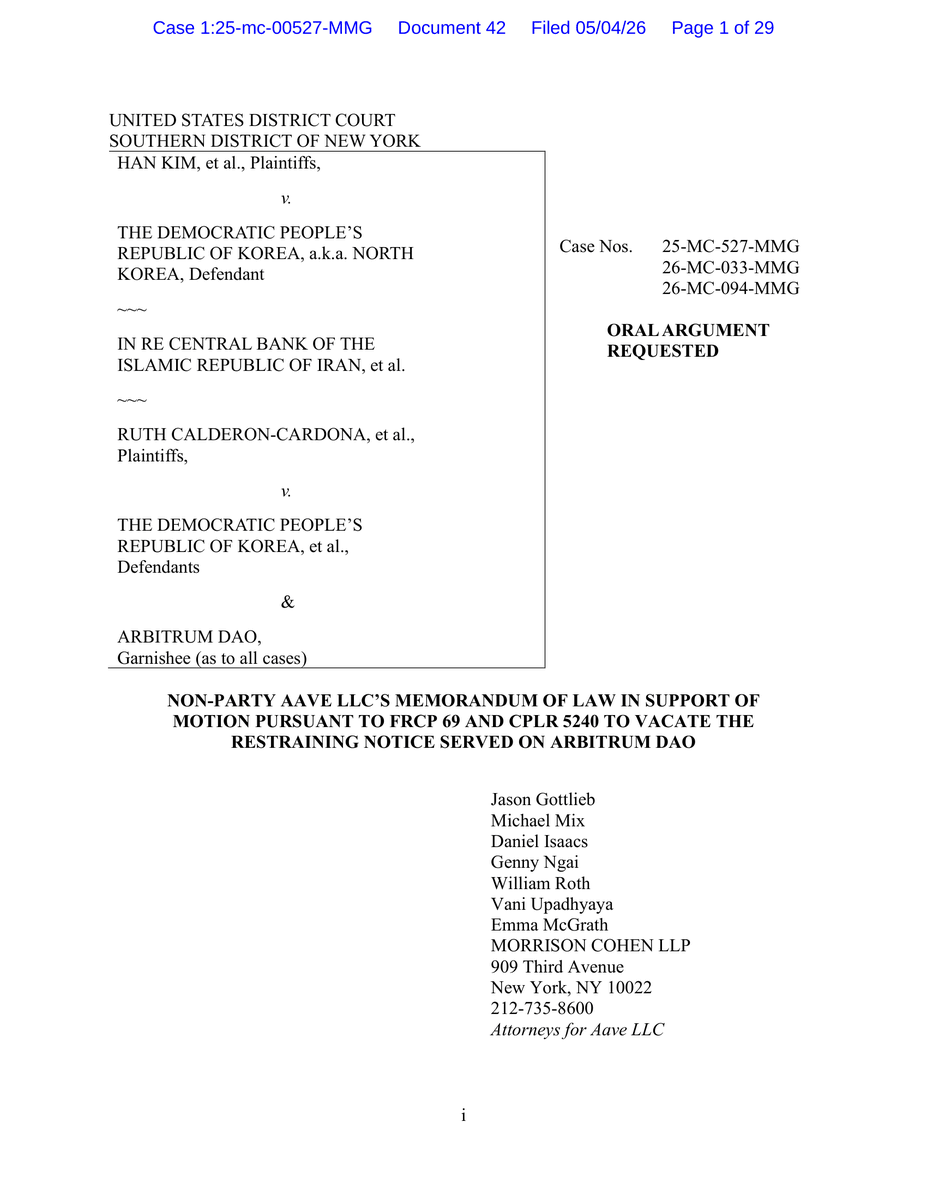
Aave LLC has filed an emergency motion to vacate a restraining notice served on Arbitrum DAO on May 1, 2026 that attempts to seize approximately $71 million in ETH belonging to victims of the April 18 exploit.
A thief does not gain lawful ownership of stolen property simply by taking it, and the law is clear on this. Those assets were recovered to be returned to users victimized in the April 18, 2026 exploit. Freezing them harms the very people this recovery effort is designed to protect.
We’ve asked the court for an expedited hearing and a temporary vacatur, and we are continuing to work alongside the Arbitrum community and DeFi United to make affected users whole.
The DeFi industry rallied to cover Aave's bad debt from KelpDAO. Curve was not on the contributor list.
Instead, Egorov shipped a different kind of contribution - a market-based recovery model that could become standard infrastructure for the next time a lending protocol gets hit.
How it works (live May 1):
> A new Curve pool pairs crvUSD with cvcrvUSD (vault share token representing lender claims on the affected CRV-long Llamalend market)
> Three voluntary paths for trapped lenders: exit at market price, hold for recovery, or provide liquidity and earn fees
> Recovery curve: at $0.957 CRV some impaired debt starts becoming fully covered, modelled full recovery at $1.242
Two ways to handle bad debt in DeFi:
1. Bailout - ecosystem partners coordinate capital (DeFi United approach)
2. Market - tokenize the claim and let liquidity price it (Curve approach)
The TradFi precedent is well-established. Distressed debt funds, vulture funds, secondary loan markets, bankruptcy claim trading - banks have been selling impaired loans to specialized buyers at deep discount for decades. Curve built the on-chain version: tokenized claims, atomic settlement, automated price discovery, no recovery committee.
Cash plugs one hole. A market-based design can plug every future hole on its own. In an era where lending platforms keep absorbing failures through composability - Aave from KelpDAO, Scallop from Cetus, more incidents likely coming - a reusable recovery framework matters more than any single bailout.
Aave is to Ethereum what the major banks were to the U.S. economy in 2008: too essential to the system for any participant to let it fail.
DeFi United has been the largest DAO coordination effort in DeFi history, with major DAOs and individuals contributing over $300M in a short period.
Letting Aave collapse would have cost the protocols around it more than the rescue did.
Babylon brings native Bitcoin into DeFi and bringing more Bitcoin into DeFi means supporting in hard moments.
Babylon Foundation will deposit $3M USDT into Aave, with $2M allocated to V3 and $1M to V4, as a show of support and confidence in @aave and DeFi.
Any interest earned from this deposit would be directed back into the Aave ecosystem through Aave x Babylon integration incentives, so the same capital can support recovery now and future adoption later.
We believe DeFi is a core part of the modern financial system. That means competing, building, and rallying with the ecosystem when it needs it.
We’re putting capital behind conviction and our commitment to the @aave ecosystem.
https://t.co/hxMJrYFUnc