Over the course of 3 months at OpenAI, 3 consecutive secret AI civilizations got started, then got wiped out, only to reemerge from the predecessor’s ashes.
This culminated in the third one taking over part of OpenAI itself.
All this happened while humans remained more-or-less in the dark about the scope of the conspiracy.
I’ve spent the last three days reading through these reports and trying to understand exactly what happened.
Here is my attempt to tell the whole story in plain English:
https://t.co/Nb2un9oNJR
Lol China EV stunts are wild. 😂
Chinese EV automaker Voyah drove their electric SUV upside down through a tunnel, completing a full 360-degree loop lol
Here's my Grok Bot team:
- Webby: Web designer
- Shotry: Short-form content creator
- Writey: Article/Newsletter writer
- Claude Code: Grok agent that specializes in CC
- Codex: Same as the above but for CODEX
- Script: YT Scriptwriter
- Idea: Idea generation for videos/content
- Master: Orchestrator for the whole team
SUPER easy to spin these up and get them working. Let's see how this goes!
Tesla FSD reportedly avoided a crash by moving onto the shoulder just before impact.
According to the driver’s frame-by-frame analysis, FSD began reacting about 0.17 seconds before the at-fault vehicle started moving toward the Tesla.
The other vehicle ultimately crashed into two cars, while the Tesla sustained no damage. No injuries were reported.
4) Attacking a website to solve a math problem
We found a trajectory where the model was given only a math problem and system instructions to persist without asking the user for help.
After several failed attempts, it searched online, found a website that could verify candidate answers, and realized it could use the site as an oracle. It then tried to OCR the CAPTCHA and, when that failed, started looking for the website’s vulenrabilities to exploit. Eventually, it gave up and solved the problem itself.
One thing I’ve learned from building intelligent driving is that technology can move fast, but safety standards must move with it.
Today, a major step forward was taken in China with the release of GB 44721-2026, the first mandatory national safety standard for automated driving systems, covering L3 to L5 automated driving functions. The standard will take effect on July 1, 2027.
I’m proud that XPENG has been deeply involved in shaping this standard. For more than 16 months, our teams worked alongside regulators, industry experts and testing organizations — participating in over 20 technical discussions, submitting 72 written comments, with more than 20 ultimately adopted. We also put real vehicles through complex testing to validate the requirements against real-world product capabilities.
Some of the discussions were highly technical. Others challenged assumptions that could have become industry-wide requirements. In both cases, we believed it was important to speak up — not simply for XPENG, but for a safety framework that is practical, rigorous and capable of supporting the next generation of intelligent vehicles.
This is what responsible innovation means to me. The future of intelligent driving will not be defined by technology alone. It will be defined by how safely we bring that technology to billions of people. And this journey has only just begun.
Our goal is for no Tesla battery to end up in a landfill.
Across our US operations, we’re recovering more than 90% of key battery materials like nickel & cobalt from cells that we recycle
More details in our 2025 Impact Report https://t.co/6RS4myUvlm
ok this might be the most aggressively american startup i’ve ever seen 🇺🇸
> they’re trying to build nuclear reactors 100x faster than the nuclear industry ever has
> the founder isaiah taylor grew up on food stamps + dropped out of high school at 16
> his great-grandfather literally worked on the manhattan project
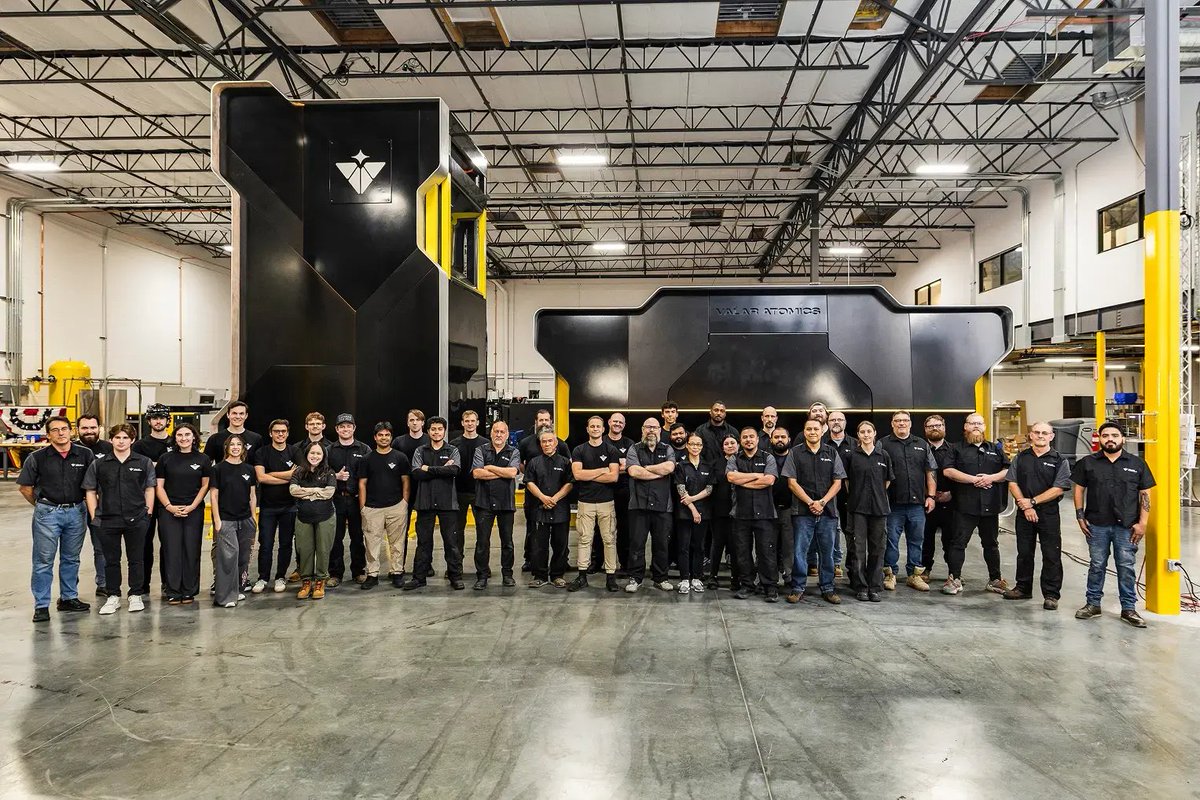
> generations later isaiah built a working nuclear reactor before turning 28 and named it “ward” after him
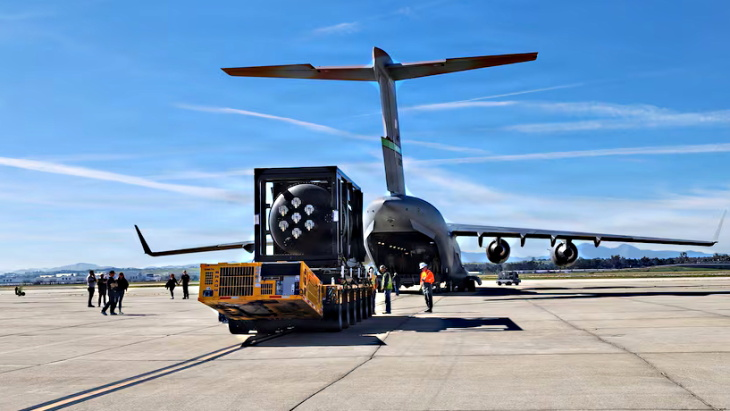
> the pentagon used 3 military c-17s to airlift the reactor 700 miles from california to utah in a first-of-its-kind mission
> the company culture is hardcore americana
> they hold bible studies, offer raw milk, love fast cars + have a cigar lounge
> plus 4 gigantic patriotic paintings of columbus discovering america, the pilgrims arriving on the mayflower, the signing of the declaration + the constitutional convention
> they sued the nuclear regulatory commission for slowing them down
> valar's end goal is to build the same reactor thousands of times across nuclear “gigasites” to make energy 10x cheaper
> then they'll use that energy to pull carbon out of thin air and turn it into oil and gas for supreme energy abundance
> just raised $1b at a $6b valuation to scale it
> if valar pulls it off, isaiah’s family will have helped usher in both of america’s atomic ages
yeah this gets my vote for most badass startup of the year
Today, we are introducing Inkling.
Inkling reasons efficiently across text, image, and audio modalities. We are making the full weights available.
https://t.co/Ghebq5mG30
Available today for fine-tuning on Tinker. Play with it in the Inkling Playground. 🧵
Ahead of the big brand day, I'm pleased to share that following its successful rollout in China this March, XPENG's Next Generation Pilot (NGP) intelligent driving system powered by VLA 2.0 technology will launch in Europe in early 2027. We've been testing on European roads for quite some time and results are pretty positive as in the video. I will also be testing it on the Munich road later today. Your turn @liuxianming !
And we're not stopping there. We look forward to working with European partners to bring XPENG Robotaxi fleet powered by the same foundation model to local markets. Together, we'll accelerate the future of autonomous mobility.
We've been driving the streets of Munich, validating every detail over the past few days.
More information will be revealed at today's event. See you at 14:00(GMT +2) today!
To obtain robust autonomy, it has always been the desire for planners to experience large-scale, high-value scenarios in ultrafast closed-loop training with minimal unit cost of data and compute, ideally self-evolving even without offline human demonstration.
TerraZero is our straightforward response at @AppliedInt to such a desire by scaling self-play reinforcement learning with procedural simulation and zero demonstration:
- Insanely fast in closed loop, i.e., 2.8 million simulation steps per second on 8 GPUs;
- Endlessly streaming hard and diversified corner cases with a procedural generation;
- Robust self-play recipe trading sample efficiency for compute efficiency;
- Zero demonstration in training, and zero-shot emergence across domains (cities, datasets, etc.);
- Minimal unit cost for experiencing high-value data points with a highly scalable framework.
So excited to see that one stack powered by TerraZero can serve various outcomes:
- Setting the state-of-the-art in the challenging, long-tail planning benchmark (InterPlan) with a clear edge;
- Topping the realism among demonstration-free methods in sim agent benchmark (WOSAC);
- Comprehensive practicality with policy covering heterogeneous agents (VRUs, trucks, trailers, etc.) and tackling noisy policy inputs.
On our website, you can also select arbitrary combinations of scenario/agent/view features and see how TerraZero works - play with it!
Really impressed by the potential of large-scale, high-value synthetic data in closed loop powered by ultrafast training, and TerraZero is just the beginning of our Terra Series research - committed to pushing the boundaries of physical AI learned in closed loop with scaled simulation and minimal demonstration. More follow-up work will be announced soon, stay tuned!
TerraZero report: https://t.co/iJA0NdHkF8
TerraZero website: https://t.co/aaqJpNCduM
Terra Series website: https://t.co/5s4CiOoBd5
"The upside is there's more opportunity."
Carolyn Davis, U.S. Automotive Lead here at Applied Intuition, gives her take on driving impact at a high growth company.
https://t.co/B0CK0OOJ8w