I had a fun interview with Dr. Xianming Liu, head of AI at @XPENG_Global, to gain some insights into the company's progress toward autonomous driving and physical AI.
It's impressive what they have been able to do in a short period of time. VLA 2.0 is now roughly at parity with Tesla FSD.
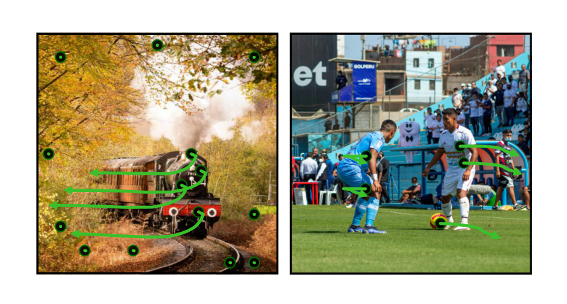
A SINGLE encoder + decoder for all the 4D tasks!
We release 🎯 D4RT (Dynamic 4D Reconstruction and Tracking).
📍 A simple, unified interface for 3D tracking, depth, and pose
🌟 SOTA results on 4D reconstruction & tracking
🚀 Up to 100x faster pose estimation than prior works
.@aelluswamy will discuss our approach to foundation models for robotics at CVPR today
Room 603, 3:30pm local time
Covering architecture, large-scale multimodal training, end-to-end control, safety & deployment
Come swing by booth 255 for live demos after!
You were all asking to not intervene @Tesla FSD when it gets into a pickle. Well, here you have an example where FSD encounters a van on a very narrow🇳🇱road and it squeezes itself in the tiniest gap with only centimetres to spare on each side! 😱 This one definitely puckered up our buttholes 😂 @pvandamcom@teslaeurope@TeslaOwnersNL@SawyerMerritt@wholemars@KRoelandschap #FSDEurope
Recently met @srush_nlp and he started giving me an impromptu lecture on how targeted on-policy self-distillation works.
I asked him if I could record it on my iPhone.
The basic idea is this: if the model made a mistake at some point in the rollout (for example, calling a tool that doesn't exist), we want to discourage this specific error, but we don't want to just learn from the final reward, because it's a very noisy signal spread out over the whole trajectory.
So we have another model read this trajectory and figure where the error was made. It simply inserts some hint tokens to the part of the trajectory right above where the mistake was made.
Now with these injected hint tokens, have the model run a forward pass. You're not having to regenerate a new rollout - aka no new decode required.
The hint causes the model to assign lower probabilities to the error tokens. You then trains the original model to match these new probabilities, teaching it to downweight that specific mistake.
You don't imagine the future by mentally rendering a movie. You trace how things move -- abstractly, sparsely, step by step.
We built a model that does exactly this. It predicts motion, not pixels -- and it's 3,000× faster than video world models.
Myriad, accepted at @CVPR 2026
Tesla Vision allows us to deploy airbags up to 70 milliseconds earlier if your Tesla detects an unavoidable collision
This can be the difference between serious injury & walking away from a crash
The past year has been the happiest period of my life.
Genesis is a place of miracles.
We set countless ambitious goals.
None of them seemed possible with existing technology.
One by one, we made them real.
The density of breakthroughs coming from such a small team, across so many directions at once, feels almost rare in human history.
What you see here is fully autonomous, 1x speed, run on the exact same model.
Nuro co-founder and co-CEO @zhujiajun recently completed his Autonomous Vehicle Operator (AVO) training, learning directly from the team that manages our engineering fleet day-to-day. Watch his first session!
AVOs play a huge role at Nuro, helping train and test the Nuro Driver while supporting safety in complex road environments. If you love driving and are excited by cutting-edge tech, we’re hiring! https://t.co/4GUTnPjmlP
#autonomousvehicles #selfdriving #drivenbynuro
I was shocked to learn that Tesla hasn't even applied for either the DMV driverless testing permit or the CPUC autonomous vehicle permit in California. Not denied — never applied. They operate under a limo/TCP permit and call it a 'Robotaxi.' Meanwhile Nuro just secured both. The contrast is stark.
$LCID $UBER $NURO
CA permits secured! We’re excited to share that Nuro has received two key regulatory approvals for the next phase of our robotaxi program with @Uber and @LucidMotors: A @CA_DMV driverless permit to expand public-road validation without safety drivers, and a @californiapuc permit to begin carrying passengers in a regulated pilot. Learn more: https://t.co/cMJFibZfdj
#selfdriving #autonomousvehicles #drivenbynuro
A 23-year-old amateur, Liam Price, used AI to solve a 60-year-old mathematical problem posed by Paul Erdős.
The problem involved “primitive sets” of numbers and a quantity called the Erdős sum.
While parts of the theory had been proven—most recently by Jared Lichtman—a key conjecture about the minimum value remained unsolved.
Price prompted an advanced AI model, which produced a valid solution using a completely new method that mathematicians had not considered.
Experts, including Terence Tao, say the problem may have seemed difficult due to a collective “mental block.”
Although the AI’s raw proof was unclear, experts refined it and confirmed its correctness.
More importantly, the approach could have broader applications, suggesting AI may help uncover new ways of thinking in mathematics.
Three years since the first flight of Starship, the next generation is here. New ship. New booster. New engines. New pad and new test site. SpaceX engineers are working to solve one of the most difficult engineering challenges in history: developing a fully, rapidly reusable rocket