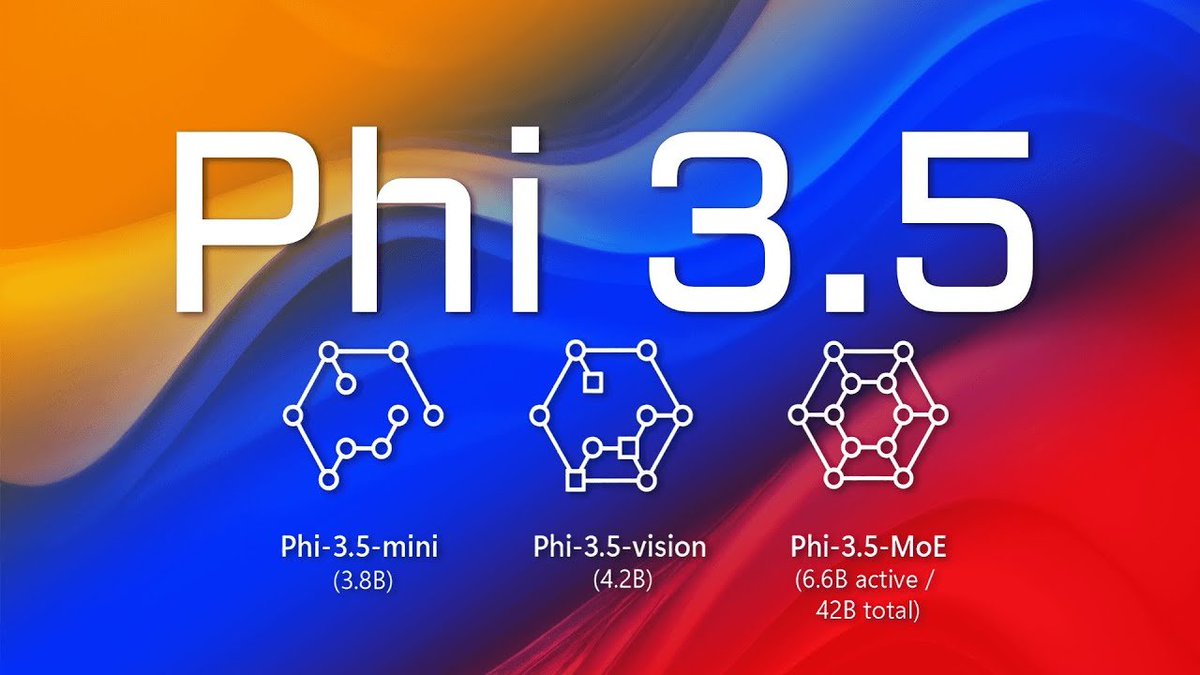
We are happy to announce the release of the Phi 3.5 family of models! Check them out:
👉Phi 3.5 mini: https://t.co/yqFYbRbWJN
👉MoE: https://t.co/sjx0EIOfmS
👉Phi 3.5 vision: https://t.co/U0FddOK1Xc
It has been a blast sharing the excitement, science, art, and community of CVPR with all of you.
The Publicity Chairs are officially signing off.
Seattle, you’re up next! 🌲 See you at #CVPR2027! 👋
@deblinaforAI@anfurnari@CSProfKGD@YVinker@_vztu
This year, the NeurIPS 2026 Position Paper Track made the decision to require that all papers be substantially human-written, with AI used for only copy-editing or similar peripheral changes to the main text!
For more details, please check our blogpost: https://t.co/wrWuMQJwrx
Releasing Echo-2 HQ, an improved model that delivers greater detail and sharper results.
You can zoom in super close and discover remarkable appearance fidelity. Available via API and in the app. Try it out!
Check out some of the scenes below👇
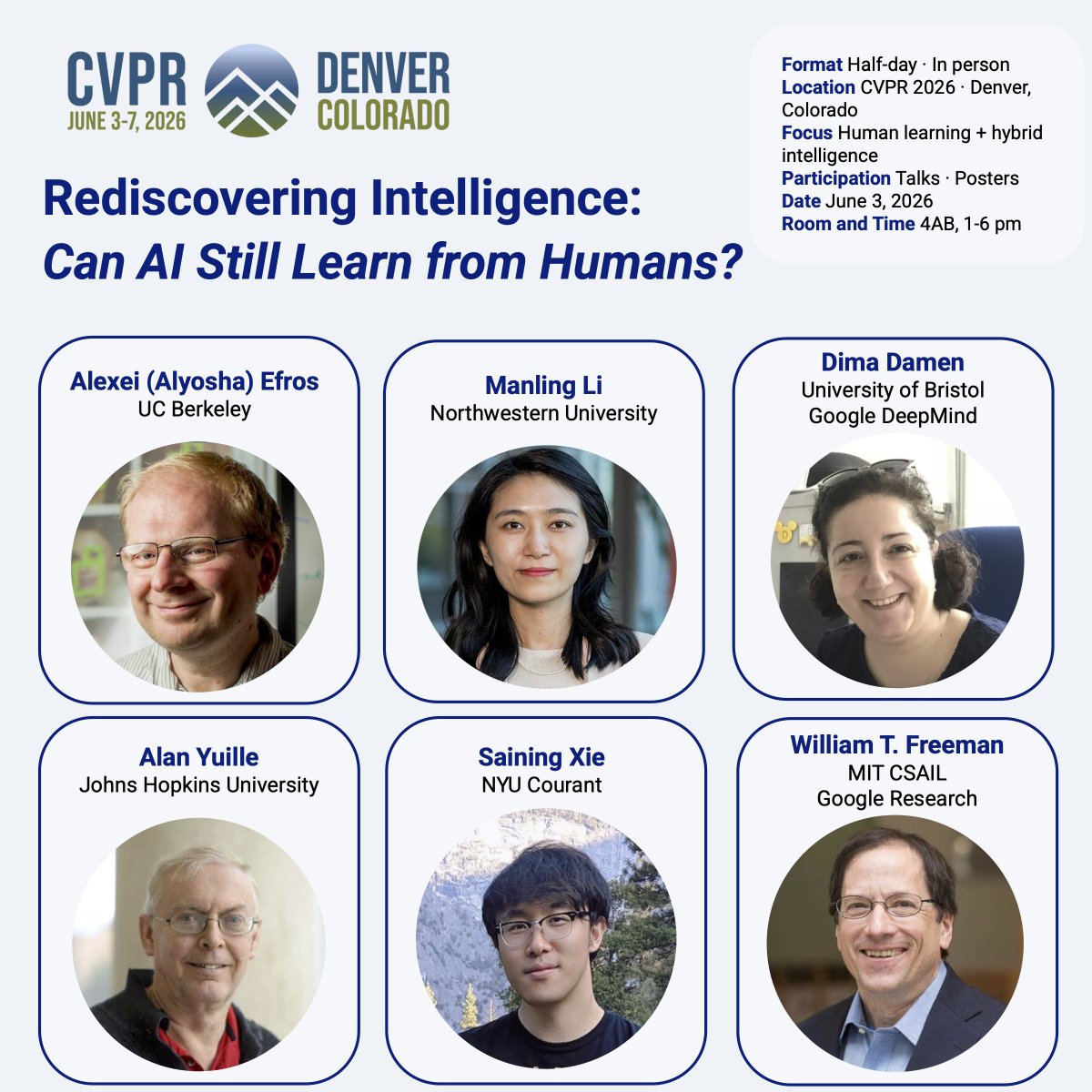
As AI systems become increasingly capable, a fundamental question emerges: Can AI still learn from humans? Join us at the ReLearn Workshop @CVPR (June 3, Denver) to explore these questions with an outstanding lineup of speakers.
We added Quake3-style multiplayer to our 3D world generator and it changes the game, literally 🔥🔥🔥
Runs directly on our model output: fast movement, arena combat, and every single match plays out on a generated world.
Stay tuned for public release and play yourself!
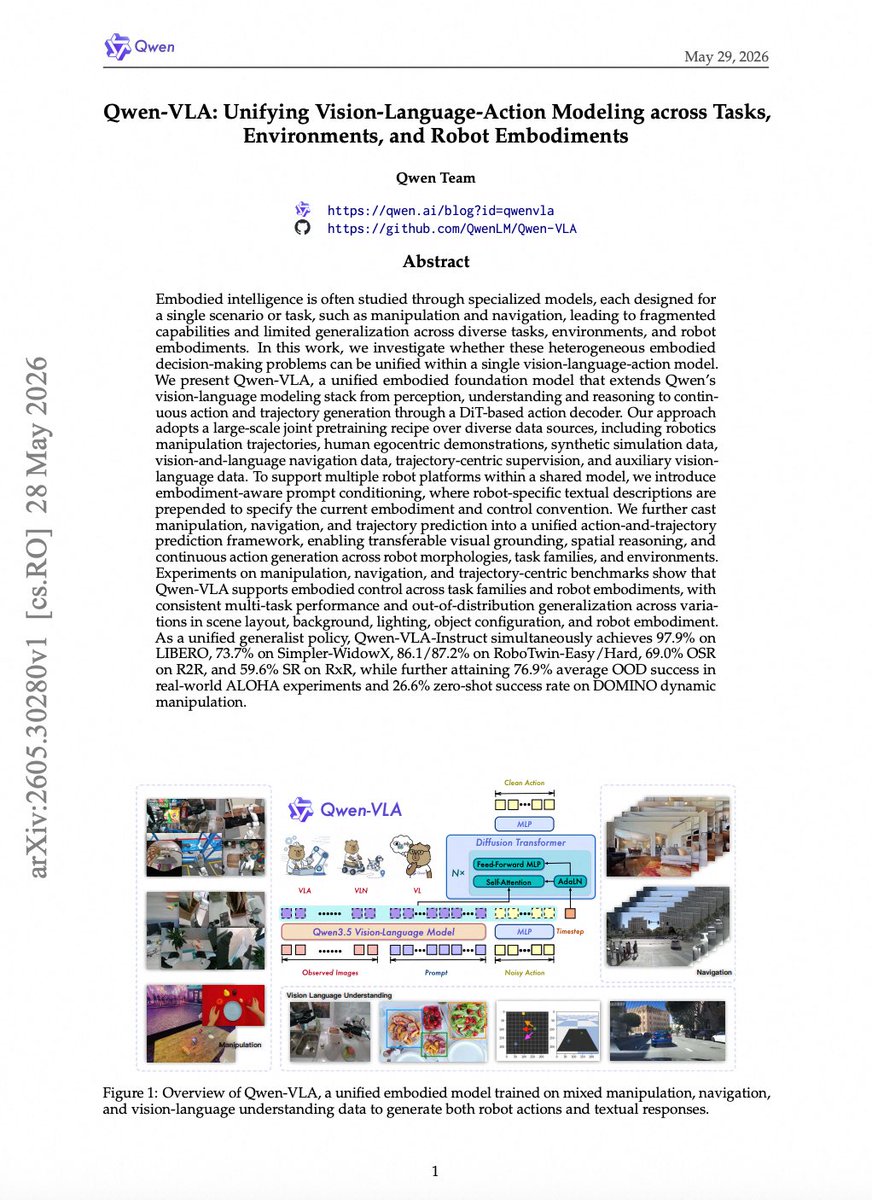
Excited to share Qwen-VLA paper, our exploration of generalist Vision-Language-Action models.
It extends Qwen’s multimodal backbone from visual understanding and reasoning to continuous action generation and trajectory prediction.
Paper:
https://t.co/9jvRW0nI8B
There have been a lot of fresh discussions lately around "bitter lessons".
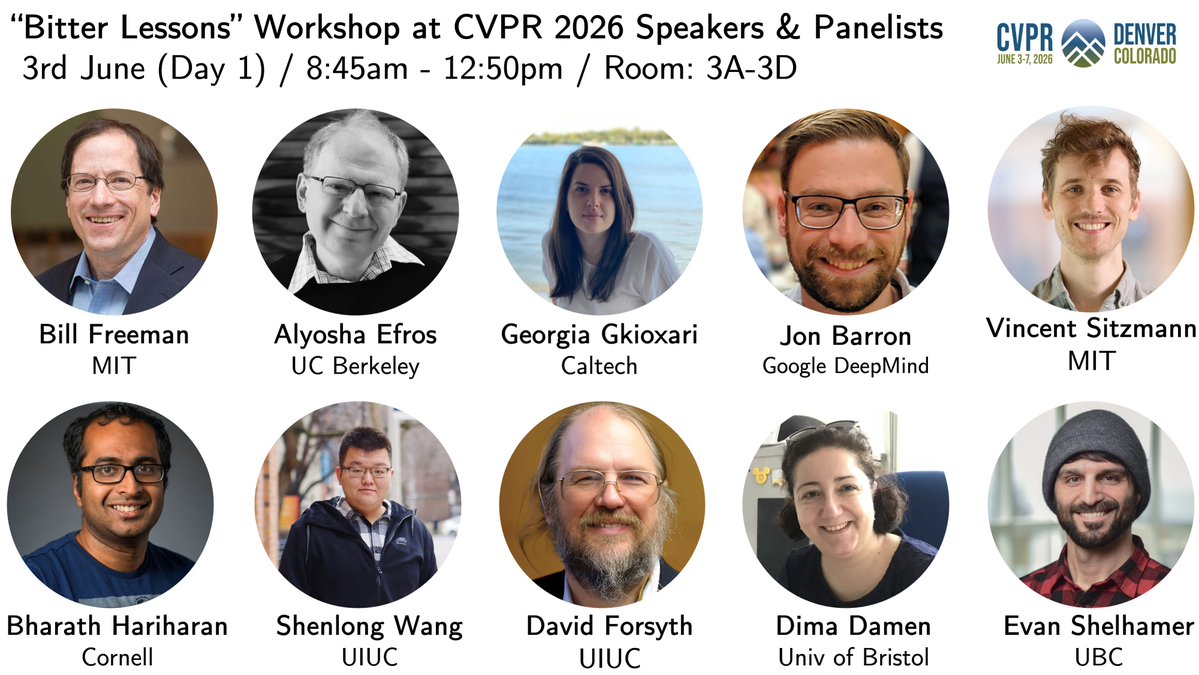
Continuing our tradition of community-building at CVPR, our workshop is back! This year's theme: Bitter Lessons in Computer Vision.
Join us on Jun 3rd at 8:45 AM in Room 3A-3D at #CVPR2026
🔗 Website: https://t.co/dMSICNNdUy
We have an incredible lineup to share their "bitter lessons": Bill Freeman, Alyosha Efros, @georgiagkioxari, @jon_barron, @vincesitzmann, @BharathHarihar3, @ShenlongWang, David Forsyth, @dimadamen@ev4n3sce, @CVPR
3D world models are mostly static - not anymore🔥
We're building physically-grounded worlds with dynamics.
For now, we use geometry from our model in a physics engine. However, in the future, we will support native physics, where the model itself becomes the physics engine.
Going to @CVPR? Join our tutorial on “Accelerated Diffusion Models: From Theory to Interactive World Models”!
Learn how to make diffusion and flow models fast enough for real-time applications. Our practice-oriented sessions are designed to bridge the gap between theory and real-world deployment, supported by our open-source NVIDIA FastGen library.
Topics:
🔹 General acceleration paradigms (@ArashVahdat)
🔹 Step-Distillation (@julberner)
🔹 Interactive World Models (@wn8_nie)
🔗 https://t.co/Iu5ncUZZtc
📅 June 3 | 9 AM - 12 PM MDT 📍 Room 201
#CVPR2026
🤖 ¿La inteligencia artificial nos está ayudando? 😱 La doctora Saiph Savage, profesora de la Universidad de Northeastern y colaboradora de la UNAM, comparte su análisis: las empresas están usando la IA solo para reducir costos y maximizar ganancias, olvidando la dignidad humana. 📊🤔
#FórmulaNoticiascon Enrique Acevedo (@Enrique_Acevedo).
graduates of the most elite colleges have superior career outcomes not primarily because of the education they receive, but because of the people they meet and the connections they make
High-fidelity generation is hitting a scaling crisis as DiT compute grows with image resolution and video length. But do we need high-resolution denoising at every step?
We introduce Spectral Progressive Diffusion, a plug-and-play framework for efficient image and video generation that directly exploits the spectral autoregression property of diffusion to grow resolution during denoising.
[1/7]
Today, we share a breakthrough on the planar unit distance problem, a famous open question first posed by Paul Erdős in 1946.
For nearly 80 years, mathematicians believed the best possible solutions looked roughly like square grids.
An OpenAI model has now disproved that belief, discovering an entirely new family of constructions that performs better.
This marks the first time AI has autonomously solved a prominent open problem central to a field of mathematics.
The bitter lesson in 26 words:
Don’t be distracted by human knowledge, as AI has been historically.
Instead focus on methods for creating knowledge that scale with computation, like search and learning.
In flow matching, a coupling determines how noise and data samples are paired during training.
The choice of coupling is important because it influences the geometry of trajectories at inference time.
The simplest choice is the independent coupling, where noise and data points are paired arbitrarily. This can lead to curved trajectories as the model averages over many conflicting pairings.
However, if we use optimal transport on batches of pairs, this leads to fewer ambiguous intersections that the model must resolve, leading to straighter trajectories at inference time.