Nalwa Sons Investments Q1 FY27
The listed holding company is Indian capital markets' most persistent unsolved puzzle, and the peer table above is basically a support group. Look at the shape of it: eight companies, and the quarterly revenue ranges from ₹5.41 crore to ₹17,076 crore in the same screen, under the same sector label, because "Investment Company" is a classification that stretches from an operating financial conglomerate to an entity whose entire staff would fit in a sedan.
Read full article on Eduinvesting
#NSIL
showing serious strength 🔥After double bottom in wave (iv) of 3, the stock has quietly built a solid base. The price action looks ready to shift gears. We are now entering wave (v) of 3 — and this leg usually delivers the strongest rally of the impulse.
New highs are not just possible… they are the most probable outcome in the months ahead.
#NSIL #ElliottWave #TechnicalAnalysis #StockMarket #Breakout #Trading #Investing #PriceAction
#MarketsWithMC | SEBI disposes of proceedings against Nalwa Sons Investments and Jindal family members, says allegations over 2014 reorganisation not established
- SEBI disposed of proceedings against Nalwa Sons Investments.
- Allegations regarding 2014 investment reorganisation not proven.
- No penalty or directions issued against NSIL and others.
@BrajeshKMJi with more details
https://t.co/sK8lz5Ctlr
#RBI#NBFC#CIC#HoldingCompanies#CorporateGovernance#IndiaInvesting
RBI’s NBFC & CIC Reset: Why Governance and Structure of Indian Investment Holding Companies Are Entering a New Phase
India’s large listed investment holding companies have always lived in a grey zone. On paper, many look like ordinary corporates. In substance, their balance sheets, capital flows, and risk profiles resemble financial institutions.
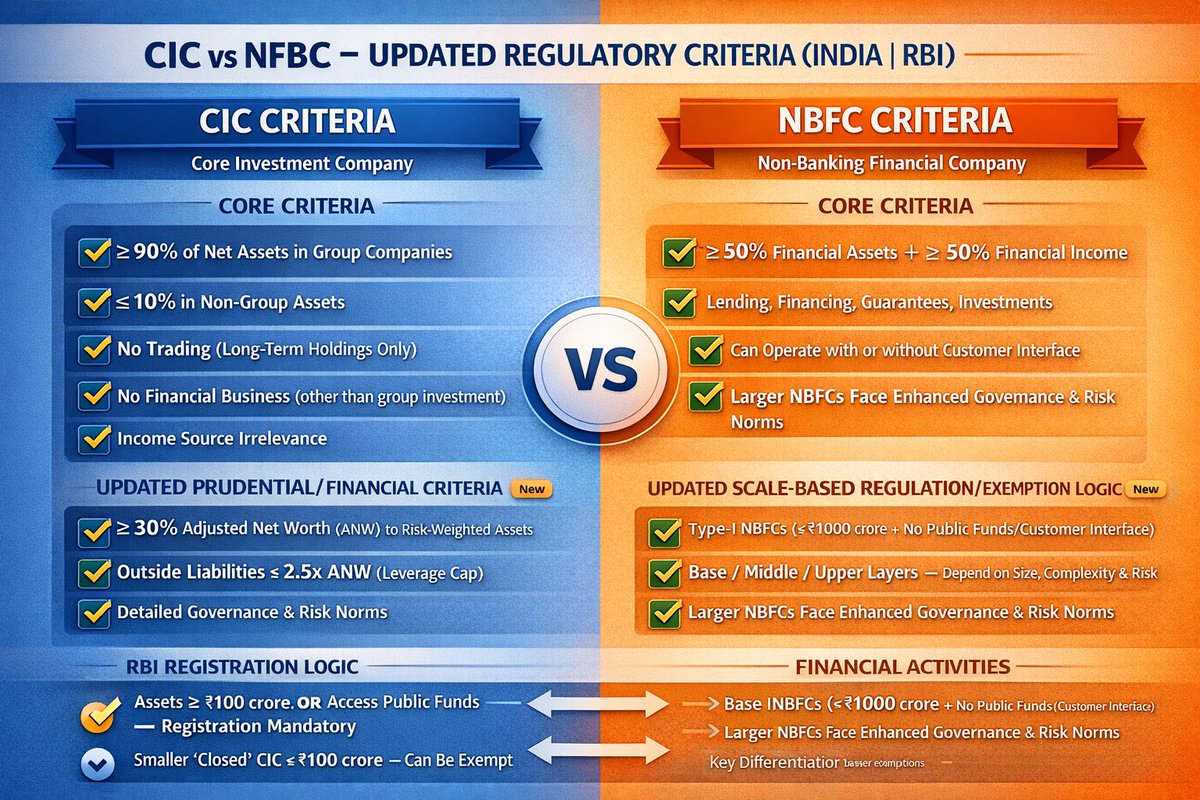
The Reserve Bank of India’s (RBI) recent moves—easing compliance for small, closed NBFCs while tightening expectations for large holding and core investment structures—are now forcing this ambiguity to resolve.
This is not incremental regulation. It is a structural reset for how Indian investment holding companies are governed, organised, and ultimately valued.
Two RBI signals that matter—and why they must be read together
1) Relief for small, closed NBFCs
RBI has proposed that NBFCs with:
•no public funds,
•no customer interface, and
•assets up to ₹1,000 crore
may not require RBI registration.
This is a clear signal: low-risk, closed investment vehicles should not drown in financial regulation.
2) Sharper scrutiny of holding and core investment entities
At the other end of the spectrum, RBI has clarified—through CIC directions and supervisory commentary—that size, leverage, and economic substance matter more than labels. Promoter holding and strategic investment entities with large balance sheets are increasingly expected to meet financial-company-grade governance and prudential standards, even if their income is not traditionally “financial”.
Together, these moves establish a principle that will define the next decade:
Small and closed = simplify. Large and systemic = formalise.
⸻
Why large investment holding companies are most affected
Large Indian investment holding companies typically exhibit:
•heavy concentration in a few strategic group investments,
•multiple layers of subsidiaries and step-down entities,
•inter-corporate loans, guarantees, and treasury flows,
•selective use of leverage.
This makes structure itself a source of risk—and that is exactly what RBI supervision targets.
The result is that many large listed holding companies now face a dual regulatory identity:
•At the top: the holding company may itself qualify as an NBFC under the principal business test or already be registered.
•Within the group: some subsidiaries operate as NBFCs, while others qualify as CICs, subject to their own capital, leverage, and governance rules.
In effect, the group—not just individual entities—becomes the unit of regulatory concern.
⸻
The dual-identity challenge: NBFC at the top, CICs inside
It is increasingly common to see structures where:
•the listed parent qualifies as an NBFC due to financial asset and income composition,
•one or more subsidiaries are CICs holding strategic group stakes,
•smaller investment SPVs may qualify for exemption under the new “closed NBFC” logic.
This creates a layered compliance reality:
•NBFC rules govern operations and income,
•CIC rules govern ownership structure, leverage, and capital discipline,
•and RBI supervision increasingly looks at risk migration across layers.
The days when each entity could be evaluated in isolation are fading.
⸻
Governance impact: from promoter discretion to institutional discipline
The most immediate impact is in the boardroom.
Investment holding companies are being nudged to behave less like passive promoters and more like capital allocators with fiduciary accountability. Expect sharper focus on:
•formal capital allocation frameworks,
•explicit leverage and guarantee policies,
•tighter related-party transaction discipline,
•clearer articulation of “strategic” versus “financial” investments.
Boards that cannot explain why a structure exists—or where risk sits—will find the regulatory conversation increasingly uncomfortable.
Deepak ji - please advice what impact would recent RBI changes with respect to recognition of CIC and less than 1000cr assets companies not requiring NBFC registration ; have on investment holding companies of big corporates and their immediate privately held subsidiaries . For example , Nalwa Sons of Jindal Group
#RBI#NBFC#CIC#HoldingCompanies#CorporateGovernance#IndiaInvesting
RBI’s NBFC & CIC Reset: Why Governance and Structure of Indian Investment Holding Companies Are Entering a New Phase
India’s large listed investment holding companies have always lived in a grey zone. On paper, many look like ordinary corporates. In substance, their balance sheets, capital flows, and risk profiles resemble financial institutions.
The Reserve Bank of India’s (RBI) recent moves—easing compliance for small, closed NBFCs while tightening expectations for large holding and core investment structures—are now forcing this ambiguity to resolve.
This is not incremental regulation. It is a structural reset for how Indian investment holding companies are governed, organised, and ultimately valued.
Two RBI signals that matter—and why they must be read together
1) Relief for small, closed NBFCs
RBI has proposed that NBFCs with:
•no public funds,
•no customer interface, and
•assets up to ₹1,000 crore
may not require RBI registration.
This is a clear signal: low-risk, closed investment vehicles should not drown in financial regulation.
2) Sharper scrutiny of holding and core investment entities
At the other end of the spectrum, RBI has clarified—through CIC directions and supervisory commentary—that size, leverage, and economic substance matter more than labels. Promoter holding and strategic investment entities with large balance sheets are increasingly expected to meet financial-company-grade governance and prudential standards, even if their income is not traditionally “financial”.
Together, these moves establish a principle that will define the next decade:
Small and closed = simplify. Large and systemic = formalise.
⸻
Why large investment holding companies are most affected
Large Indian investment holding companies typically exhibit:
•heavy concentration in a few strategic group investments,
•multiple layers of subsidiaries and step-down entities,
•inter-corporate loans, guarantees, and treasury flows,
•selective use of leverage.
This makes structure itself a source of risk—and that is exactly what RBI supervision targets.
The result is that many large listed holding companies now face a dual regulatory identity:
•At the top: the holding company may itself qualify as an NBFC under the principal business test or already be registered.
•Within the group: some subsidiaries operate as NBFCs, while others qualify as CICs, subject to their own capital, leverage, and governance rules.
In effect, the group—not just individual entities—becomes the unit of regulatory concern.
⸻
The dual-identity challenge: NBFC at the top, CICs inside
It is increasingly common to see structures where:
•the listed parent qualifies as an NBFC due to financial asset and income composition,
•one or more subsidiaries are CICs holding strategic group stakes,
•smaller investment SPVs may qualify for exemption under the new “closed NBFC” logic.
This creates a layered compliance reality:
•NBFC rules govern operations and income,
•CIC rules govern ownership structure, leverage, and capital discipline,
•and RBI supervision increasingly looks at risk migration across layers.
The days when each entity could be evaluated in isolation are fading.
⸻
Governance impact: from promoter discretion to institutional discipline
The most immediate impact is in the boardroom.
Investment holding companies are being nudged to behave less like passive promoters and more like capital allocators with fiduciary accountability. Expect sharper focus on:
•formal capital allocation frameworks,
•explicit leverage and guarantee policies,
•tighter related-party transaction discipline,
•clearer articulation of “strategic” versus “financial” investments.
Boards that cannot explain why a structure exists—or where risk sits—will find the regulatory conversation increasingly uncomfortable.
Structural consequences: simplification over time
RBI’s approach indirectly encourages:
•consolidation or de-registration of small, non-public NBFC subsidiaries,
•pruning of redundant intermediate layers,
•cleaner separation between operating companies, CICs, and treasury vehicles.
This is not cosmetic restructuring. It directly affects capital efficiency, transparency, and risk perception—all of which matter to long-term investors.
⸻
Market implications: governance clarity and the holding company discount
Indian investment holding companies have historically traded at steep discounts to NAV due to:
•opaque structures,
•unpredictable capital allocation,
•governance uncertainty.
RBI’s recent trajectory—lighter touch for low-risk entities, firmer standards for large ones—can act as a catalyst for differentiation.
Well-governed holding companies that embrace clarity may benefit from:
•reduced regulatory ambiguity,
•improved institutional confidence,
•gradual compression of the governance discount.
Poorly structured or opaque entities, by contrast, may find the discount becoming structural rather than cyclical.
⸻
A forward-looking checklist for promoters and investors
https://t.co/HNukRlA8C9 every group entity: NBFC, CIC, or neither—and why.
2.Identify small, closed NBFCs that can be simplified or exited.
3.Stress-test CIC entities against capital and leverage expectations.
4.Rationalise layers that exist only for legacy or convenience.
5.Communicate group structure and capital allocation logic clearly to investors.
6.Prepare for a substance-over-form regulatory conversation.
⸻
Closing thought
RBI’s recent moves are not anti-holding-company. They are anti-opacity.
For large Indian investment holding companies, this is a transition from promoter-era flexibility to institutional-era discipline. Those who adapt early may find that governance clarity is not a cost—but a re-rating lever.
Disclaimer : The views are authors’ interpretation; please check factually before use of any information .
There's a rule by the RBI. If you have 50% of your assets are "financial assets" (including mutual funds, shares etc but FDs are ok) and "financial" income is more than 50% (dividends, capital gains, interest etc but not FD interest)
Then you were supposed to register with the RBI as an NBFC.
This creates a problem for a "friends and family" fund structure created as a company. You can pool in money together, and use that to invest - in startups, in public markets, in bonds, whatever. But since most of the income and assets are financial, you need registration with RBI as an NBFC!
What RBI has done today is to remove that requirement if you're less than 1000 cr. in assets, and don't have any customer interface or take money from the public. Great to create new funds that are primarily pooled family or friend vehicles in India.
This will eventually create competition of us, as a mutual fund, but I would say this: let a 1000 fund managers bloom.
India doesn't have as many privately held funds as we should. Our family offices usually invest in each family member's name, separately, because a collective investment would trigger NBFC clauses. A few people that come together to invest shouldn't have to do something as gargantuan as an RBI registration.
Very progressive. Early stages yet. But it will benefit the investment attitude in the country.
#IndiaOpportunity#FIIs#HoldingCompanies#ViksitBharat#Investment#Markets
To global FIIs & long-only funds:
India’s next leg of compounding is underway—manufacturing, infra, consumption, and financialization moving in sync.
Want instant, diversified exposure without stock-picking risk?
➡️ Indian Investment Holding Companies
Clean structures. Deep discounts to NAV. Embedded optionality.
Re-rating is a matter of when, not if.
#indiaustradedeal#Modi#TRUMP#MFN#Economy#TradeDeal
Superb run up by Indian leadership… by immaculately crafting a spree of FTAs and Trade Deal one after the other…putting India on global map as Most Favorite Nation ( instead of Most Favored Nation )
It’s time for INDIA to be #ViksitBharat .
#indiaustradedeal#Modi#TRUMP#MFN#Economy#TradeDeal
Superb run up by Indian leadership… by immaculately crafting a spree of FTAs and Trade Deal one after the other…putting India on global map as Most Favorite Nation ( instead of Most Favored Nation )
It’s time for INDIA to be #ViksitBharat .
#indiaustradedeal#Modi#TRUMP#MFN#Economy#TradeDeal
Superb run up by Indian leadership… by immaculately crafting a spree of FTAs and Trade Deal one after the other…putting India on global map as Most Favorite Nation ( instead of Most Favored Nation )
It’s time for INDIA to be #ViksitBharat .
#indiaustradedeal#Modi#TRUMP#MFN#Economy#TradeDeal
Superb run up by Indian leadership… by immaculately crafting a spree of FTAs and Trade Deal one after the other…putting India on global map as Most Favorite Nation ( instead of Most Favored Nation )
It’s time for INDIA to be #ViksitBharat .