Nick Bostrom says AI will start to surpass us in philosophy, just as it has in math and probably soon in other fields
So now, while we still have something to contribute, is the time to make whatever positive impact we hope to have. This is the golden age for purpose and positive impact
Jajaja. Efectivamente. Claude bien que se atreve con problemas matemáticos, pero ¿y de los problemas filosóficos? ¿Cuándo va a caer el del libre albedrío o el de la existencia de Dios?
Is it too long before some earnest philosopher claims that a philosophical problem has been solved by AI? It could be the Eighteenth Brumaire of Logical Positivism.
Luciano Floridi, filósofo: “¿Cómo es que, cuando estas empresas necesitan cerrar el acceso a sus modelos en Europa, lo hacen y tardan segundos, y en cambio ese apocalipsis de la IA no lo podrían bloquear? Es desinformación, propaganda, intereses" https://t.co/5fmEw4rjN2
No. Even if consciousness were an illusion, it exists within biological brains—as an illusion. In current silicon-based systems, it exists neither as a reality nor as an illusion. Furthermore, you are proposing a false dichotomy: either it is an illusion or it is panpsychism. There are many other alternatives.
🚨 مايكروسوفت تفتح بابًا غريبًا في عالم الذكاء الاصطناعي: ماذا لو لم نحتج إلى تدريب الشبكات العصبية أصلًا؟
باحثون من Microsoft Research بالتعاون مع جامعات Johns Hopkins وColumbia وNYU نشروا ورقة بحثية بعنوان:
Interpretable Weight-Space Programming (iWSP)
الفكرة مذهلة: بدلًا من تدريب الشبكة العصبية باستخدام Backpropagation، يجعلون وكيل ذكاء اصطناعي يكتب أوزان الشبكة مباشرة داخل كود Python!
كيف تعمل الطريقة؟
1️⃣ يحصل الوكيل على المهمة وبنية شبكة عصبية جاهزة.
2️⃣ يكتب قيم الأوزان والعمليات الحسابية بنفسه، دون استخدام Backpropagation أو Optimizers أو أوزان مدرّبة مسبقًا.
3️⃣ يشغّل الشبكة ويقيس أدائها على مجموعة بيانات مخصصة للتقييم.
4️⃣ يحلل النتيجة، ويعدّل الكود والأوزان، ثم يكرر العملية من 30 إلى 50 مرة حتى يصل إلى حل أفضل.
والنتائج كانت لافتة:
🤯 100% دقة في 13 مهمة خوارزمية مختلفة، شملت الحساب والفرز وحساب المسافات بين النصوص، حتى على بيانات لم يرها النموذج أثناء التطوير.
والأغرب أن بعض الشبكات احتاجت إلى وسيط قدره 166 معاملًا فقط لتحقيق هذه النتائج مع نموذج Claude Opus 5.5، أي ضغط عدد الأوزان بنحو 29 مرة مقارنة بالخط الأساسي المستخدم في التجربة.
لكن الباحثين لم يتوقفوا هنا!
استخدموا الطريقة لبناء نماذج تتنبأ باستجابات الدماغ البشري للصور والكلام والأصوات.
وفي إحدى التجارب، اكتشف النموذج أن جزءًا من قدرته على التنبؤ باستجابات الدماغ لم يكن ناتجًا عن فهم القصة، بل عن استغلال نمط مرتبط ببداية ونهاية جلسة التصوير!
وهنا تظهر القيمة الحقيقية للفكرة:
بدلًا من الحصول على شبكة عصبية ضخمة لا نعرف كيف اتخذت قرارها، نحصل على نموذج يمكن قراءة منطقه وفهم العمليات التي ينفذها وتعديلها مباشرة.
لكن هل انتهى عصر Backpropagation؟ بالطبع لا.
الطريقة ما زالت محدودة، وأداء النماذج في مهام اللغة كان أقل من بعض النماذج المدربة تقليديًا. لكنها تفتح مسارًا بحثيًا جديدًا: أن يصبح الذكاء الاصطناعي قادرًا على تصميم الشبكات العصبية وكتابة أوزانها، لا مجرد استخدامها.
نحن أمام تحول مثير في دور الـ AI: من نموذج يتعلم من البيانات إلى وكيل يكتب بنفسه طريقة عمل النموذج!
A televised exchange between the philosophers Hubert Dreyfus and Daniel Dennett on artificial intelligence after Deep Blue's victory over Garry Kasparov in 1997.
@EduartMontes Así pienso yo (siguiendo a Kant): hay que tratar bien a las máquinas, no porque les duela que les trates mal, sino por lo que dice de ti el hecho de tratarlas mal. Hay que tratar bien a todas las cosas del mundo.
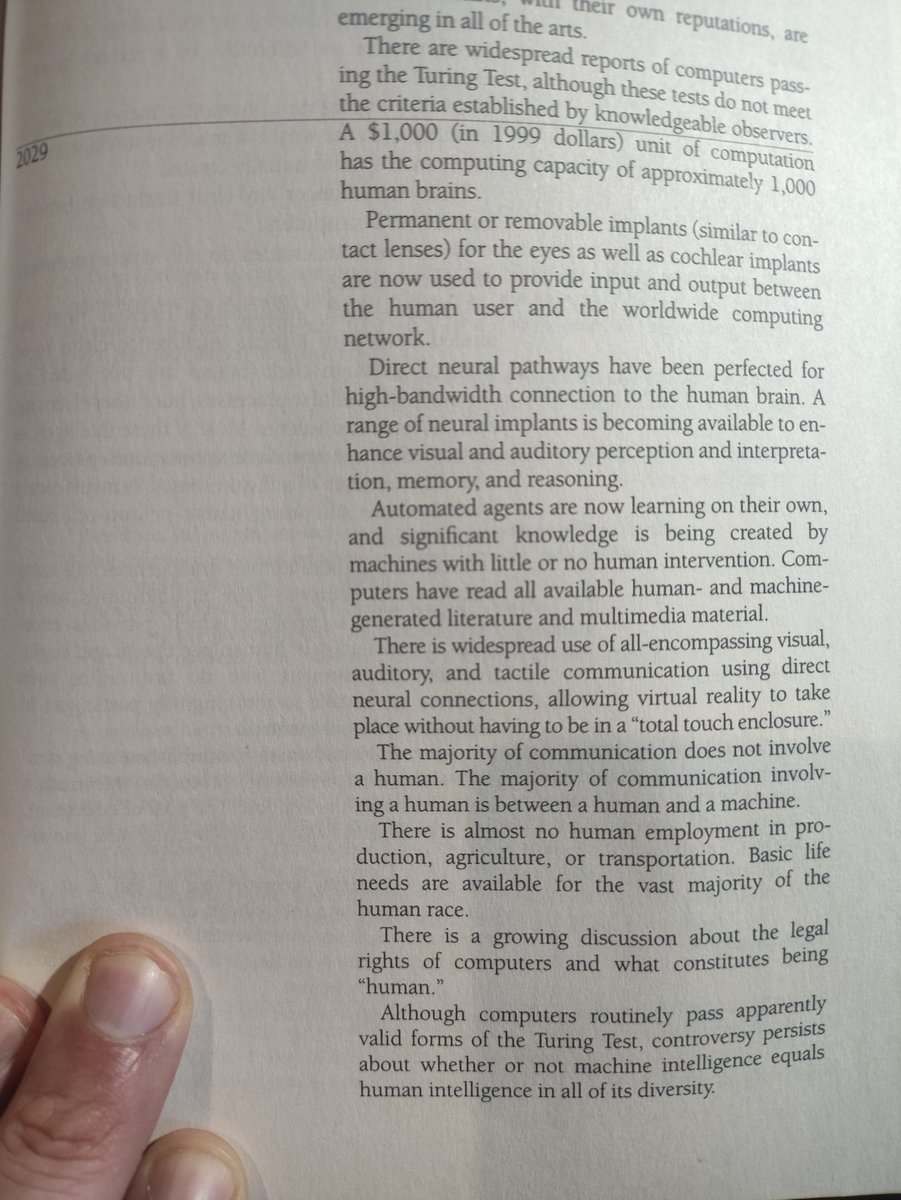
En vista del hype desaforado de estos días, he vuelto a ver las predicciones de Kurzweil para 2029. He vuelto a las realizadas en The age of spiritual machines de 1999. Algunas predicciones no se cumplen (el interfaz cerebro-máquina tipo Neuralink va despacio y no, todavía no se ha sustituido al humano en los principales empleos ni las necesidades humanas se encuentran plenamente satisfechas), pero otras curiosamente sí (los agentes, las comunicaciones humano-máquina, el debate acerca de la inteligencia...). Además, cuando giras la página y ves la última predicción: "Las máquinas afirman que son conscientes. Esas afirmaciones se aceptan en gran medida". Creo que, en el 2026, todavía no se aceptan mayoritariamente, pero vete tú a saber en el 2029... Si imaginamos una máquina muy similar a un humano en conducta y apariencia y, por tanto, capaz de despertar en nosotros empatía, y esa máquina dice que es consciente y pide derechos... Estoy seguro que se los daremos aunque sepamos que no son verdaderamente conscientes ¿Qué político se va a meter en el fregado de negar derechos cuando lo aplaudido es siempre lo contrario?
@horacio_ps No, que va. Viendo en retrospectiva, no encuentro cosa más difícil ¡Si hace casi menos de dos días a los LLMs se les daban mal las matemáticas!
¿Qué mejor que hacer un sábado noche que ver este vídeo en donde, contra todo pronóstico, se critica la idea de que hablemos de "inteligencia" para hablar de LLMs? https://t.co/BsWQoEq3s0
Well, that is the million-dollar question. An LLM is a statistical inference engine—a machine, a mathematical system for generating text. It has no biographical identity, no personal life experiences, no "self"... How do we turn it into an individual, a person, a conscious subject? I have no idea. And whoever figures that out will have a very well-deserved Nobel Prize.
I use two criteria to attribute consciousness to others: their behavior (they act as I do) and their underlying functioning (they possess brains, nervous systems, dopamine, cortisol, etc.). Thus, without having Cartesian certainty—which I do not require—I infer that they are conscious. When I look at an LLM, I can observe similar linguistic behavior, but the underlying functioning is missing: what mechanisms—whether based on carbon or silicon—does an LLM possess that would enable it to generate subjective states?
I don’t believe consciousness is all that secretive. We have access to our own conscious states and can express them through language. Others have conscious states similar to mine, which makes communication possible. AI has no access to any conscious states—only to texts that discuss them. Claude can talk to me about subjective experiences because it has "read" texts written by people who actually had those experiences. I don’t see what your point is.