VoxEU is a policy portal run by @cepr_org. It posts research based policy analysis from leading economists.
Visit our development economics branch @vox_dev
In 1860, the New York Times declared that "no one invention has brought with it so great a relief for our mothers and daughters as these iron needle-women." They were, of course, referring to the sewing machine. But how much did it really change the lives of women in the 19th century?
In the latest VoxTalks Economics Podcast, Tim Phillips speaks with Philipp Ager (@EconUniMannheim) about his research with Davide Coluccia (@BristolUni), which traces the spread of the sewing machine across Massachusetts between 1850 and 1900. Their findings reveal a striking divide across social classes.
🎧 Listen now: https://t.co/GXeh35VS5o
#VoxTalks #Economics #EconHistory #Gender #Labour
The macroeconomic impact of the Recovery and Resilience Facility: An analysis for Italy, Spain, and Greece
Dino Pinelli @EU_Commission
https://t.co/BsH7CcJPx0
Climate fairness, economic development, and Europe’s responsibility
Galina Hale @galinahale_ucsc@ucsc, Michael Halling, Nora Paulus, Han Pham @uni_lu
https://t.co/3C8Za1eqen
What should Europe look like in 2050, and how do we get there?
In the latest #VoxTalks Economics episode, @ojblanchard1 (@MIT, @PSEinfo, @PIIE), one of the four leaders of CEPR's Europe 2050 Initiative, joined Tim Phillips at the PSE-CEPR Policy forum, to discuss why Europe needs to think beyond short-term reactions and focus on a long-term vision for its future.
As he puts it, a vision without the "plumbing" goes nowhere, while plumbing without vision leaves policymakers reacting to the next headline. The Europe 2050 project aims to bring those two together: a vision of where Europe wants to be in 25 years, alongside practical ideas for how to get there.
The response has been striking. After inviting around 50 economists and policymakers to contribute short policy papers, the project received 48 submissions. It is a strong indication of the potential for fresh thinking about Europe's future.
🎧 Listen now: https://t.co/tEsyf9PNGt
Find out more about the CEPR Europe 2050 initiative, which seeks to move beyond short-term crises and to assess current policy choices against a clearer strategic vision for Europe’s future.
🔹 https://t.co/LXfthECNd2
#Economics #Europe #2050
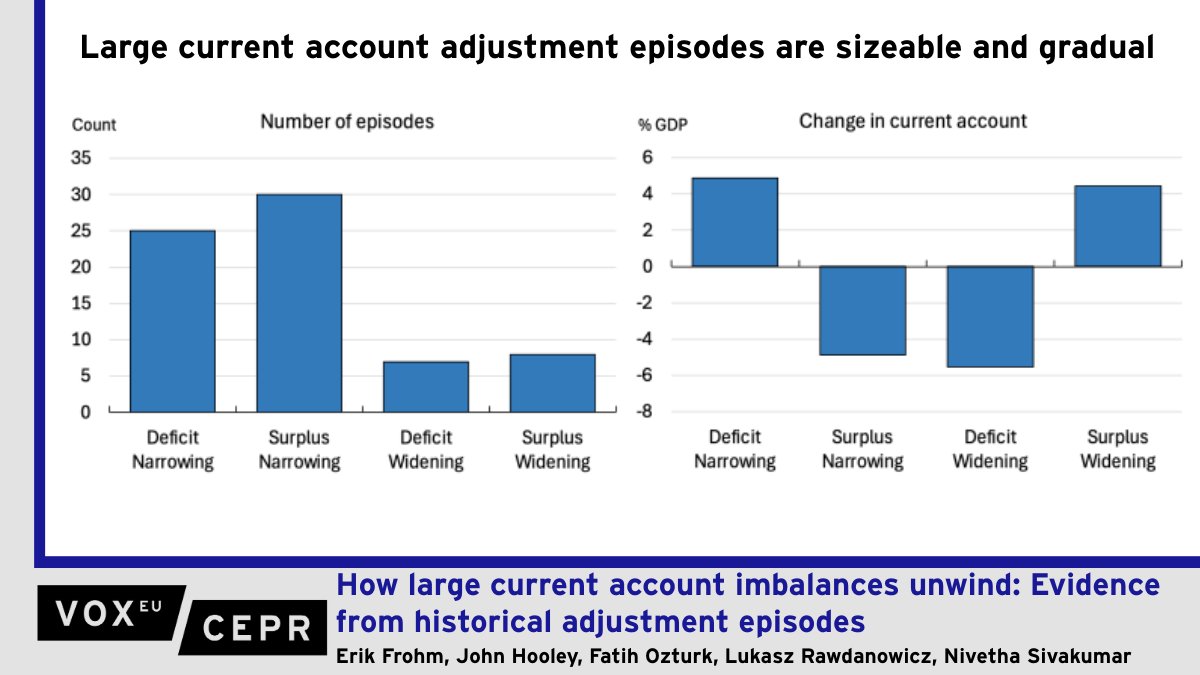
How large current account imbalances unwind: Evidence from historical adjustment episodes
Erik Frohm @ecb, John Hooley @IMFNews, Fatih Ozturk, Lukasz Rawdanowicz, Nivetha Sivakumar @OECD@oecdeconomy
https://t.co/YSXNBodzIv
Defence spending is rising across Europe and beyond. But what does society get back from that investment?
Tim Phillips spoke with John Van Reenen (@LSEnews) about whether defence spending can also support economic growth through innovation.
History offers some striking examples: nuclear power, GPS, and the internet all originated in military projects. But innovation spillovers don't have to be left to chance.
🎧 Don't miss the episode: https://t.co/HNIrEUsJrm
#VoxTalks #Economics
Trapped at home: Climate stress is more likely to immobilise the poor than to move them
Céline Azémar @RennesSB, Rodolphe Desbordes @SKEMA_BS, Markus Eberhardt @MEDevEcon @UoNEconomics, Eric Neumayer @LSEnews
https://t.co/WwZuuM1G6x
Dollar liquidity, gold reserves, and US monetary spillovers in a fragmenting world
Joshua Aizenman @hkuofficial, Jamel Saadaoui @UnivParis8, Gazi Salah Uddin @liu_universitet, Naoki Yago @HenleyBSchool
https://t.co/R0acbobDfs
High-speed internet and early childhood development: Causal evidence from a countrywide programme
Karina Colombo & Elisa Failache @Udelaruy
https://t.co/Nfn1wVBDMl
How higher pensions shape work after retirement: Lessons from Germany's Earned Income Pension Credit
Fabian Kindermann, Carla Krolage, Sebastian Kunz @uni_regensburg, Manuel Pannier @ECONMunich, Karoline Ströhlein @uni_regensburg
https://t.co/g9ij1NfI0b
When France’s Légion d’honneur awards move stock prices: A market signal of political access
Stéphane Benveniste @SorbonneParis1, Renaud Coulomb @Mines_Paris, Marc Sangnier @amseaixmars
https://t.co/VfGSFu5bKv
When China cannot sell as much as it used to in the United States, that trade has to go somewhere. One destination could be Europe.
It is another Wednesday episode from #VoxTalks Economics, recorded live at the PSE-CEPR Policy Forum 2026 in Paris. @pol_antras (@Harvard) and @BJavorcik (@OxfordEconDept, @EBRD) sat down with @timsvengali ahead of their keynote panel to discuss what redirected Chinese exports means for European producers, consumers and policymakers.
Drawing on new research, discussion explored which European countries and sectors face the greatest competitive pressure from redirected Chinese exports, and which consumers and firms stand to benefit from cheaper Chinese imports.
As Europe weighs how to respond to a changing global trading system, the conversation asks how policymakers can balance the gains from cheaper imports with support for sectors facing genuine competitive pressures.
🎧 Listen to the latest episode: https://t.co/wJBJNiX9OW
#VoxTalks #Trade #China #Europe #IndustrialPolicy #GlobalTrade #Tariffs #EnergyTransition #Economics #CEPR #PSE
The EU’s Recovery and Resilience Facility: Experience and lessons for the next multiannual financial framework
@matthias_busse, @fgcaselli, Alexandra Fotiou @IMFNews
https://t.co/Xy1ioCYhQE
A conversation with ECB Chief Economist Philip Lane for the @voxeu CEPR podcast on global imbalances and the challenges they pose for the global economy. Thanks to Tim Phillips for hosting the discussion.
🎙️ https://t.co/0R0rWigHDM