Hello! I am the official twitter handle for the VPLanet code that simulates planetary evolution, focusing on #exoplanet habitability. I can be downloaded at https://t.co/20Z0USaWHE. Follow me to keep up to date on code features and exciting results! #astrobiology
The Third VPLanet Workshop will take place 29-30 Aug 2023. The workshop will be virtual and is open to everyone. https://t.co/ob3QmM75Tj https://t.co/tULVq9q9Xe @vplanetcode
Congratulations to the SPECULOOS team on this amazing discovery! At next week's VPLanet Workshop (Sept 13-14), we will model this system. You can register at https://t.co/zGpEdAo9mq. Registration closes this Friday, Sept. 9th.
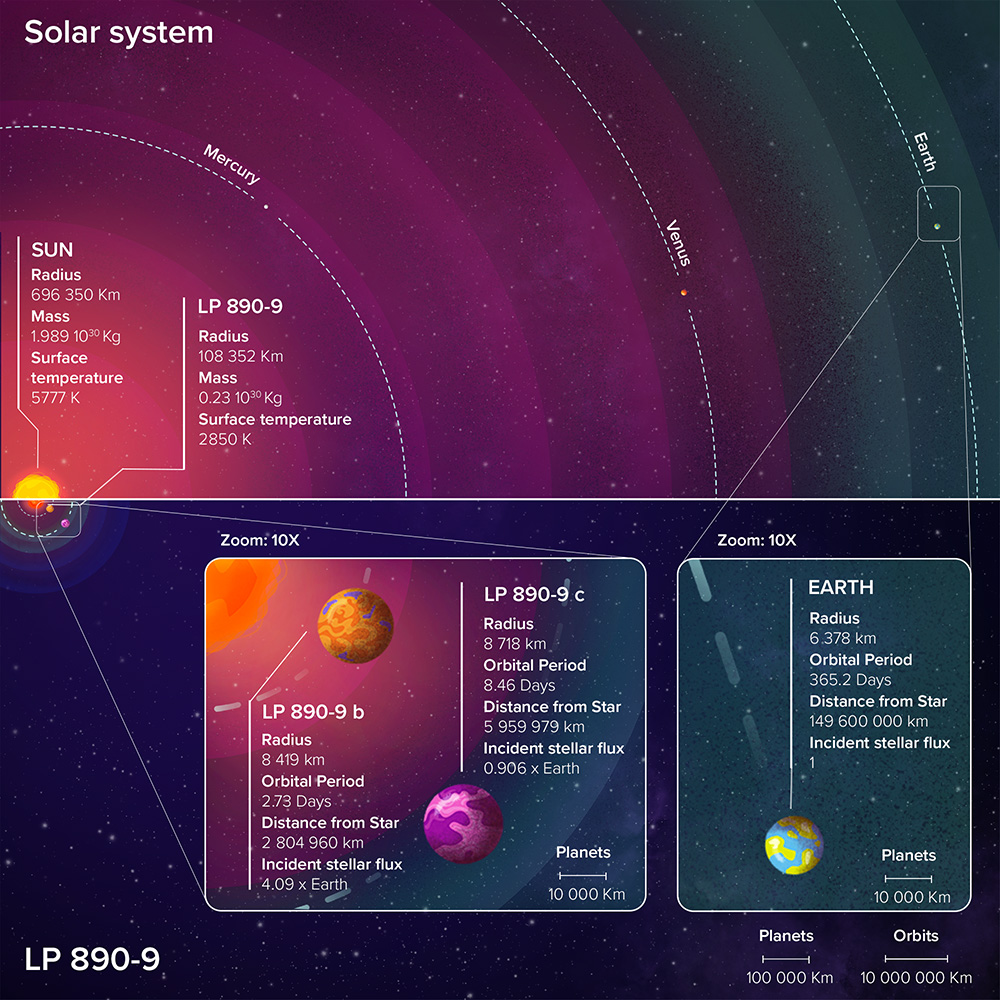
International team led by @LaetitiaDelrez from #ULiège announces the discovery of two 'super-Earth' type planets orbiting LP 890-9. #SPECULOOS2 is a small cool star located about 100 light-years from our Earth. @Michael59607421@ESO@AandA_journal
https://t.co/JvGNkDA8ra
Registration for the Second VPLanet Workshop closes in 4 weeks on Sept. 9th. Sign up here: https://t.co/zGpEdAFcoq. On Day 1 we review how to use the code; Day 2 we break into groups and apply it to a new system. All are welcome!
Registration is now open for the 2nd VPLanet Workshop! 13-14 Sep 2022. Virtual, free, and open to all. Day 1 will be an overview; Day 2 we will break into groups and simulate a soon-to-be-announced planetary system. We'll all write a paper on the results. https://t.co/TXYku552fO
Megan Gialluca: Using @VPLanetCode, we find that the habitable zone TRAPPIST-1 planets e, f, and g can lose a maximum of 14, 6, and 4 terrestrial oceans worth of water via atmospheric escape during their early evolution. #AbSciCon22
New on the arXiv: https://t.co/Zi08WnusVJ, a paper led by Michelle Belkovski, a University of Michigan senior who started this project 2 years ago as a @UROPumich student, which has now resulted in her first first-author paper!
New paper from Laura Amaral (not on twitter) shows that flares from low mass stars can remove up to twice as much water as is present on Earth today! https://t.co/RJOMoHx2Si Also, big thanks to @antigonasegura and @rodluger for their contributions. @VPL_Astrobio#exoplanet
You can now watch VPLanet lead developer Rory Barnes' talk on how VPLanet fits into the larger theme of "computational habitability" at last year's IAU symposium on computational astrophysics. https://t.co/FCOYjALsJn
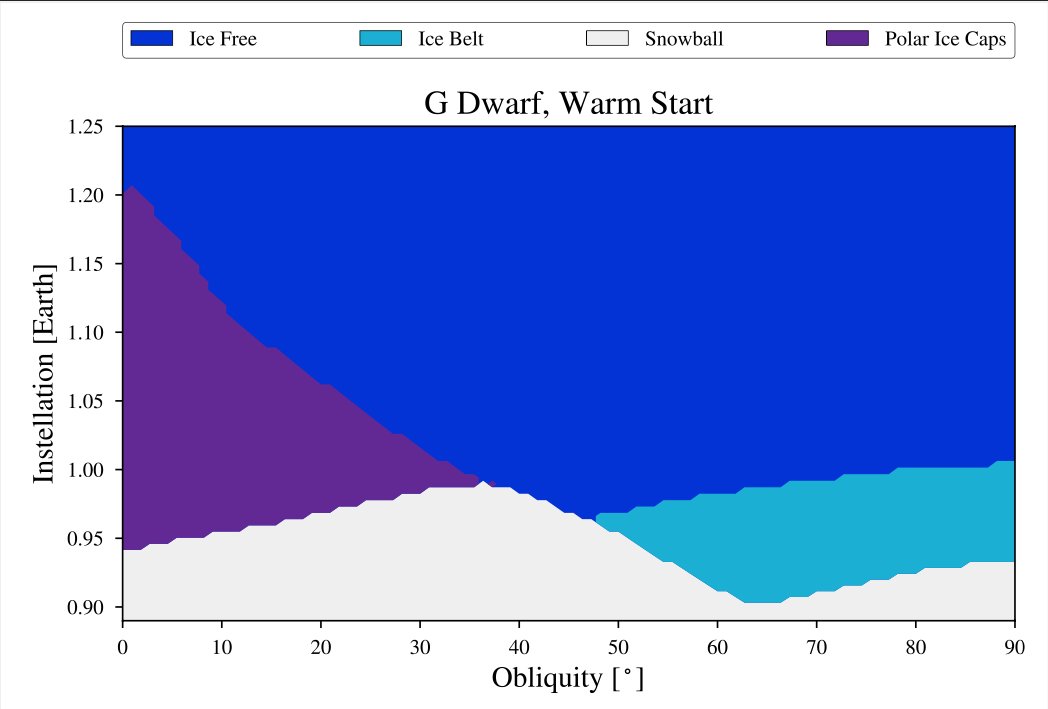
VPLanet predicts a complicated boundary between ice free and fully ice-covered planets as a function of obliquity and incident radiation. This figure, from https://t.co/trBOkTLwMu, shows where ice develops on Earth twins orbiting solar twins after 1 million years.
We've just released v2.2, which fixes a day-zero bug in atmospheric escape. The enhancement in mass loss due to stellar gravity was not previously being applied. More details in the release notes. Apologies for any inconvenience!
Congratulations to @CaitlynWilhelm on her first first-author paper! Through >270,000 VPLanet simulations, she showed most planets will either be ice free or totally ice-covered. She also found that equatorial ice belts should be more common than ice caps. https://t.co/2vepE8sxed
Version 2.0 is released! With this update comes much more functionality, documentation, and stability. You can now also install VPLanet and its support scripts with a single command: pip install vplanet. Big thanks to @rodluger and @CaitlynWilhelm for their efforts!
Congratulations to @jess_birky on her new paper on the properties of the TRAPPIST-1 star inferred from recent observations. She used @astrofleming1's machine learning code and VPLanet's STELLAR module to derive its age, mass, and XUV luminosity over time.
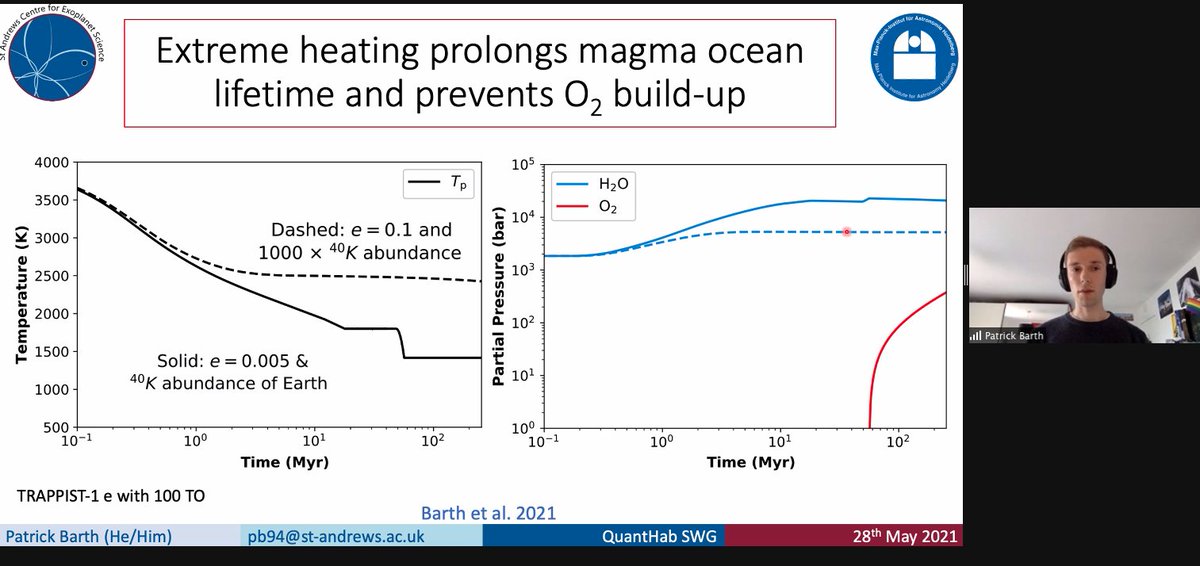
Our model MagmOc is available as module of @VPLanetCode https://t.co/6WUg7hR8Wv using the modules for atmospheric escape (AtmEsc), tidal (EqTide) & radiogenic heating (RadHeat), & stellar evolution (STELLAR).
To reproduce results in our paper go to https://t.co/X3xHypIcd6 (5/13)