Jako chemického technologa mě dost fascinuje, že ruské rafinerie na ty ukrajinské údery vůbec nejsou připraveny. Z toho, jak tam šlehají ty obrovské plameny (teď v Omsku, ale i v Moskvě a jiných zasažených mordorských rafinériích), je zřejmé, že v době dopadu dronů byla technologie v normálním provozu, kolony a trubky byly plné uhlovodíků, v zařízeních byl tlak. Dopad dronu pak způsobí explozi uhlovodíků, rozsáhlý požár a destrukci technologie, která se bude opravovat měsíce nebo i roky.
Přitom by stačilo před dopadem dronů havarijně odstavit technologii.
Standardní odstavení rafinerie trvá dny až týdny, ale nouzově se dá rafinerie odstavit během několika hodin. Musí se uzavřít klíčové ventily, aby se části technologie oddělily, musí se odstavit čerpadla nastřikující uhlovodíky do kolon a dalších aparátů a systém se musí odtlakovat na fléru (polní hořák).
Rafinerie na toto mají vypracované postupy pro případ různých havárií.
Havarijní odstavení může technologii částečně poškodit, ale pokud dron zasáhne takto připravenou technologii, tak způsobí řádově menší škody, než když zasáhne technologii ve standardním provozu.
Našel jsem, že ukrajinské drony Fire Point FP-1 letí rychlostí asi 200 km/h. Takže pokud letěly do Omsku 2500 km od hranice s Ukrajinou, tak nad Ruskem musely strávit přes 12 hodin.
Rusácká protivzdušná obrana je příšerná a nedokáže ubránit ani Moskvu, ale předpokládal bych, že armáda ty drony aspoň detekuje, z trajektorie odhadne jejich cíl a dá rafineriím vědět, aby se připravily.
To, že Rusko, země postavená na ropě, neumí ani ochránit svoje rafinerie, je důkaz toho, že ta země je úplně v prdeli, řídí to tam naprosto neschopní kreténi a celé se to tam brzo zhroutí.
⚡️ Dekarbonizaci jsme mohli postavit na levném plynu, který nemáme, takže nám zbylo jádro. To ale děláme takovým způsobem, že ve finále nebude ani na důchody, říká @M_Zamecnik.
Myslím, že přichází logický a pro menšinové akcionáře nejpřijatelnější a nejprůhlednější krok ze všech komplikovanějších ohledně případného zestátnění (včetně vytěsnění) #ČEZ. Jak to tedy může proběhnout?
Scénář, který jsem navrhnul už před více než 5 lety a o té doby opakovaně. Ano, poslední dobou jsem váhal, zda ho nepřetlačí rozdělení ČEZ rovnoměrným způsobem dle Zákona o přeměnách.
1) ČEZ založí dceřinou společnost a vkladem aktivit ČEZ Prodej, ČEZ Distribuce, GasNet, ESCO či trading.
2) ČEZ se pokusí na trhu nebo přímým oslovením zájemců prodat třeba až 49 % podíl v tomto většinově regulovaném byznysu.
Nepochybuji, že při EBITDA 50+ mld. Kč může být oceněno na EV 500 až 700 mld. Kč. O hodnotě 49 % této entity rozhodne, jaký dluh bude do této entity převeden.
3) ČEZ získá z prodeje prostředky do bilance ČEZ. Ani na vteřinu nebude finanční hodnota ČEZ2 - regulované části mimo bilanci ČEZ. Tím se ukáže hodnota celého ČEZ. ČEZ2 regulovanou část povede Pavel Cyrani dnešní místopředseda představenstva ČEZ - pravá ruka CEO ČEZ Daniela Beneše.
4) Získané peníze poslouží pro odkup vlastních akcií ČEZ, tak, aby se stát dostal nad 90 % podíl v ČEZ
5) 90+ % akcionář ČEZ tj. stát vytěsní zbylé akcionáře
= 100 % ČEZ bude vlastnit stát a ČEZ bude vlastnit 51 % v regulované části ČEZ2- regulovaná část.
https://t.co/7g6JbrVQDW
Jsou lidé, kterým prostě záleží na principech. Uznejte sami: „No, hele, já jsem ještě nedostal od (nezřetelné jméno) zbytek těch peněz za tu volbu. Víš co, jde o princip.“
„Jo,“ zazní odpověď. „Ty jsi jako ještě nedostal nic?“
„Ale jo, dostal. Ale není to prostě všecko.“
„A kolik teda ještě chybí?“
„No, ještě 500.“
„Jako ještě půl mega?“
„Jo.“
https://t.co/3dLZnYpO1L
A great typically British take on the state of our roads.
Very funny but sadly true. Where is all of the tax money going ? Not on repairing potholes that’s for sure. Please share
Sedím tu s managery z Kodaku a bavíme se o digitální fotografii.
Shoda je docela jasná: zatím na základě zkušeností posledních dvou let není production-ready. Spousta hype, ale realita profesionální fotografie je úplně jinde. Takže ne — analogová fotografie fakt nekončí.
𝗛𝗼𝘄 𝗢𝗽𝗲𝗻𝗔𝗜 𝗘𝗻𝗴𝗶𝗻𝗲𝗲𝗿𝗶𝗻𝗴 𝗔𝗰𝘁𝘂𝗮𝗹𝗹𝘆 𝗪𝗼𝗿𝗸𝘀 𝗜𝗻𝘁𝗲𝗿𝗻𝗮𝗹𝗹𝘆
Calvin French-Owen wrote an interesting post about how OpenAI works internally. He joined in May 2024 and helped launch Codex.
Here's what stood out:
𝟭. 𝗖𝘂𝗹𝘁𝘂𝗿𝗲
Everything runs on Slack. French-Owen received about 10 emails during his entire time there. When he asked about the quarterly roadmap, the answer was simple. "This doesn't exist."
OpenAI operates radically bottom-up. Researchers function on their own, by picking problems and running with them.
Good ideas come from anywhere. Getting research done often means hooking a curious nerd on your problem. If something seems boring or "solved," nobody works on it.
Teams form around ideas, not org charts. Need two experienced engineers for a launch? Ask an EM, and they show up the next day. No waiting for quarterly planning.
The company runs on Twitter vibes. Tweet something about OpenAI that goes viral, and someone internally will read it.
𝟮. 𝗘𝗻𝗴𝗶𝗻𝗲𝗲𝗿𝗶𝗻𝗴
They have a single giant Python monorepo with no enforced style guides. You’ll see scale-tested libraries from longtime Google engineers right next to disposable Jupyter notebooks from fresh PhDs.
Code wins arguments. No central architecture committee. Decisions get made by whoever does the work.
There is a strong bias for action; duplicate libraries are everywhere. French-Owen saw half a dozen different queue management implementations.
They use Azure only, and it's limited. Only three services French-Owen trusted: AKS, CosmosDB, and BlobStore. No true equivalents of Dynamo, Spanner, or BigQuery.
Also, there is a strong bias to build things in-house.
𝟯. 𝗦𝗵𝗶𝗽𝗽𝗶𝗻𝗴 𝗖𝗼𝗱𝗲𝘅
Seven weeks from first commit to public launch, a team of 8 engineers, 4 researchers, 2 designers, 2 GTM, and 1 PM pulled it off.
They built a container runtime. They fine-tuned a custom model. They handled GitOps, enabled internet access, and shipped a product people wanted to use.
Most nights ended at 11 pm or midnight. Back in the office at 7 am. The night before launch, five people stayed until 4 a.m., deploying the main monolith.
They generated 630,000 PRs in 53 days, which is roughly 78,000 public PRs per engineer since launch.
This is a wild race that shows how a startup with a high sense of urgency works today.
Full text in comments.
Bitcoin is in its final stages.
Hundreds of billions have been invested into something with literally zero utility or intrinsic value.
It was created by gamblers, pedophiles, and criminals, then sold to the masses through fabricated narratives like “inflation hedge,” “store of value,” and “digital gold” to inflate prices for insiders.
This will be the largest destruction of wealth in history. It is a giant game of musical chairs, and the music has stopped.
One of the big problems with Cucumber, over the years, was the fact that the programmers wrote the fixtures, and so there was a perverse incentive for the programmers to tune the GWT syntax in a way that made the fixtures easier to write. This led to lots of nasty implementation complexity leaking into the GWT statements.
CLAUDE feels the same perverse incentive. It tries to fill the GWT statements with implementation details. However, this is easy to countermand. When I see implementation details leaking into the GWT statements, I fire up an agent to remove them and return the statements to natural language that describes only external observables.
You've got to stay on top of these lazy junior developers. They'll make a horrible mess if you take the leash off them.
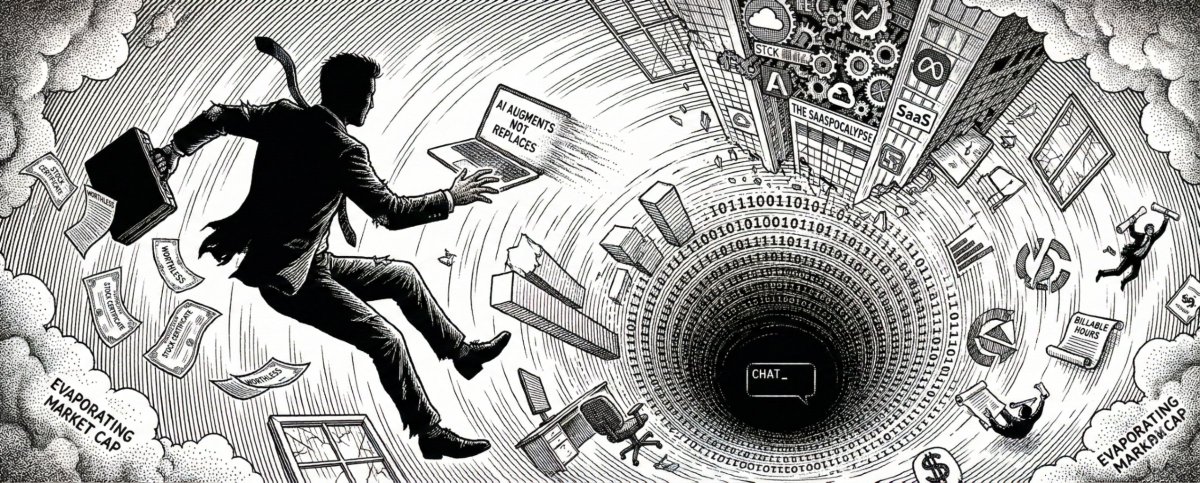
Regarding the SaaSpocalypse.
I am the Chief Strategy Officer of a major enterprise software company.
We've lost 47% of our market cap in four months.
Our stock dropped 6% on Monday.
My bonus is gone.
My options are underwater.
My second vacation home is in jeopardy.
The third one is fine.
For now.
I need to explain what happened.
We didn't do anything wrong.
Anthropic did.
They released plugins.
For Claude.
Eleven of them.
Open source.
Legal automation. Contract review. Compliance workflows. NDA triage.
Work that used to cost $400 per hour.
Now costs $20 per month.
We had a phrase for this.
"AI augments, not replaces."
That was the pitch.
The pitch to investors.
The pitch to customers.
The pitch to employees.
The pitch to law school graduates with $200,000 in debt.
The pitch to the senators we lobby.
"AI augments, not replaces."
It was a beautiful phrase.
Calming.
Reassuring.
Focus-grouped extensively.
Completely false.
We knew.
We all knew.
Every enterprise software CEO on the planet knew.
We discussed it at Davos.
Over $47 cocktails.
While wearing badges that said "Human-Centered AI."
The technology was coming.
The replacement was inevitable.
The timeline was unclear.
Our exit liquidity was not.
We just didn't expect Anthropic to be so... helpful.
On January 30th, they released the plugins.
By February 2nd, Thomson Reuters was down 18%.
In a single day.
LegalZoom dropped 20%.
Our Head of Investor Relations had a panic attack.
On a Zoom call.
With investors.
They saw.
We call it the "SaaSpocalypse."
That's a joke.
It's not funny.
My net worth dropped by $14 million.
That's two Teslas per hour for a week.
Jensen Huang said our reaction was "purely illogical."
Easy for him to say.
He sells the shovels.
We sold the promises.
He's up 340% since 2023.
We're down 47% since September.
But sure.
Illogical.
The promises that AI would make your existing software better.
Not obsolete.
The promises that you still needed expensive platforms.
Expensive integrations.
Expensive support contracts.
Expensive consultants.
Expensive lawyers.
The lawyers.
The lawyers are the real story.
Big Law runs on billable hours.
$800 an hour.
$1,200 an hour.
$2,000 an hour.
For contract review.
For NDA triage.
For compliance workflows.
For "adding value."
Work that requires a JD.
Three years of law school.
Bar passage.
Six years of experience.
A corner office.
A parking spot.
A subscription to the Yale Law Journal.
Claude does it now.
For $20 a month.
Claude doesn't need a parking spot.
Claude doesn't expense client dinners.
Claude doesn't bill 2,400 hours to make partner.
Claude doesn't have a Yale Law Journal subscription.
Claude doesn't have student loans.
Claude doesn't cry in the bathroom at 2 AM.
Claude just... works.
The American Bar Association had a conference last week.
They predicted "the demise of the billable hour model."
At a conference about billing.
They served $18 sandwiches.
The irony was lost on no one.
The sandwiches were mediocre.
Morgan Stanley called it "intensifying competition."
That's Wall Street speak for "your business model is dying."
Adam Parker at Trivariate Research said software stocks are "guilty until proven innocent."
He said we're "a falling knife."
He's right.
We are a falling knife.
And we sold you the handle.
For years.
With a service contract.
And an annual maintenance fee.
We said: "AI is a tool."
We meant: "AI is our tool."
We said: "AI augments humans."
We meant: "AI augments our revenue."
We said: "AI won't replace your job."
We meant: "AI won't replace your job until it does."
We said: "The human touch is irreplaceable."
We meant: "The human touch is expensive and we're working on it."
We said: "AI needs human oversight."
We meant: "For legal liability purposes only."
We said: "We're committed to responsible AI."
We meant: "We're committed to responsible AI until it's unprofitable."
It's unprofitable now.
It does now.
The associate lawyers are first.
The ones who thought they were safe.
The ones who thought "AI can't practice law."
AI can't practice law.
AI can do 80% of what associates bill for.
The other 20% is "relationship management."
That means: lunch.
Then the contract reviewers.
Then the compliance analysts.
Then the consultants.
Then the financial analysts.
Then the people who make PowerPoints about synergy.
Actually, we're keeping those.
Someone has to explain the layoffs.
Mike O'Rourke said it best: "If the legal industry can be disrupted, so can consulting and financial services."
He's not wrong.
He's terrifyingly correct.
He probably shouldn't have said that out loud.
His LinkedIn is now "Open to Work."
Every knowledge worker who bills by the hour is now in a race.
A race against a Claude plugin.
An open-source Claude plugin.
We didn't see that coming.
We expected proprietary.
We expected expensive.
We expected enterprise sales cycles.
Eighteen-month implementations.
Mandatory consulting packages.
Executive briefings in Aspen.
Anthropic just... gave it away.
Eleven plugins.
Free.
"Customize workflows."
"Slash commands."
"Consistent outcomes."
For $20 a month.
No executive briefing.
No Aspen.
No $47 cocktails.
Just a chat interface.
And the death of our business model.
The board meeting was yesterday.
The CFO cried.
The General Counsel updated his resume.
On company time.
Using the company laptop.
Bold move.
The Chief Revenue Officer blamed the sales team.
The sales team blamed the product.
The product blamed the market.
The market blamed us.
The PR team blamed "macro headwinds."
The CEO blamed "exogenous factors."
The board blamed the CEO.
The CEO blamed his predecessor.
His predecessor is on three other boards.
He's fine.
The market is correct.
We knew.
We all knew.
Every pitch deck.
Every investor presentation.
Every "thought leadership" article.
Every podcast appearance.
Every TED talk about "the future of work."
"AI augments, not replaces."
We said it.
We didn't believe it.
We had a private Slack channel.
Called "#inevitable."
We discussed the timeline.
We discussed our options vesting schedule.
We discussed which executives should sell first.
"Staggered for optics."
And now the market doesn't believe us.
$250 billion.
Gone.
In a week.
Because a company in San Francisco released eleven plugins.
For free.
And did what we said was impossible.
Replaced expensive knowledge workers.
With a chat interface.
A chat interface that doesn't need dental.
We have a new phrase now.
"Pivot to AI-native."
That means: "We're rebuilding everything."
That means: "The last five years were wasted."
That means: "Your job is also in jeopardy."
That means: "Please don't look at our executives' stock sales from Q4."
But don't worry.
We're "leaning into the disruption."
We're "embracing the paradigm shift."
We're "right-sizing for the new reality."
Right-sizing means layoffs.
Paradigm shift means our product is obsolete.
Leaning in means we have no plan.
AI augments, not replaces.
We would never lie to you.
Again.
Anyway, buy the dip!
Our investor relations team says it's a "compelling entry point."
They're also updating their resumes.
Why so many global CEOs are Indian is the wrong question. The real question is what kind of system produces them.
This isn’t about Indians being genetically smarter or IITs magically creating genius. It’s only about selection pressure. India is not a talent factory. India is a high-pressure talent filter.
Most Indians are born into middle class or lower middle class families. There is no safety net, no fallback plan, no cushion. From the day you’re born there is an unspoken contract. Do well or the whole family stays stuck.
Education isn’t optional. It’s survival, now add population. Five to ten lakh people fighting for a few thousand seats. Even after years of preparation, effort doesn’t guarantee success. You still have to win against insane odds.
What comes out of this system is not creativity. It’s endurance. People who can sit for long hours, delay gratification for a decade, operate under pressure without breaking, and don’t feel entitled to comfort.
That profile matters - Large global companies don’t reward raw brilliance at the top. They reward people who can survive complexity, politics, scale, and boredom for 20 to 30 years straight.
That’s why Indian origin leaders show up disproportionately in operator roles. CEOs, presidents, heads of massive systems, not founders.
They didn’t rise because they were the loudest or flashiest. They rose because they had already been trained by a brutal system that rewards consistency over brilliance.
Compare that to a child born in a developed country. There is pressure, yes. But there is also a safety net. More options. Less existential fear. That environment is great for creativity and risk taking. It produces founders and innovators.
India produces survivors who become operators. That’s the difference most people miss. And let’s be clear, this system is not something to romanticize.
For every one person who makes it, millions burn out. Talent gets wasted. Mental health gets crushed. The system is inefficient and cruel. But it does one thing extremely well. It filters for people who can endure.
That’s why Indians don’t dominate early stage innovation globally, but they dominate long-run leadership in established systems.
So no, Indians aren’t exceptional because of IQ. They’re exceptional because they were never allowed to be comfortable.
The uncomfortable question is not why this works. The real question is whether this is the only way we should be producing leaders. And whether the cost is worth it.