Great piece by @vtg2, a comprehensive deep dive into the remarkable narrowing of wage inequality in the last few years--linking data, stories and putting it in the context of the difficult choices that monetary policymakers face. https://t.co/HBtcR3PmqO
Lots of really bad takes about SVB. Let’s try and correct
This is not a solvency crisis like 2008. Bad loans or poor investments were not made. Money was not lost. So, everyone is going to get their money back. (And please no takes about no interest rate hedging. Asset/liability mismatches are how banking works.)
Instead this is an old fashion 1930s liquidity crisis. Too many depositors demanded cash at once (as in right now) and SVB (and SI) could not convert loans and securities (and crypto) to cash that quickly. So, everyone is getting their money back from SVB (and SI), just not at 8AM Monday. And, yes this is a big problem as this is working capital for a lot of companies. They have payrolls to meet and vendors to pay next week. And if they don’t pay bills and employees, they in turn don’t pay their bills and this can quickly cascade into a major economic problem.
The important question is why so many demanded their money back at once. And I’m not referring to the last two days. I’m asking about the days/weeks leading up to this last two days forcing SVB to sell securities and realize a $1.8B loss, necessitating a capital raise. Why were depositors withdrawing in big enough amounts before Thursday/Friday?
First, welcome to the world of mobile banking. Gone are the frictions of standing in line with tellers instructed to count money slowly. (Media images of lines Friday were largely gawkers)
How did $42 billion get withdrawn Friday alone without thousands in line? Answer, your phone! This is not the Bailey Savings and Loan anymore.
This should scare the hell of bankers and regulators worldwide. The entire $17 trillion deposit base is now on a hair trigger expecting instant liquidity.
Add in social media and millions get a message, like Peter Thiel telling Founders companies to pull out, or Senator Warren gloating that SI went under, and pick up their phone open a Chase account and Venmo-ed their life savings into it in 10 minutes. Instant liquidity (not solvency) crisis with everyone still in bed.
Banking will never be the same.
The second, and I did a long thread on this on Friday … banks are over-reserved, after 14 years of QE, and are still paying 0.50% on accounts when T-bills are yielding 5.00%. They don’t need to compete for deposits.
Initially as rates passed 2%, 3% and 4%, the public did not notice. So bankers thought deposits were well anchored at their bank and not moving regardless of the interest rate paid.
But at 5% the public finally noticed, and millions reached for the phone at once and transferred to a money market account or Treasury direct to buy T-bills. Banks were squeezed to convert loans and securities to cash instantly so depositors could leave for better rates.
Add in the bleed out from tech firms struggling, and Senator Warrens tweeting with glee about SI going out of business, and depositors at SVB got the message and picked up their phones and acted.
This is why I have been tweeting that this has to stop now. The Fed is meeting Monday at 11:30. Too late! They need to meet today (Sunday) at 11:30.
What needs to be done? Two things.
The FDIC needs to raise the deposit insurance ceiling to unlimited as they did this in 2008. Besides $250k is a made up number anyway. So make up a bigger number.
Banks need to get their deposit base to stop figuring out how to buy a 4.5% money market fund. They need to raise the interest rates they pay 3.00% - 3.50%, from 0.50%, immediately. Yes, this will kill bank profitability so expect Bank Execs to balk at doing this.
This way the public gets the message that you money is safe, no matter the bank, or the amount, and the rate paid on your money is at least competitive with other alternatives. So, do nothing.
Otherwise, if we are all waiting for the Fed to START a meeting at 11:30 Monday, hundreds of billions of deposits will have moved by phone and it will be far worse.
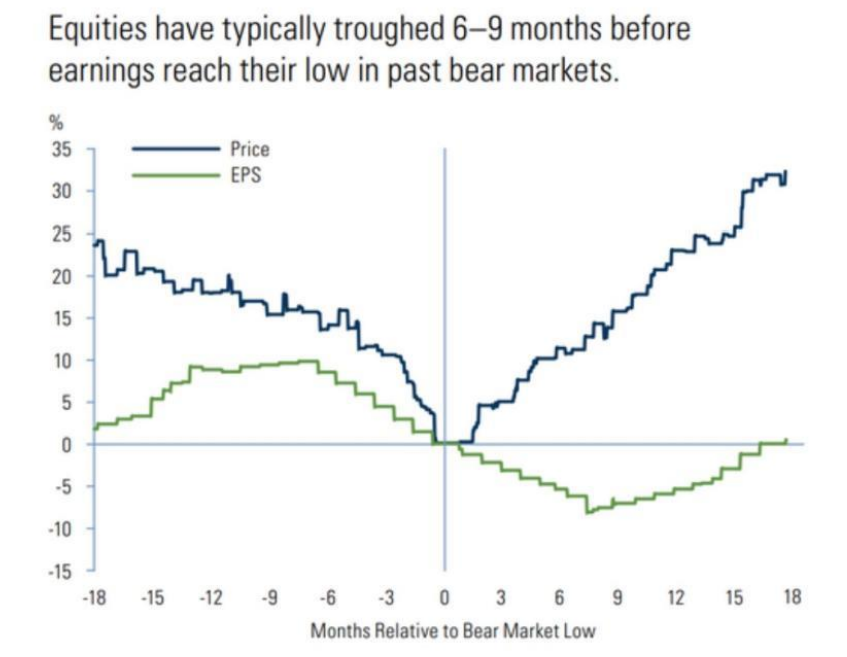
Excellent chart showing how earnings and valuations don't bottom together!
Historically, stock prices bottom 6-9 months before EPS reach their low as multiples start to rise reflecting Fed cuts and accommodative policy ahead.
I looked through the 2023 macro outlooks from the largest financial institutions including Goldman Sachs, JP Morgan, and BlackRock.
(Links to all reports at the end)
Here’s what they’re expecting next year:
c) The job market remains strong. Employees who got fired immediately found a new job. d) Declines in the Unemployment lvl may reflect movements of unemployed individuals out of the labor force because they stopped looking to find a job.
Just a random thought on the economy before bed. The big question nowadays is that whether we gonna get a soft landing or a hard landing. Let’s actually break this down into components to answer this question. (A thread) #stock#macroeconomic#FederalReserve
Why is such phenomenon happens? Some assumptions are a) unemployment lvl is a lagging indicator, so it takes time for higher rate to leave a mark on the job mkt b) Employees hoarding, bc the job mkt is so tight, it’s hard to find a skillful employee, so let’s just keep them.
Excellent speech by Jay Powell today, very clear and well laid out.
If you're interested in the macroeconomy (even if not an obsessive Fed watcher) I would recommend as a primer.
I also agree with almost every word (and number) of it.
Some key points:
https://t.co/0ImTFS8jN9
The telephone, the internet, and crypto share one thing in common. Each technology improves on the next in terms of its ability to facilitate fraud. As such, I was initially a crypto skeptic, but after studying some of the more interesting crypto projects, I have come to
/1.Big day in EU economic policy: the @eu_commission just published its proposal for a reform of the EU fiscal rules. Here is what it says and what it means (see: https://t.co/3VMMHj5DAB)