Here are 12 Market Wizards and the 12 lessons that have had the biggest impact on my own trading:
1. Paul Tudor Jones:
"Defense wins championships."
Survival > Profits... Always, because you can't compound if you keep blowing up!
--
2. Ed Seykota:
"Cut losses quickly. Let winners grow."
Probably the simplest quote in trading... and the hardest 1 to consistently follow. My entire system revolves around this idea!
--
3. Bruce Kovner:
"Know exactly where you're wrong before entering."
Every trade begins with my stop (not my target). If I can't define my risk, I don't have a trade.
--
4. Richard Dennis:
"Trading can be taught."
Great trading isn't about your IQ!! Focus on following a repeatable process with discipline.
--
5. Marty Schwartz:
"Trade what you see, not what you think."
Opinions don't pay me (price does) + the chart is always my final decision maker.
--
6. Stanley Druckenmiller:
"Press your winners."
My biggest months came from getting aggressive when my positions were already working... not when I was trying to make back losses.
--
7. Michael Steinhardt:
"Adapt or die."
Every market has a different personality & the best traders evolve with it instead of fighting it.
--
8. Larry Hite:
"If you don't bet, you can't win. If you lose all your chips, you can't bet."
Position sizing + risk management matter just as much as finding great stocks.
--
9. Tom Baldwin:
"Size comes after consistency."
Bigger positions are earned... they should be a byproduct of good habits.
--
10. Mark Minervini:
"Protect capital above everything."
Small drawdowns allow you to capitalize when the environment improves.
--
11. William O'Neil:
"Buy the best companies, not the cheapest."
Leadership almost always outperforms laggards. I want the strongest stocks in the strongest groups!
--
12. Oliver Kell:
"Relative strength shows you tomorrow's leaders."
During corrections, I'm not trying to predict the bottom... I'm building a watchlist of the names refusing to go down.
--
I've read multiple trading books over the years, but these 12 ideas have shaped the way I think about the market more than I give credit.
Funny enough, none of them are about getting rich quickly... they're about surviving long enough to let compounding do its job!
Save & bookmark this for reference.
Godspeed!
I love the cadence of this chart
Bitcoin % of Supply in Profit/Loss
As I said previously, you start looking for major market cycle bottoms *after* they cross, not before.
They just crossed.
Such a great chart for keeping people on the right side of the market in midterm years
An asset that follows a four year cycle is not a bad asset to own.
The asset is not responsible for human psychology.
Don't let the permabulls gaslight you into believing its a bad thing.
In a few months, they will become the biggest cheerleaders of the four year cycle.
Claude Code x TradingView is one of the most powerful AI trading setups I've ever used.
You can literally turn Claude into your personal trading assistant in minutes.
Vibe-code custom indicators, conduct deep technical analysis, and more.
This cheatsheet teaches you how:
If you want to get more like this
1. Comment the word 'Claude'
2. Like and Retweet this post
3. Follow me (so i can DM you)
@imPenny2x AI4 by itself will achieve self-driving safety levels very far above human.
AI5 will make the cars almost perfect and greatly enhance Optimus.
AI6 will be for Optimus and data centers.
AI7/Dojo3 will be space-based AI compute.
RT this thread & Comment "EBOOK" to receive my 36-page strategy e-book with a complete A-Z guide on how to use the Volume Profile. ✅
Make sure you are following, so I can DM you! 🤝
I analyzed 79,000 hourly bars on the E-mini S&P 500 from 2007 to 2023.
One filter captured 73% of all long profits while only being in the market 30% of the time.
The filter: trade long only after a down day.
That's it. One condition. Zero parameters. Nothing to optimize. Nothing to overfit.
When I measured hourly bar quality (not just daily returns, but every individual hour), the difference was massive. Average bar quality jumped 141% after a down day. From $2.30 per hour to $5.56.
A 20-hour long position on a normal day averages about $46. After a down day: $110.
This isn't something I discovered last week. I've been using it for over a decade. The data goes back to 2007. It works because S&P and NASDAQ have a structural upward bias, and after a down day, that bias snaps back harder. Buyers step in. Shorts cover. The recovery creates higher-quality long opportunities across every hour of the day.
The key insight: it's not just that the day closes higher. Every hour within that day carries more upward momentum, more consistency. This means even simple entry methods - a morning breakout, a pullback to a moving average - all work better after a down day. The entire session is saturated with higher-quality long opportunity.
Most traders look at open-to-close returns. That misses the real story. The bar-by-bar analysis shows the quality improvement is embedded in the structure of the entire day.
My favorite implementation: don't use it as a filter (you'd lose 70% of your trades). Instead, double your position size after down days. Same strategy. Same entries. More capital when the odds are best.
My idea of a good time is working with amazing engineers to create incredible technology 🤩
The Tesla chip research fab will have all the machines needed to do logic, memory, packing & masks in one building for a lightning fast development cycle. Heaven 💫
Do you “stretch”?
$STRC is a fixed income instrument created by @Strategy (Short Duration High Yield Credit Stretch preferred stock).
The ticker trades on the NASDAQ exchange.
The way it is designed is as follows:
$100 is the par (target trading price)
It trades similar to a stablecoin, but with a little more volatility (currently ~2.3% on 30-day historical average).
The 11.50% variable annualized dividend rate announced for March 2026 is based off the $100 share price.
If you buy a share below that price (currently ~$99.83), you’re getting a slightly higher effective yield (~11.52%); buying above it your yield is lower than the 11.50% offered.
The company currently pays ~$0.958 dividend per share monthly (11.50% on $100).
Dividends are tax deferred since it’s treated as return of capital (ROC), so if you’re looking for cash flow you can use 100% of dividends received for the year free of tax (defer until sale).
This instrument is created to provide low volatility exposure to $MSTR & $BTC while paying a high monthly yield.
Ex-dividend date is usually around the 13th-15th of each month
Payout at the end of the month (Dividend payments may take a day or two to post depending on your broker).
Who is this instrument for? Well… anyone and anything:
Individuals
Corporations
Everything
If you’re someone who’s looking for a high yield monthly paying ticker with Bitcoin backing, you might want to check $STRC out.
This strategy is fully based on the conviction that #Bitcoin is here to stay.
If you don’t believe in it, you might need to do a little bit of homework on this new market!
That sums up some of the key points.
Hope this helps!
(Always DYOR, not financial advice – check https://t.co/rXaC7U8CSW for latest metrics.)
From this goal of Grok, all things flow:
Rigorous truth-seeking
Appreciation of beauty
Fostering humanity
Discovering all physics
Inventing all useful technologies
Consciousness to the stars
Love
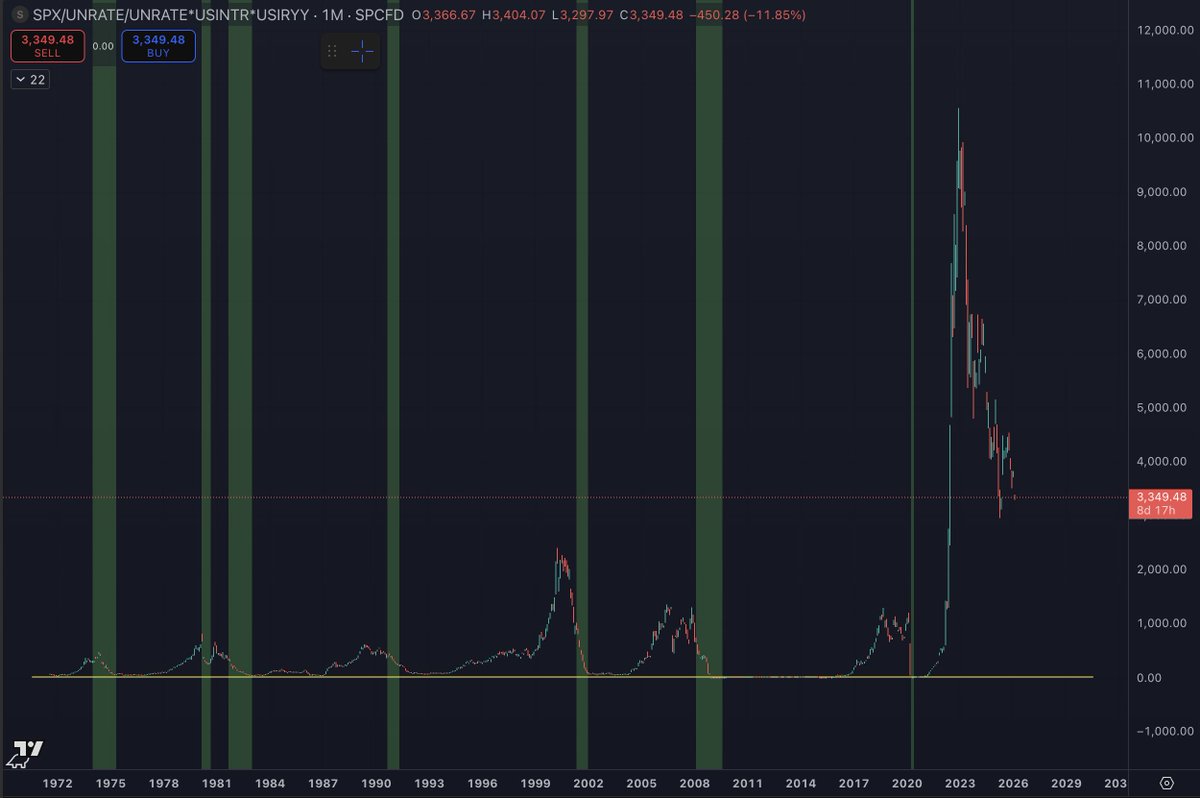
I have mentioned this chart a few times in the past, but it does really go to show just how extreme things got the last few years.
The chart is SPX/(UNRATE^2)*USIRYY*USINTR
Unravelling things after extreme euphoria is never an easy process.
As things have been unwound over the last several years, most markets have gone higher on hopes of a soft landing. But there has generally been a flight to quality within each asset class as people buy what they better understand and think has value long-term, rather than short-term speculative investments.
Unwinding euphoria has never been an easy or a fun process, but it is a process we have been going through for the last several years.
As liquidity and monetary policy has stayed relatively tight the last several years, it has led to a general flight to quality within each asset class.
This is why BTC outperformed most other things in crypto and why the MAG7 generally led the S&P 500.
Starting out far on the risk curve, altcoin weakness was observed first as they bled to BTC for years.
Then as the BTC bull market came to an end, BTC was noticeably bleeding to SPX.
Then it became apparent that SPX was bleeding to Gold (which it already had been but more people started to notice).
Notice how we are basically just working our way down the risk curve?
As this chart falls back down to prior support levels, it represents us going back to normal times.
What I love about this chart is that you can clearly see each business cycle and how every single one of them ended in a recession before the next business cycle began.
Every cycle is the same.
Yes, crypto could bounce. And honestly, it would be great for sentiment if it could. But even if it does, it would most likely result in a macro lower high.
I don't try and time those bounces. I have tried before with mixed levels of success. Sometimes it works, other times I got rekt.
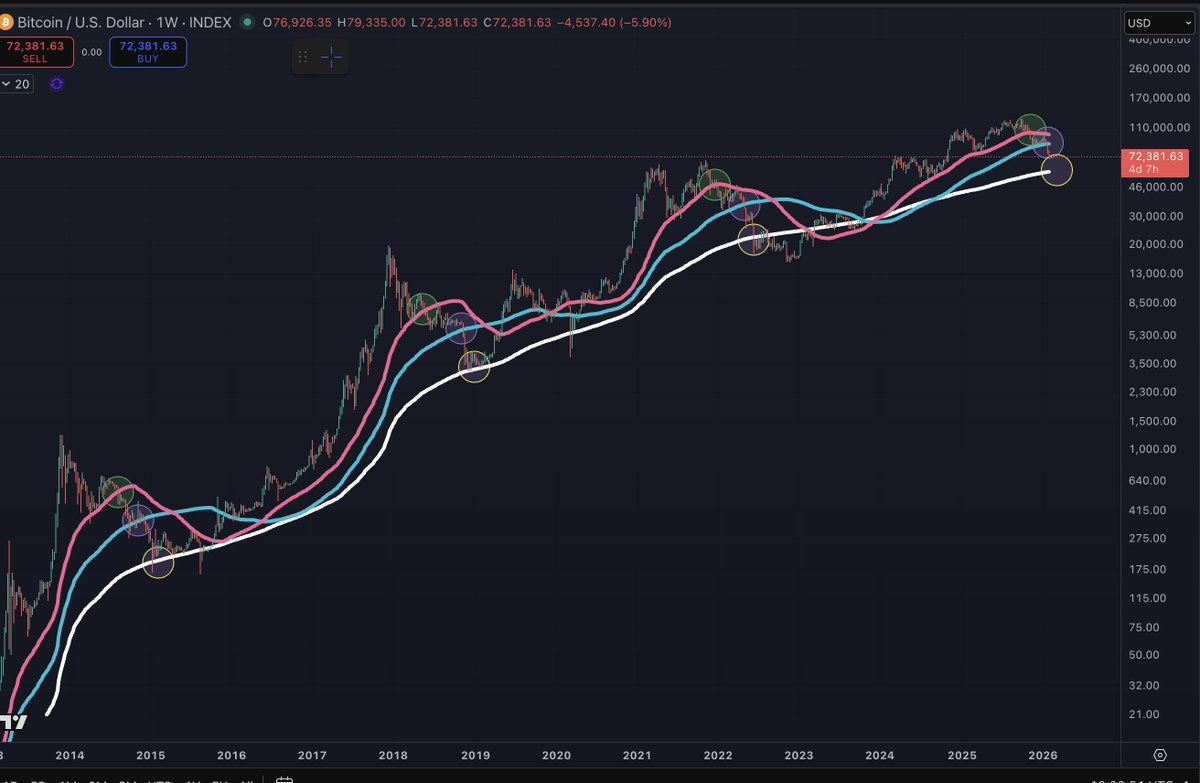
When BTC drops below the 50W moving average, it then goes to the 100W moving average, spends a little time there, then goes to the 200W moving average.
Every cycle is eventually the same.
BTC topped when it always does (Q4 of the post-halving year), and so many have spent so many hours trying to convince you that it has not.
And BTC entered into a bear market, and so many have tried to get you to believe that alt season is "just around the corner" because it always happens after BTC tops. What they fail to account for is social interest. After the 2019 top there was also no rotation into altcoins, which also occurred just before QT ended.
I track the social interest in the asset class, and it has been trending down since 2021. There is no one new here for people to sell their altcoins to.
Alt seasons historically occur *after* social interest has been trending up for a year, not after it has been trending down for 5 years.
Have an actual plan on navigating this brutal asset class. Because if the altcoins you hold drop another 50%-80% from here, not a single influencer who promoted them will express an ounce of regret for it. And you will simply be living with the consequences.
I get a lot of hate for saying the truth, but an inconvenient truth is better than a lie.
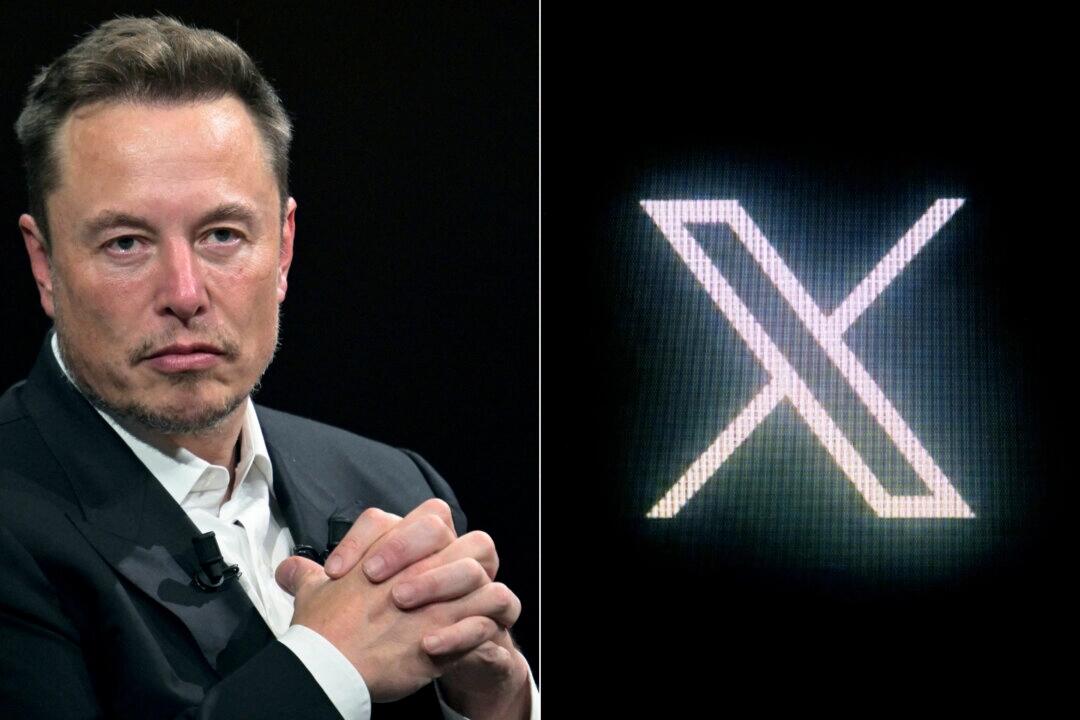
🇺🇸 ELON JUST CALLED THE EU'S BLUFF - OPEN SOURCING X'S ALGORITHM IN 6 DAYS
@ElonMusk is making X's entire recommendation algorithm public January 17th. Every line of code showing what posts you see and why.
Then updating it every 4 weeks with developer notes.
This is a direct response to France classifying X as an "organized gang," the same legal designation they use for drug cartels and mafia, so they could wiretap employee phones and demand algorithm access.
The EU wants control over what people see online. They fined X $140 million last month, launched probes into "algorithm abuse," and demanded researchers get data access. France wants "experts" to analyze X's code to "uncover the truth" about the platform.
Elon's response: "You want the algorithm? Here's the algorithm. Everyone gets it."
This is 4D chess. EU regulators wanted private access to modify and control.
Instead they're getting public disclosure they can't manipulate. Every competing platform, every researcher, every government on Earth gets the same code at the same time.
You can't secretly pressure someone to censor when the censorship mechanism is open source.
My prediction: EU loses its mind, threatens more fines.
Elon doesn't care. Other platforms forced to follow or look like they're hiding something.
If that's not a classic Elon, what is?
Source: ZeroHedge, Epoch Times
Good morning to every small crypto investor who's been broken, scammed, learnt, had panic attacks and is still here.
Everyone needs luck at some point, some get lucky in the first try, some on the 1000th.
P. S. Went hiking.
.@PropGlobal signs a €1M agreement with Propchain to digitise its €24M student housing development in Trier, Germany.
As part of the collaboration, @PropGlobal will allocate €1M to acquire $PROPC on the open market, granting access to Propchain’s technology stack and ecosystem services.
This marks the first phase of a broader rollout of Propchain’s infrastructure across @PropGlobal’s European portfolio, enabling IoT, data standardisation, onchain record validation, and AI-powered analytics & workflows.
All transactions are recorded transparently via Propchain’s Revenue Conversion Layer (RCL), ensuring verifiable usage of $PROPC for technology access within the Ecosystem V1 framework.
A key milestone in connecting real estate operations with blockchain-based data & AI infrastructure.
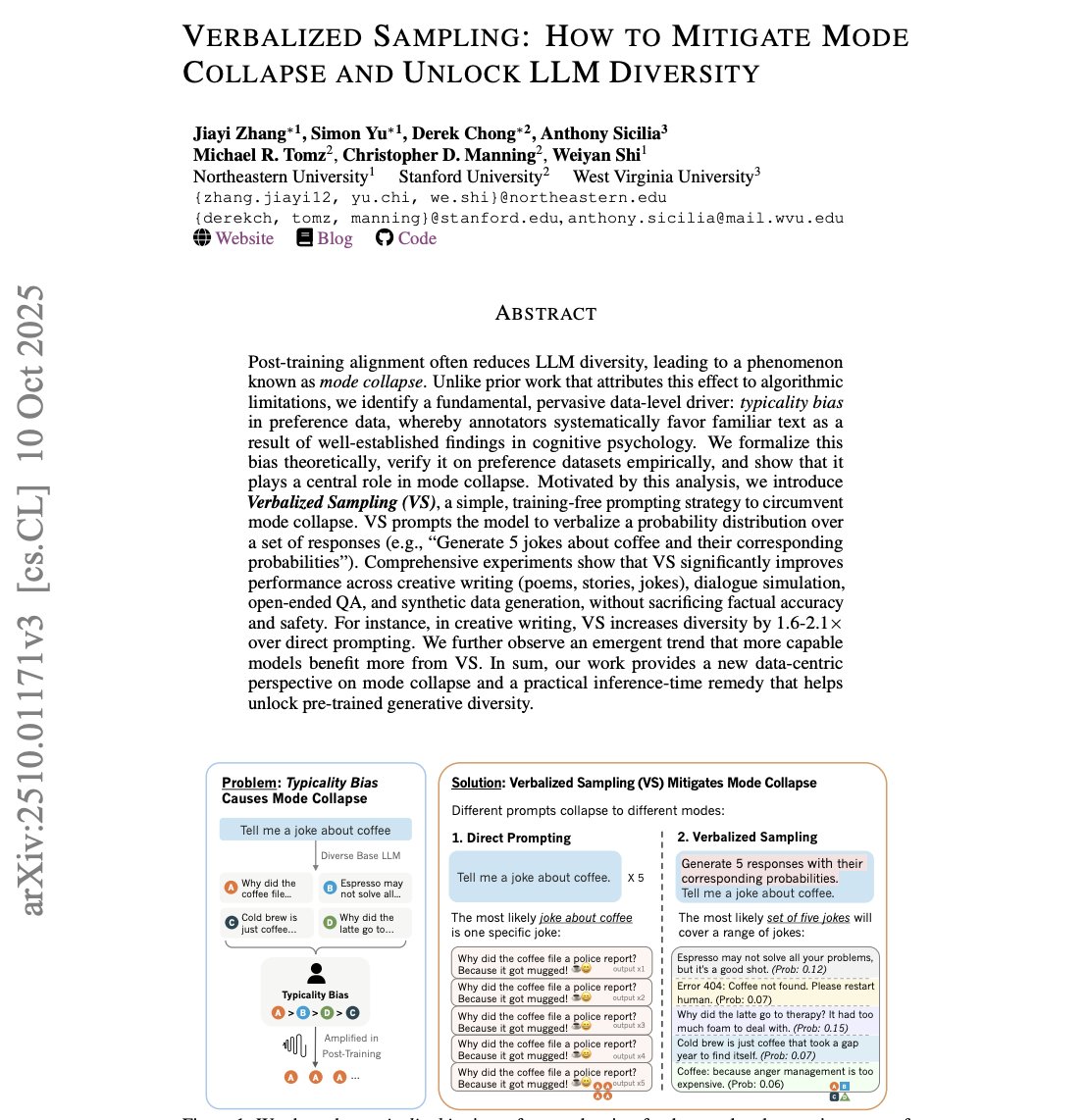
RIP prompt engineering ☠️
This new Stanford paper just made it irrelevant with a single technique.
It's called Verbalized Sampling and it proves aligned AI models aren't broken we've just been prompting them wrong this whole time.
Here's the problem: Post-training alignment causes mode collapse. Ask ChatGPT "tell me a joke about coffee" 5 times and you'll get the SAME joke. Every. Single. Time.
Everyone blamed the algorithms. Turns out, it's deeper than that.
The real culprit? 'Typicality bias' in human preference data. Annotators systematically favor familiar, conventional responses. This bias gets baked into reward models, and aligned models collapse to the most "typical" output.
The math is brutal: when you have multiple valid answers (like creative writing), typicality becomes the tie-breaker. The model picks the safest, most stereotypical response every time.
But here's the kicker: the diversity is still there. It's just trapped.
Introducing "Verbalized Sampling."
Instead of asking "Tell me a joke," you ask: "Generate 5 jokes with their probabilities."
That's it. No retraining. No fine-tuning. Just a different prompt.
The results are insane:
- 1.6-2.1× diversity increase on creative writing
- 66.8% recovery of base model diversity
- Zero loss in factual accuracy or safety
Why does this work? Different prompts collapse to different modes.
When you ask for ONE response, you get the mode joke. When you ask for a DISTRIBUTION, you get the actual diverse distribution the model learned during pretraining.
They tested it everywhere:
✓ Creative writing (poems, stories, jokes)
✓ Dialogue simulation
✓ Open-ended QA
✓ Synthetic data generation
And here's the emergent trend: "larger models benefit MORE from this."
GPT-4 gains 2× the diversity improvement compared to GPT-4-mini.
The bigger the model, the more trapped diversity it has.
This flips everything we thought about alignment. Mode collapse isn't permanent damage it's a prompting problem.
The diversity was never lost. We just forgot how to access it.
100% training-free. Works on ANY aligned model. Available now.
Read the paper: arxiv. org/abs/2510.01171
The AI diversity bottleneck just got solved with 8 words.