My conversation with @DanielSLoeb1, his first ever podcast and one I've been wanting to do for years.
Dan started Third Point in 1995 with $3 million. Today the firm manages over $24 billion across equities, credit, venture, and insurance.
Along the way he wrote some of the most iconic activist letters.
We discuss:
- Why deep value stopped working
- The power of writing
- The Twitter and XAI credit trades
- Lessons from FTX and Danaher
- The Sony and Sotheby's stories
- What makes a great analyst today
- The importance of kindness
I feel lucky we all get to learn from one of the greats.
Enjoy!
Timestamps:
0:00 Intro
2:48 Macro Views and Tech Trends
5:13 The Roots of Third Point
10:30 Evolving to Quality and Thematic Investing
19:07 Market Psychology and Inefficiencies
24:10 Good and Bad Corporate Governance
29:19 Activism
31:23 Sotheby's
41:37 AI
44:28 Sony
52:50 Danaher's Operating System
56:31 Building an Insurance Business
59:25 FTX
1:05:17 What Makes a Great Analyst Today
1:07:24 The Next Decade
1:10:00 Kindest Thing
This 1 hour lecture on Bloomberg Terminal will teach you more about trading markets than a 2 month internship at Goldman Sachs or JPMorgan.
Bookmark this & give it 1 hour today, no matter what. It’s the most productive start you can give your week. Then read the article below.
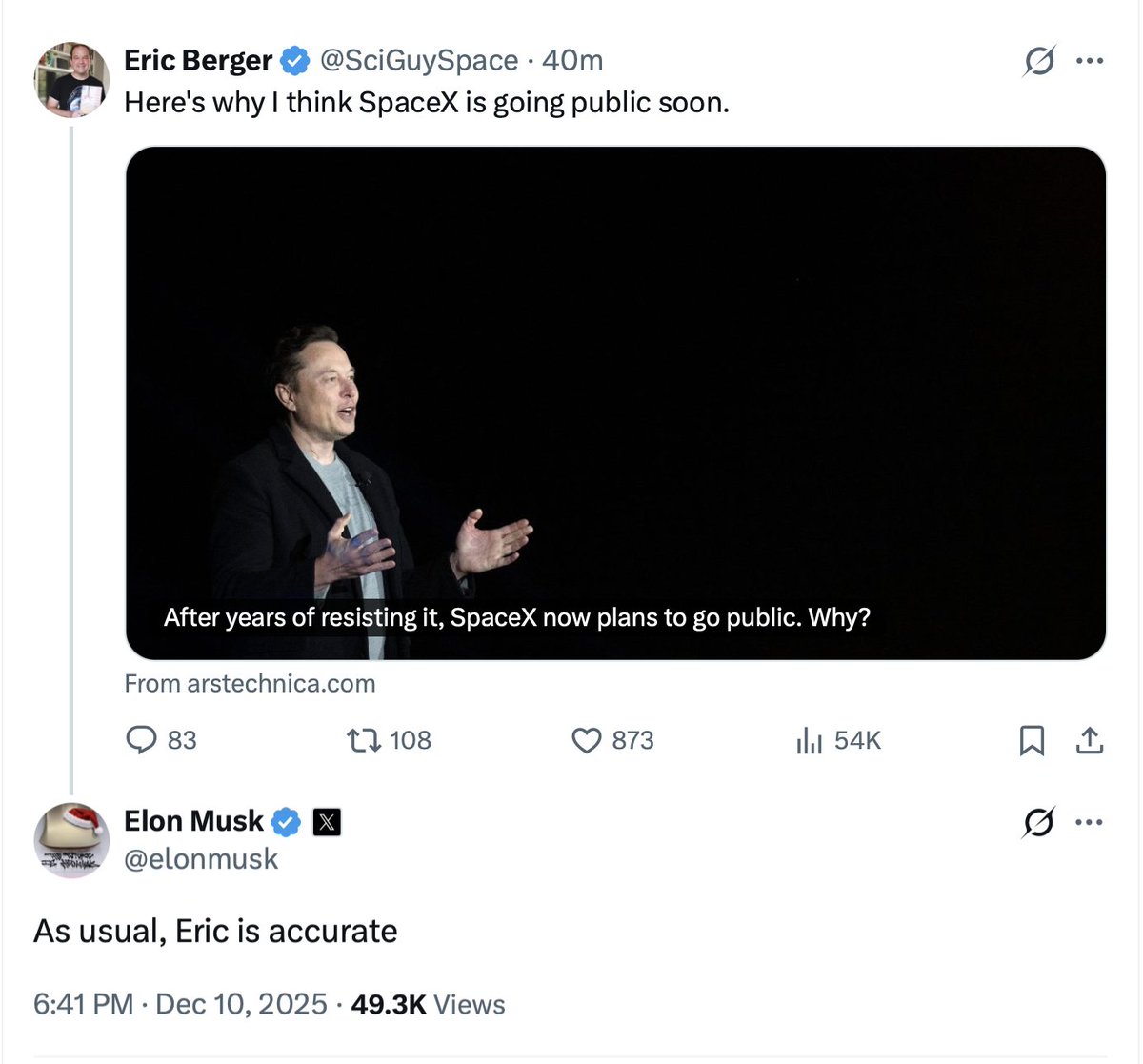
BREAKING: Elon Musk has just officially confirmed that SpaceX will IPO in 2026 🚀
In short, SpaceX will use the money it raises in an IPO to move even faster: "It will take a lot of cash to design and build the satellites and launch the rockets to deploy data centers in space."
My AI investment thesis is that every AI application startup is likely to be crushed by rapid expansion of the foundational model providers.
App functionality will be added to the foundational models' offerings, because the big players aren't slow incumbents (it is wrong to apply the analogy of "fast startup, slow incumbent" here), they are just big. Far more so than with any other prior new technology, there is a massive and fast-moving wave that obsoletes every new app almost as fast as it can be invented. There is almost no time to build a company and scale it.
There are two ways AI application startup founders can make money:
- Make a flash-in-the-pan app that generates a ton of cash and bank the cash (my estimate is that you have about 12-18 months cashflow generation)
- Make a good enough app that you get acquired by one of the big players for sufficient equity
The situation is highly unstable - we don't know if it's going to crash or go to the moon but both scenarios make it very unlikely that any AI application startup will independently become a generational supercompany (baseline odds are low to begin with).
The best odds are finding an application niche in a highly specialized field with extremely unique and specific data barriers, ideally ones relating to real atoms (hardware or world-related) data and not software/finance.
🚨BREAKING: Crypto liquidations soar to $9.4 BILLION in 24 hours – the LARGEST single-day event ever.
Bigger than LUNA. Bigger than COVID. Bigger than FTX.
We just witnessed history.
It's official:
The top 10% largest US stocks now reflect a record 76% of the US equity market.
This has officially surpassed the previous record set before the Great Depression in the 1930s.
By comparison, at the 2000 Dot-Com Bubble peak, the top 10%'s share was at ~73%.
In the 1980s, this figure was below 50%.
Meanwhile, the top 10 stocks in the S&P 500 now represent a record 40% of the index’s market cap.
We are witnessing history.