Did $CSU.TO $TOI.V loosen its acquisition discipline to put more money to work?
The latest filings suggest not.
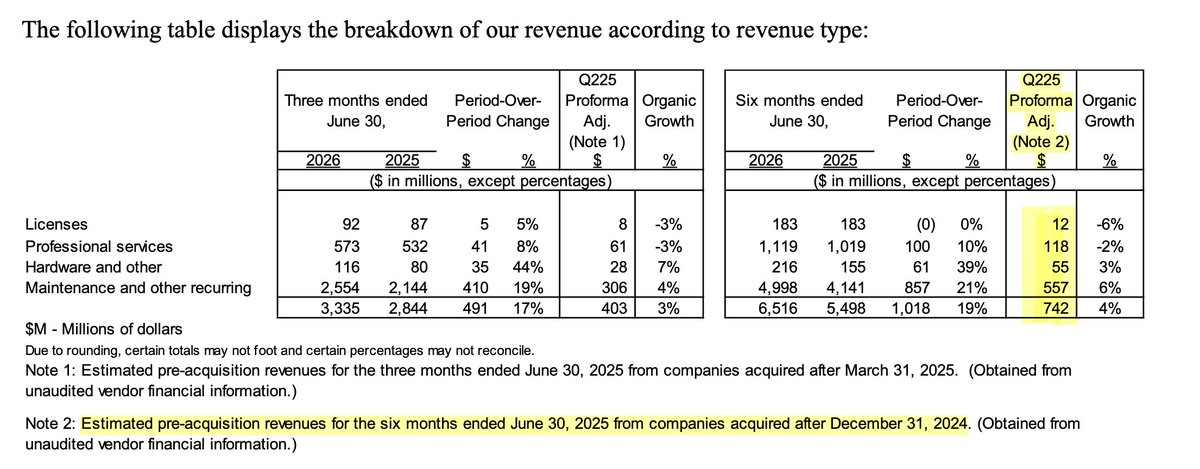
Buried in CSU’s quarterly organic-growth table is the revenue acquired businesses generated before CSU bought them. That lets us reverse engineer a rough portfolio-level purchase multiple.
CSU recorded ~$3.28B of total consideration for acquisitions completed from 2025 through H1 2026.
Those businesses generated $742M of pre-acquisition revenue in H1 2025 or approximately $1.48B annualized.
Implied purchase price: ~2.2x revenue.
Run the same calculation one year earlier: $2.39B of consideration against approximately $1.07B of annualized vendor revenue, or ~2.25x.
In other words, deployment increased 37%, while the revenue base acquired increased 39%.
Quality also held steady: maintenance and recurring revenue represented 75% of the newer cohort’s vendor revenue versus 74% for the prior cohort.
This matters because investors fear CSU’s growing size will force it into larger, more expensive deals and compress returns.
Thus far, the disclosures show stable pricing and a stable recurring revenue mix despite much heavier deployment.
The calculation is approximate and ignores margins and seasonality. But as a capital discipline check, it is more informative than any single headline acquisition.
No obvious multiple creep yet.
$CSU.TO and $TOI.V are down about 10% month to date.
At C$96 Topicus trades at over a 5% FCFA2S yield, which makes it a reasonable moment to revisit what actually decides the return here over time.
Not the multiple going in, but what the capital earns once it is deployed.
The worry with any serial acquirer at scale is that size pushes it into bigger, worse deals. Topicus has two Polish holdings far enough along to test that.
1) Topicus bought 72.68% of Sygnity in May 2022 for just under PLN 200m, roughly ten times earnings at the time.
Sygnity's revenue in the first half of 2026 was larger than its entire 2021, profit up 51%, EBITDA margins near 30%.
Annualize the half and Topicus's share of Sygnity's earnings is about 34% of what it paid. Every year, four years in.
2) Asseco is the newer one, and it cost as much as everything else Topicus bought in 2025 put together €385m for a 23.14% stake.
Revenue rose 16% in the first half of 2026 and net profit 52%. Topicus's share of those earnings annualizes to 12% of what it paid, in year two.
Between them, Poland is now about a quarter of Topicus on a look-through basis.
Most of it never touches the revenue line. Asseco contributes earnings, not sales, since it is equity accounted.
Topicus did all of this without slowing down elsewhere. Deployment ran at its usual pace through the half and net debt still came down.
Two years in, the largest position Topicus has ever taken is the fastest growing thing it owns.
No sign yet that size is costing them anything.
Of course! Culture is the first half of why I'm confident TOI & CSU will be great investments over the next decade.
The second is the sheer stickiness of critical software.
I've seen professionally how reluctant customers are to the smallest changes in their workflows. I've bent over backwards to keep ancient workflows compatible, because retraining staff on a new system is extremely expensive and disruptive and the people who already know the old one are hard to replace.
How much Kennedy Wilson risk does Fairfax carry?
It records US$861 million of securities.
The disclosed financing implies potential gross exposure of US$2.16 billion before recoveries.
When Kennedy Wilson went private on June 16 at US$10.90 per share, $FFH.TO contributed US$400.0 million of cash and rolled US$316.0 million of preferred stock plus US$145.2 million of common, both at fair value.
In exchange, Fairfax received US$716.0 million of mandatorily redeemable Kona Bidco preferred, recorded as bonds, and US$145.2 million of Kona common which it equity-accounted.
So the new cash did not increase Fairfax's common-equity position: it increased the credit position from US$316.0 million to US$716.0 million.
The overlooked disclosure is separate. Kona borrowed US$1.3 billion to fund the buyout, with Fairfax providing a standby guarantee enforceable upon certain payment defaults.
Because Fairfax has a majority economic interest but lacks control, Kona is equity-accounted, its acquisition debt is therefore not consolidated within Fairfax's US$14.29 billion of reported borrowings.
US$861 million of recorded securities plus US$1.3 billion guaranteed equals US$2.16 billion, or US$108 per Fairfax share.
US$65 of that is contingent rather than invested capital.
Caveat: the guarantee's terms are not disclosed. It is not a current loss and I don't expect it to be one in the future, just something to keep in mind.
Only US$145.2 million is labelled an associate. The rest is a bond position and a contingent credit exposure.
I don't think LVMH is broken. We're seeing the normalization toward 10-year and through-cycle trends.
I like of think of it as @JohnHuber72's "Category 2" compounder. Francois Rochon added to LVMH in 2025 and expects a 13% return over the next 5 years.
2023 is the wrong base to evaluate LVMH.
Markets overpay for temporary boosts in earnings and don't like it when companies are unable to make them permanent. Hence its five-year lows.
That €22.8bn of recurring EBIT in 2023 followed reopening, excess savings, returning travel, and unusually strong pricing in the luxury sector.
Yet from 2015 to 2025, revenue compounded 8.5% a year and EBIT 10.4%. Start in 2019 and you get 7.1% and 7.5%.
FY25's €17.8bn looks like normalization, not breakage.
Two things would have to be true for real impairment:
• Brands losing relevance across all or most categories
• Underlying profit falling over the long term after accounting for the 2023 boom.
Neither showed up in H1.
Recurring EBIT fell by €321m, from €9,012m to €8,691m. But the business added €341m organically before a €686m currency drag erased that growth and pushed reported profit lower.
Four of five business groups expanded operating margin. Only Fashion & Leather Goods contracted, down about 60bp, with management saying its profit and margin declines were more than entirely attributable to currency.
Louis Vuitton and Dior both had positive growth in Q2.
At ~13–14x trailing EBIT depending on leases and minorities, the business has to grow mid-to-high single digits to provide a 13% return in 5 years.
Not a core position for me but I believe Rochon will prove right over the next 5 years.
$LVMUY $LVMH $MC.PA $LVMH.TO
I recently re-started reading the Buffett partnership letters and it’s genuinely amazIng how little market behaviour has changed since 1950s.
Excerpt from 1958 letter:
“During the past year almost any reason has been seized upon to justify ‘Investing’ in the market.
There are undoubtedly more mercurially-tempered people in the stock market now than for a good many years and the duration of their stay will be limited to how long they think profits can be made quickly and effortlessly.
While it is impossible to determine how long they will continue to add numbers to their ranks and thereby stimulate rising prices, I believe it is valid to say that the longer their visit, the greater the reaction from it.”
This was when the Shiller PE ratio was 16-18 over the year.
It is 42.5 today.
“I do believe that widespread public belief in the inevitability of profits from investment in stocks will lead to eventual trouble.”
In 1960 Buffett put 35% of his partnership's assets into a single work-out.
It screened at:
• 2.4x revenue
• 47x earnings
• Net profit had fallen 5x in 20 years.
Sanborn Map made street-by-street fire maps of every US city, fifty pounds of paper for Omaha alone.
Insurers underwrote off them and for 75 years nobody competed, profits over $500k a year by the late 1930s.
Early on the industry got nervous Sanborn was gouging them and stuck its own executives into 9 of the 14 board seats. Those nine owned 46 shares between them. Out of 105,000.
By 1958 insurers had moved to carding and map profits were under $100k.
Dividends cut five times in eight years, no record of anyone proposing a cut to director fees.
What Buffett saw however, was a $45 stock with $65 a share of marketable securities on the balance sheet.
You paid 70 cents on the dollar for the portfolio and got handed the map business at minus $20.
The core wasn't dead either, about thirty insurers were still buying.
He took the late president's widow's block, worked up to 24,000 shares, took a board seat. No proxy fight.
Anyone who wanted out exchanged stock for portfolio at fair value, the SEC signed off, 72% of the shares left.
What Buffett got a the end: "The map business was left with over $1.25 million in government and municipal bonds as a reserve fund, and a potential corporate capital gains tax of over $1 million was eliminated.
The remaining stockholders were left with a slightly improved asset value, substantially higher earnings per share, and an increased dividend rate."
Where does this setup exist today? I have one :)
$CSU.TO Another reason why deal structure matters as much as, if not more than the headline multiple.
6.4x LTM FCFA2S at the asset level is ~3.2x on the equity actually written. The debt sits at Altera, not CSU.
Consolidated organic rev going nowhere is a nothing-burger when the equity pays itself back every three years.
Ex-Altera, organic still grew 4%.
$CSU.TO Here's how to milk a 🐄
Harris bought Altera for $670M . They financed this acquisition issuing $335M in debt, issued at the Altera level, so CSU really paid $335M in equity (50% debt / 50% equity)
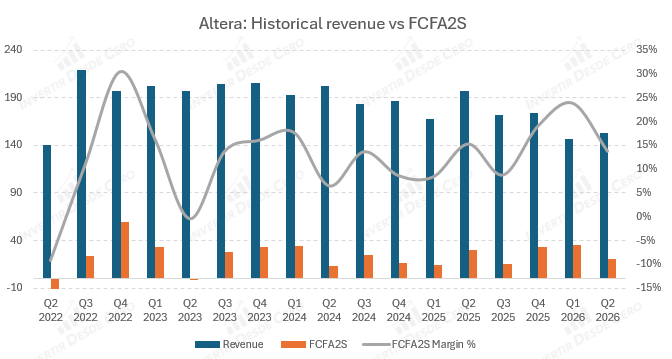
Over the LTM, Altera generated $104M in FCFA2S, impliying a "ROE" of 31%. Not bad for a declining asset 👌
It's also remarkable to see the FCFA2S margin remaining fairly stable despite revenue declines YoY
Fun fact: Altera generated $400 million in FCFA2S since its acquisition, which closed in May 2022. This asset paid for itself 🤝
E-L Financial $ELF.TO
$17.47 stock. The company has an NEV of $27.37 a share at 30 June, up 17.5% year over year.
Empire Life is $5.19 of that $27.37. Which leaves $22.18 a share of marked securities against a $17.47 price. You pay 79 cents on the dollar for the liquid book and get the life company for nothing.
Unlike Sanborn's maps, Empire Life isn’t dying.
Empire earned roughly $190m over the last twelve months and pushes about $135m a year of that up to the parent as dividends.
It paid that and its capital ratio still went up, 153% to 159% LICAT, roughly $690m above what the regulator requires. Second-best capitalised lifeco in the country.
And it sits inside that $27.37 at 1.0x book. Manulife trades at 1.5x, Sun Life and iA near 1.8x, Great-West above 2x. Nobody sells a life company at book.
12.3% NEV per share CAGR since 1969. Fewer effective shares out than in 1971.
The difference from Sanborn is the board. Sanborn's directors owned 46 shares between them. Jackman is actively trying to close the discount with buybacks and special dividends.
$1.05 in March, $1.50 in 2025, $0.60 in 2024. That's $3.15 over three years against a $17.79 share price, on top of the $0.16 regular dividend.
I wish every executive were like Rob. Focus on executing the core business well instead of juicing “EBITA per share” or whatever measure is hot atm.
Buybacks can unlock substantial value when done right, but most management teams fail to make their buyback policy accretive for shareholders.
Steady deployment of capital at mid-teens ROIC suits me just fine :)
$HMM.A has doubled YTD and it's still cheaper, and growing faster, than most of what gets sold as "quality growth"
EV of roughly C$255M. Trailing EBIT is about C$27M. So 9 EV/EBIT.
Trailing FCF is around C$21M, so 12x on the same EV.
The gap here is expansion.
Capex ran about C$15M over the last four quarters against roughly C$6M in all of 2025.
Nearly all of the difference is the C$18M the board approved in March: 85,000 square feet of paint and fabrication capacity, ready to be in service in the first half of 2027.
Normalized, I'd estimate the capex at C$6-7M, of which maybe C$3-5M is maintenance. EV / Normalized EBIT ~9x as well.
The business is growing rapidly too. Q2 revenue came in around C$85M, up 19%.
Operating income is roughly C$10.5M.
Gross margin up about 4.5%.
Annualize the first half and you're around 7x EBIT now.
Anyone else long $HMM.A?
One line from the release didn't make my thread, and it's the most forward-looking thing in it.
Leisman: "Over the ensuing weeks, the Company plans to unveil its plans for lowering its cost of capital, which could include a pathway for substantial shareholder capital returns."
Weeks, not quarters.
A gold miner with ~$112M cash + growing cashflows, two development projects it says it can fund without external capital, and now talk of returning capital to shareholders.
$MAKO $MKO.V
My favourite gold miner, $MAKO Mining reports a beautiful Q2 2026:
Q2 highlights:
• Revenue $62.6M, from $38.7M (+61.7%)
• Adjusted EBITDA $31.7M, from $21.3M (+48.9%)
• Gold sold 14,610 oz, from 11,476 (+27.3%), at an average realized price of $4,201/oz, from $3,321 (+26.5%)
•Cash cost $1,996/oz, AISC $2,286/oz
• ROE 36.6%, ROA 23.8%
San Albino: 53,120 t milled, 7.54 g/t, 80.7% recovery, 10,612 oz sold, realized $4,156/oz, cash cost $1,421/oz, AISC $1,535/oz
Moss: 481,812 t stacked, 0.32 g/t, 75% recovery, 3,998 oz gold and 17,013 oz silver sold, realized $4,321/oz, cash cost $3,331/oz, AISC $3,708/oz
@AkibaLeisman says ~$112M of cash and gold-linked securities plus operating cash flow from San Albino and Moss is more than sufficient to fully fund Mt. Hamilton and Eagle Mountain without external capital.
My one gripe here, the management didn't engage in buybacks when the stock when the stock got so cheap.
Last 2 years (not ttm): $HMM.A generated about $59m of operating cashflow.
Spent $18m on Capex, paid down $16m debt, $1.5m went to dividends.
The rest is pretty much accumulated as cash. They deploy cash incrementally and earn low-to-mid teens ROIC so it still a low-to-mid teen return without any multiple expansion.