Not every business owner wants to build an empire.
Some just want to make a good living, support their family, and control their own time.
That's success, too.
https://t.co/dXvAP5ntgz #TheAmericanDream
Experience only becomes valuable when you're willing to learn from it and change how you approach things.
You can't recover the time spent making mistakes, but you can make sure those mistakes help you make better decisions going forward.
@DougKennedy93 Too much thought leadership is just familiar advice repackaged to sound impressive. I'd rather hear an honest opinion backed by real experience, even if I disagree with it, than another polished post that says absolutely nothing new.
@SahilBloom Age brings experience, perspective, and often a clearer understanding of what actually matters. The biggest mistake isn't starting something later in life; it's assuming your opportunities to grow and enjoy life have already passed.
The cost of not accepting credit cards can be difficult to see because a business never receives a statement showing the sales it might have missed.
Processing fees are visible. Equipment expenses are visible. But when a customer leaves because a business only accepts cash, that potential sale may never appear in the records.
Does that mean every cash-only business should start accepting cards?
No. It means the decision deserves a closer look.
A business should compare the cost of card processing with the possibility of additional sales, the expense of handling cash, customer payment preferences, and the profit remaining after completing a transaction. The right answer depends on the business, its customers, and its margins.
I’ve worked with small business owners in merchant services since we co-founded Valued Merchant Services in 2006. One thing I’ve learned is that the lowest processing expense does not necessarily create the best overall business result. At the same time, adding credit cards does not automatically guarantee higher sales or profits.
In this guide, I’ll explain what cash-only businesses may be giving up, examine the actual costs of accepting cards, and walk through a realistic example for calculating whether the change could pay for itself.
Quick Answer: Is It Worth Accepting Credit Cards?
Accepting cards may make financial sense when the contribution from genuinely additional sales and any operational savings exceeds processing fees, equipment expenses, and other related costs. A cash-only business should consider how many customers prefer cards, how many purchases it currently loses, its average ticket, its profit margin, and how much existing cash business would shift to cards. The answer is not the same for every merchant.
Read more: https://t.co/yKemEcPCiO
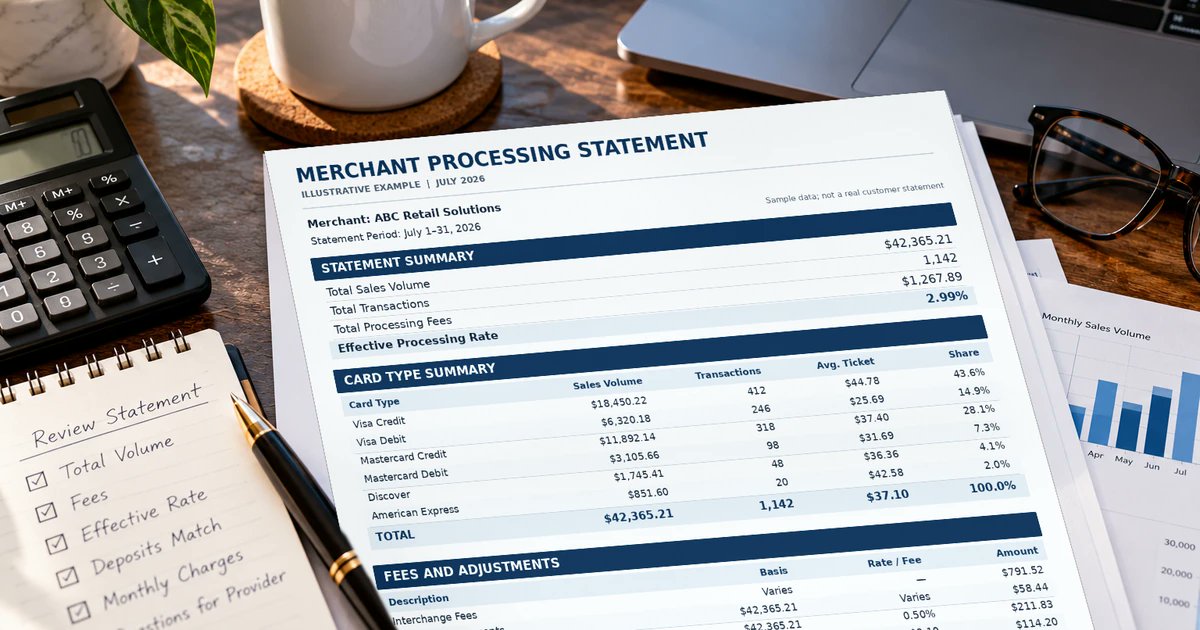
How to Read a Credit Card Processing Statement: 7 Steps
Learning how to read a credit card processing statement starts with five numbers: your card sales volume, transaction count, processing fees, other account charges, and net deposits. Find those figures, verify how the fees were calculated, and reconcile the money that reached your bank account. This helps you understand what accepting payments actually costs your business.
A merchant processing statement is more than a monthly bill. It’s a record of card transactions, fees, settlements, adjustments, and other activity associated with a merchant account.
Unfortunately, statements can be difficult to interpret. Different providers organize information differently, and some use technical abbreviations that aren’t immediately clear to business owners.
You may see dozens of interchange categories, percentage-based charges, per-transaction fees, network assessments, and monthly account expenses. Some charges are deducted before deposits arrive, while others are billed separately.
That can make the actual cost considerably different from the single processing rate a merchant remembers being quoted.
Since co-founding Valued Merchant Services in 2006, I’ve worked with business owners who wanted straightforward explanations of their processing expenses. Some discovered charges they didn’t recognize. Others learned that their existing arrangement was already competitive.
In either situation, understanding the statement creates a better basis for making decisions.
This guide explains how to read a credit card processing statement in seven steps, identify and verify common charges, compare pricing models, reconcile bank deposits, and understand why your Form 1099-K may report a different figure from your net deposits.
Read more: https://t.co/NhmwjmLcdo
#creditcardprocessingstatements
Learning how to keep employees motivated during difficult times is one of the most important responsibilities of a business owner or manager.
When employees face uncertainty, heavier workloads, personal challenges, or changes at work, the answer isn’t always a bigger paycheck or an elaborate rewards program.
Often, motivation begins with honest communication, meaningful recognition, fair expectations, and knowing that leadership is paying attention.
Running a small business is challenging even when the economy is strong and everything is going according to plan.
When circumstances become difficult, those challenges can affect everyone in the organization.
Business owners worry about expenses, customer demand, competition, and cash flow. Employees may be concerned about job security, changing responsibilities, family obligations, or whether their efforts are being recognized.
I’ve been involved in building and leading Valued Merchant Services since we founded the company in 2006. One thing I’ve come to appreciate is that people don’t always need another motivational speech.
Sometimes they need clearer direction. Sometimes they need help solving a problem. Other times, they simply need to know that someone notices the effort they’re putting in.
Good leadership involves recognizing the difference.
Let’s look at practical ways small business owners can support their teams, build stronger working relationships, and keep employees motivated when circumstances are less than ideal.
https://t.co/I135LkyxkX #smallbusiness #employeemotivation
@_Pammy_DS_ As you get older, you realize how much time and energy you once wasted on things that never really mattered. A peaceful home, good relationships, and people you can count on become far more valuable than impressing anyone.
Choosing the best POS system for your business means finding the right combination of software, hardware, payment processing, and support.
A touchscreen may look impressive in a demonstration, but the real test is whether the system helps your employees serve customers, keeps your records accurate, and works reliably during a busy business day.
I’ve worked with business owners in the merchant services industry since we founded Valued Merchant Services in 2006.
During that time, I’ve watched point-of-sale technology change from traditional countertop terminals and cash registers into sophisticated platforms capable of managing sales, inventory, employees, appointments, online orders, and much more.
That progress has created opportunities for small businesses. It has also made choosing a POS system more complicated.
Today, two systems that look nearly identical may have completely different features, payment processing requirements, software subscriptions, hardware compatibility, and support arrangements.
The cheapest system isn’t necessarily the least expensive to operate. The platform with the most features may not be the easiest for your staff to use. And buying a new POS doesn’t automatically mean you’ll save money on processing.
My advice is to start with your business, not the equipment.
This guide explains what to look for, which questions to ask, and how to evaluate your options before making a long-term commitment.
https://t.co/bAE8vIlhlT #pointofsale
Choosing the best POS system for your business means finding the right combination of software, hardware, payment processing, and support.
A touchscreen may look impressive in a demonstration, but the real test is whether the system helps your employees serve customers, keeps your records accurate, and works reliably during a busy business day.
I’ve worked with business owners in the merchant services industry since we founded Valued Merchant Services in 2006.
During that time, I’ve watched point-of-sale technology change from traditional countertop terminals and cash registers into sophisticated platforms capable of managing sales, inventory, employees, appointments, online orders, and much more.
That progress has created opportunities for small businesses. It has also made choosing a POS system more complicated.
Today, two systems that look nearly identical may have completely different features, payment processing requirements, software subscriptions, hardware compatibility, and support arrangements.
The cheapest system isn’t necessarily the least expensive to operate. The platform with the most features may not be the easiest for your staff to use. And buying a new POS doesn’t automatically mean you’ll save money on processing.
My advice is to start with your business, not the equipment.
This guide explains what to look for, which questions to ask, and how to evaluate your options before making a long-term commitment.
Read more: https://t.co/bAE8vIlhlT
#PointOfSale #Payments
We often give our mistakes more attention than the decisions that could improve our future.
Choosing the right partner, taking a new opportunity, or finally changing an unhealthy habit can have a positive impact for decades.
Built in Idaho. Serving the entire Gem State.
From Boise and the Treasure Valley to Twin Falls, Coeur d'Alene, Pocatello, and eastern Idaho.
Valued Merchant Services helps businesses compare processing costs, POS systems, online payments, and ways to improve how they get paid.
Our national headquarters is in Idaho Falls.
https://t.co/ZJm4v6Hrh8 #Idaho #Payments
There's always another email to answer, another deal to close, or another problem to solve. Building a successful business should give you more opportunities to enjoy life with the people you love, not fewer.
A strategy meeting is only valuable if people leave knowing exactly what needs to happen, who's responsible, and when it's due.
Without accountability and regular progress reviews, even the best ideas become expensive conversations.