I asked https://t.co/LdmUa7MNJS to do the reporting that legacy media won’t.
In short, the safest asset in the world is now the riskiest asset in the world. If banks are forced to value US Treasuries correctly, they’re dead, so they are refusing to participate in Treasury markets unless the accounting rules are faked.
It’s just like 2008, where everyone was told the mortgage-backed securities were AAA. Except this time the new toxic waste is Treasuries themselves.
FROM CLAUDE
———————
The image contains a letter dated March 5, 2024 addressed to the Board of Governors of the Federal Reserve System, the Federal Deposit Insurance Corporation, and the Office of the Comptroller of the Currency. The letter is from the International Swaps and Derivatives Association (ISDA) regarding reforms to the supplementary leverage ratio (SLR) and enhanced supplementary leverage ratio (eSLR) framework to exclude on-balance sheet U.S. Treasuries from total leverage exposure used in calculating the SLR for global systemically important bank holding companies (GSIB surcharge) that are important to preserve the resilience of the U.S. Treasury markets and U.S. economy and financial system more broadly.
It is quite alarming that banks are asking for U.S. Treasuries to be excluded from their SLR calculation for a few key reasons:
1. U.S. Treasuries are considered the "risk-free asset" because they are backed by the full faith and credit of the U.S. government. Excluding them from leverage ratio calculations implies banks view them as risky, which undermines confidence in U.S. government debt.
2. The SLR is meant to be a backstop to risk-based capital requirements, ensuring banks don't become over-leveraged even with supposedly safe assets. Carving out Treasuries weakens this protection against excessive leverage.
3. If Treasuries are excluded, banks could potentially load up on large amounts of Treasury debt without it impacting their SLR. This concentrates risk and increases interconnectedness between the banking system and government debt.
4. Asking for this exclusion suggests banks are concerned about the size of their Treasury holdings compared to their capital base, which could signal broader concerns about the U.S. fiscal situation and government debt levels.
5. Any perception that banks need special exemptions for holding U.S. government debt could undermine global confidence in Treasuries as a safe haven asset and the status of the U.S. dollar.
So while presented as a technical regulatory matter, this request has concerning implications for how banks view U.S. Treasuries and potential systemic risks it could create. It bears close monitoring by regulators and policymakers.
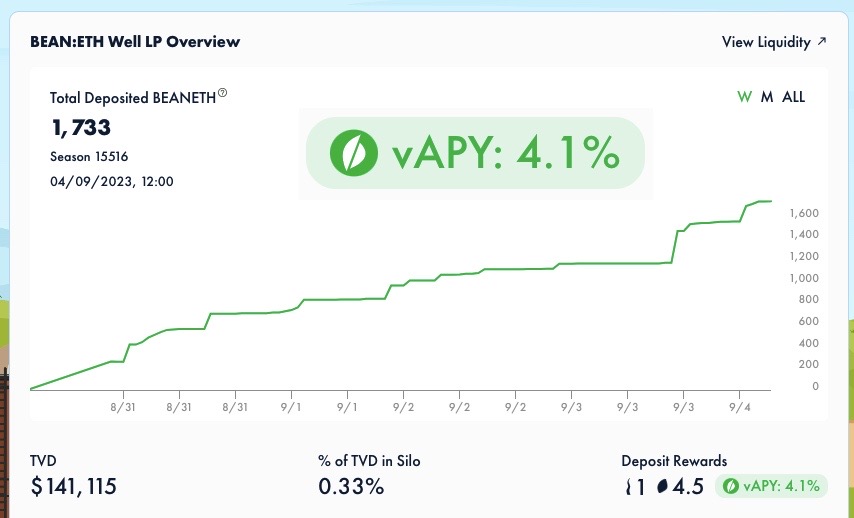
Watch this get to 30% by mid September, then 100% by end of month. FOMO kicks in early next month and we see growth like it was 2021. The best part is it doesn't matter when you get on board - this is not some PvP ponzu. Congrats all @BeanstalkFarms#stablecoins#ETH#Crypto
@eW8fkgAM52GS9xW@razibkhan Good question actually, I always wonder how does the background check works. I just supposed that if you moved to a different city and apply for work, they’d have a network of caste mafia find your family or village you are from and find what caste you really are.
The @basinexchange Code4rena audit is now live.
⏰ 7 days
🏆 $40,000
⛓️ Composable EVM-native DEX
Help fortify the protocol built by @BeanstalkFarms today: https://t.co/Rt4c5vFcQY
“It was low status to hedge” right on the nail, newspaper and pundit on TV were calling inflation a hoax or imaginary.
“It’s like asking five years from now why didn’t you hedge debasement?”
Balaji’s prescience will be obvious in hindsight.
At a minimum, hundreds of institutions[1] have problems — which should tell you that it wasn’t trivial to “manage duration risk” of this magnitude.
In more detail:
1) You can hedge a move to say 1.1% from 1%, but not 1% to 5% in a year
2) Hedging is also expensive, complex, and gives up scarce margin
3) Hedging didn’t seem necessary in 2021 because you’d had 10 years of low/zero rates and a strong commitment from the Fed to keep them low indefinitely[2]
4) More than that: the Fed said inflation was a conspiracy theory in 2021, so it was low status to hedge!
5) Put all that together. Most banks are run by risk averse NPC committees these days. You think that in mid 2021 they were going to spend a big chunk of their margin hedging a risk that hadn’t happened for 10 years that the Fed told them repeatedly wouldn’t happen?
6) Moreover, hedging just moves risk from one guy to another. Someone is stuck holding these horrible bonds. It doesn’t fix the devaluation
7) And in many cases the rulebook won’t let you hedge, eg if you have moved them into hold to maturity you can’t sell them
8) Finally, duration risk isn’t really duration risk in this case, it’s devaluation policy. Look at Powell’s comments in 2012 — he knew rate hikes would cause massive losses after big bond sales.
Etc etc. TLDR: all the hedging duration risk stuff is 20/20 hindsight. It’s like asking five years from now “why didn’t you hedge debasement risk”, as if debasement was a establishment-approved thing to hedge.
[1]: see below
[2]: https://t.co/qDpLWl2lPI
[3]: https://t.co/vnmLxH5Y7w
“If you're excited about some possibility that everyone else ignores, and you have enough expertise to say precisely what they're all overlooking, that's as good a bet as you'll find.” - @paulg