Bots have only made companies more aloof and less accountable.
Our long and drawn out court proceedings make the environment favorable to these companies.
Consumers, esp like me, with no following, have to just deal with this new age reality.
I got into medical school on "merit" - 60th on general category list in Mumbai 1982.
Have a Gold Medal at MD exams Mumbai University.
Let me tell you something:
Merit is a myth.
It's all about privilege, social capital, access to resources & hence opportunity.
Let the games begin!
Athletes from across the world are gathering today to kick off the 2024 #Olympics – pushing boundaries and inspiring generations. If you were an Olympic athlete, which sport would you play?
@leviathan164217@kaaldeshpatra@akhilpachori Lol.
There is beauty in simplicity
But to achieve it there is a lot of complexity hidden. Which this government doesn't seem to understand.
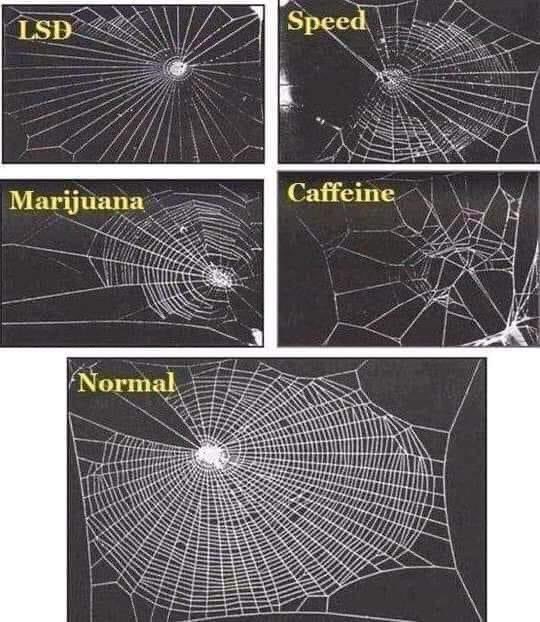
In 1995, a group of scientists conducted a study on the effects of various drugs on spiders, specifically focusing on the way they weave their webs. This research aimed to explore the impact of psychoactive substances on the behavior and motor skills of these arachnids
The initial motivation for the study was a request from a zoologist colleague to shift the time when garden spiders build their webs from between 2:00 a.m. and 5:00 a.m., which was apparently a source of annoyance. The scientists tested spiders with a range of psychoactive drugs, including amphetamine, mescaline, strychnine, LSD, and caffeine, and found that the drugs affect the size and shape of the web rather than the time it is built.
At small doses of caffeine (10 µg/spider), the webs were smaller; the radii were uneven, but the regularity of the circles was unaffected. At higher doses (100 µg/spider), the webs were even smaller, and the design became irregular and fragmented. The scientists also discovered that caffeine has a significant effect on spiders, which is reflected in the construction of their webs.
The study revealed that nearly every drug yielded the same effects, in slightly varying degrees of non-functionality. Spiders dosed with sleeping drugs became "very drowsy," skipped spinning the longest, most challenging radial threads (those on the outer corners of the frame), and left huge gaps in their webs; Benzedrine caused the spiders to spin a spiral "that zig-zagged like an unsteady walker" and induced the inability to locate precise spots within the web; marijuana made the insects omit altogether the inner part of the web; scopolamine, which has hallucinogenic effects in humans, destroyed the spiders' sense of direction altogether.
Overall, this research provided valuable insights into the impact of drugs on spiders and their web-building behavior. While the exact analogy between the effects of drugs on spiders and humans is still uncertain, the study showcased the importance of understanding the effects of psychoactive substances on various organisms.
"Right now millionaires alone are on track to burn 72% of the remaining carbon budget for 1.5C. We are devoting huge amounts of energy to enable the excess consumption of the ruling class. In the midst of a climate emergency, this is totally irrational.” https://t.co/jIYoMJbC3R