Fidelity chose @ethereum to issue its first ever stablecoin.
FIDD, the Fidelity Digital Dollar, is issued by Fidelity Digital Assets, an OCC-chartered national trust bank.
Fidelity at a glance:
→ 50m+ individual investors
→ $17.9 trillion in assets under administration
→ 5.5 million daily average trades
With FIDD, Fidelity is bringing more of the capital markets lifecycle onchain.
Another major FI making Ethereum the default chain in its digital asset strategy.
Live in production on @ethereum and in DeFi on Curve and Uniswap.
THROWBACK to when Dylan Harper went ballistic in a must-win Game 3 without Wemby in Portland!
In 30 minutes:
- 27 pts
- 10 rebs
- 3 asts
- 1 stl + 1 blk
- 92.2 TS%
- +25
and 22 SECOND HALF PTS!!!
Clutchest Rookie Ever!!
I have never seen so many people capitulating out of $ETH or crypto.
Some are writing blogs and essays explaining why it failed, mainly naming how other chains won the race, measured by fees taken in.
Some of my thoughts, in these hard times:
Time will tell, but I think many people are mistaken in treating $ETH like an end-stage $AMZN, as if the main question is already about mature margins, fees, and cash flows.
In reality, Ethereum is still very much earlier in its economies-of-scale phase, with nearly all metrics in the top right corner and growing at mid double digits to tripple.
Furthermore, most of the market is focused on the wrong battle: who can become the fastest and cheapest payment processor.
Lower fees, higher throughput, faster settlement. But that is likely a race to commoditization, similar to the payment processors crash over the last years.
If the only value proposition is speed and cost, then the moat gets thinner over time, easy disruptable. Someone can always be faster. Someone can always subsidize fees lower. Someone can always optimize one narrow use case.
The real value may not be in the transaction fee itself.
The real value is likely in the amount of economic activity secured by the network, the credibility of that security, the neutrality of the base layer, and the difficulty of replacing it once enough assets, applications, institutions, and users depend on it.
That is where Ethereum seems different to me and why so many institutions are choosing $ETH.
Most other projects still feel replaceable. They may have better performance in one area, better UX in another, or lower fees in the short term. But if their advantage is mainly technical efficiency, that advantage can be copied, competed away, or made irrelevant.
The newest hottest thing today is replacing the hottest thing from last quarter.
Ethereum’s bet appears to be much larger: become the most secure, decentralized, credibly neutral settlement layer for the internet economy.
Not the cheapest rail.
The hardest rail to replace.
In the end, the most valuable network may not be the one with the lowest transaction costs. It may be the one people trust most to secure the highest-value assets and applications over the longest period of time.
If $ETH can retain its market share while continuing to scale through upgrades that improve speed, throughput, and fees, its potential remains significant, especially if AI agents become truly crypto-native.
If it combines all of the above and earn the crown as the leading value-secured network, then $ETH could eventually be viewed as something like a truly decentralized, inflation-adjusting global bond: securing the world’s assets, free from political meddling, and deserving of a premium market cap because of the value it protects on top of the deflationary pressures create incentives to stake, get yield and trust the equivalent of buybacks and griwth in value secured to provide additional value.
Keep in mind over 1/3 of $ETH is now staked!
In that scenario, $ETH would not just be another asset to hold. It could become one of the only truly neutral and secure bonds for the digital economy.
... But sure, lets compare it to $SOL with 6% inflation, no moat, no security, massive outages, decreasing validator nodes and alike.
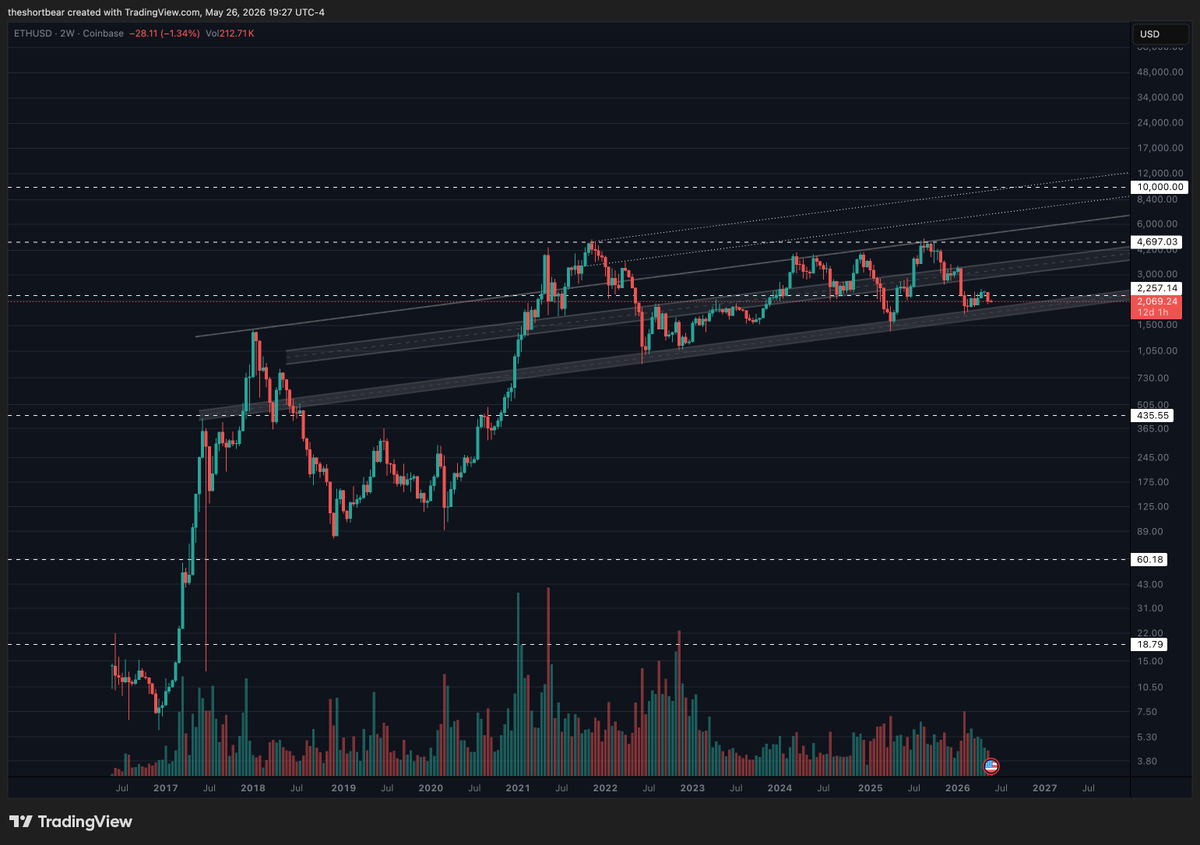
it just all feels like people are getting lost in short term fees and the easiest valuation attempt rather than what $ETH is actually built for, all while its testing its bottom range and players go full portfolio into AI.
$ETH market cap $256B.
The stablecoins running on it = $322B up 10x in 5 years, headed to $2T by 2030.
The tokenized real world assets settling on it are $65B, which are up 245x since 2020, headed to $10T by 2030.
The infrastructure is worth less than what runs on it.
Also the ETH/BTC ratio is at a 5 year low.
Either the thesis is wrong or the price is. I am betting on the latter.
Any strong opinions out there based on existing/projected data/facts?
$ETH
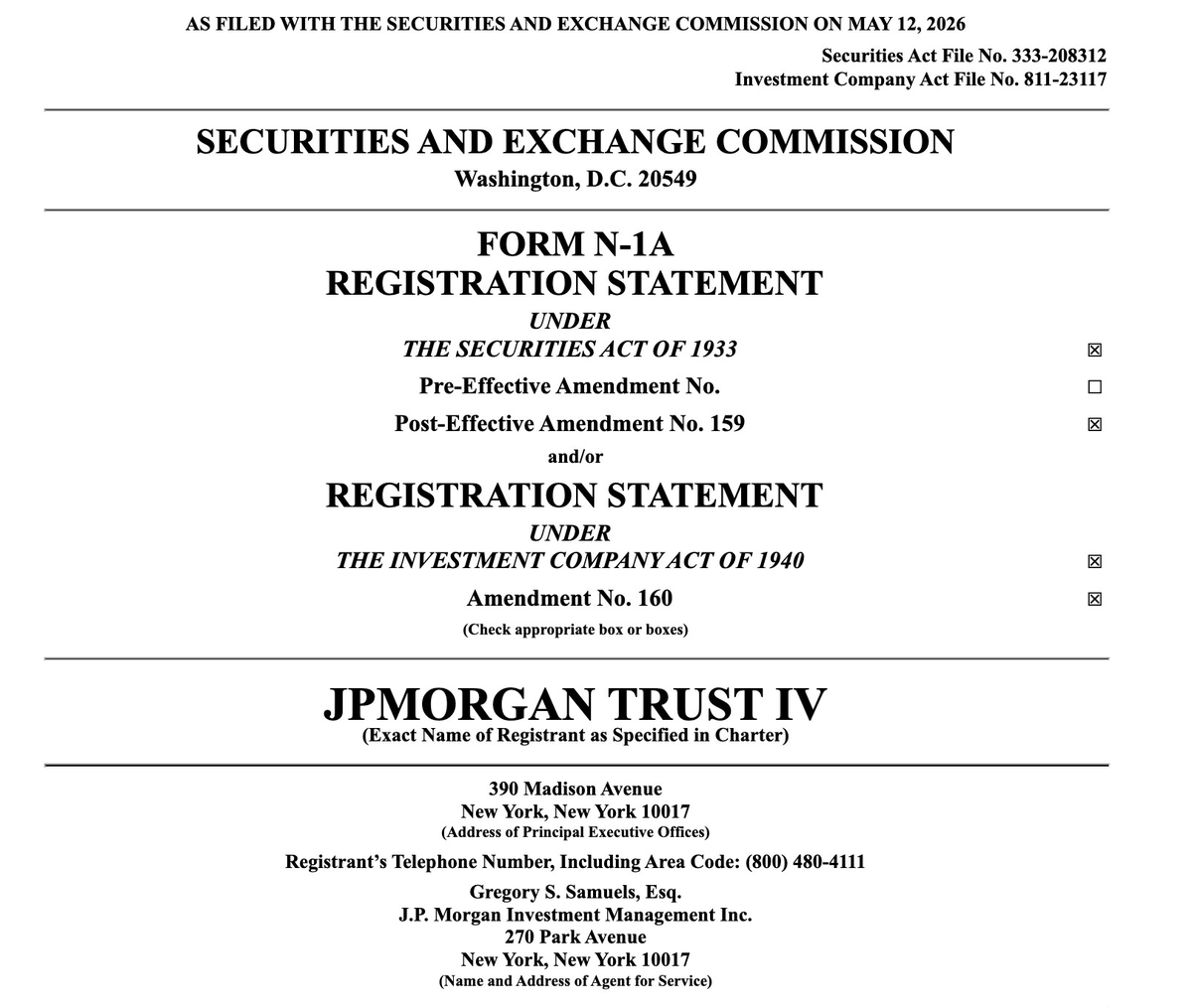
🔥 JPMorgan just filed for a new tokenized money market fund that runs directly on the public Ethereum blockchain.
This fund is designed as 100% compliant reserves for stablecoins under the GENIUS Act — using Ethereum for instant peer-to-peer transfers, 24/7 liquidity, and seamless on-chain settlement.
The world’s largest bank is now building real TradFi products natively on Ethereum. Institutional adoption just hit another level.
On Monday in NYC:
Etherealize will join 150+ executives from major US institutions at the Institutional Ethereum Forum, hosted by @ethereumfndn.
$250+ trillion in assets represented in one room to discuss Ethereum's role as infrastructure for the future of finance.
Today, the Foundation’s Board released the EF Mandate.
This document, which was first intended for EF members, reaffirms the promise of Ethereum, and the role of EF within this ecosystem.
Vitalik Buterin explains why proof-of-stake is more secure than proof-of-work
“I think proof of stake is very secure because to attack the system, you need to have basically as much stake as the rest of the network. Right now, for example, we have 5 million ETH staking, which means you have to come up with 5 million ETH and then join the network.”
At the time of this writing, more than 37 million ETH are being staked, with 3 million ETH waiting to join via the validator queue. At today’s prices, that’s more than $80 billion of ETH someone would have to acquire to attack the network and revert finalized blocks, which is more than the cost of attacking even the Bitcoin network by some estimates.
The other defense mechanism that proof-of-stake has that proof-of-work doesn’t is slashing, which makes Ethereum antifragile. Vitalik explains:
“Recovering from attacks is much easier in proof-of-stake than proof-of-work. For many kinds of attacks you do against [the Ethereum] network, we have this concept of automatic slashing. In order to revert a finalized block, you basically have to have a big portion of your validators sign two conflicting messages. This is something where once these messages are on the network, you can go and prove ‘these people did it.’ So we have this feature in the protocol where you basically take all these people who provably misbehaved and you burn their coins.”
Vitalik also acknowledges the possibility of censoring attacks, where if 1/3rd of validators refuse to attest, the chain can’t finalize. But, as he explains, Ethereum has a contingency plan for this as well:
“Everyone who got censored would create a minority chain, and the community would have to do a soft fork. The would have to say, ‘this chain is clearly attacking us and this one is not attacking us, so we’re going to join this chain.’ Then what happens is, on that new chain, the attackers also lose a lot of coins. The difference between proof-of-stake and proof-of-work is that in a proof-of-stake system, you can identify specific participants — and this isn’t a human going in and saying ‘I don’t like you’. It’s all automated.”
One last benefit of proof-of-stake is that security scales with the value of the network. As Vitalik put it five years ago, it is really relative security, and not absolute security, that matters:
“The security needs of a thing have to be proportional to the size of that thing, because as a thing gets bigger, its enemies become bigger and more well-motivated. If BTC were 100x as big as it is today, the value from destroying it would be 100x higher, and the kinds of actors that would want to care about destroying it would be much bigger and scarier. This is also why countries of all sizes have roughly similarly sized militaries as a percentage of GDP. Hence, cost of attack divided by market cap really is the correct statistic to measure, and in the long run issuance-free PoW really does look not that good."
Source: @lexfridman (Jun 2021)
Etherealize CEO Vivek Raman: Banks are looking at Larry Fink and Ethereum
“It’s impossible not to be bullish now. […] The [Ethereum] network has never been stronger, more resilient, or future-proofed to scale with Layer 2s plugged in and ready for the institutional moment right now. Asset price will follow.”
“[BlackRock CEO] Larry Fink is a pioneer in the space. He has been a visionary, and his voice is heard and listened to by everyone else on Wall Street. The banks are looking at him. The asset managers are looking at him. He’s one of the leaders that’s digital assets-forward, and when he tokenized BUIDL — their money market fund — on Ethereum before there was regulatory clarity and before we got out of the Gensler SEC, that set the standard for Ethereum to be the default.”
“Ever since then, the money in money market funds on Ethereum has multiplied. Stablecoins on Ethereum have multiplied. And now Larry Fink is coming in and saying, ‘We need one common blockchain’ so that we don’t have fragmentation and all tokenized assets can be in one place. That means Ethereum — it’s the best set up for it.”
Source: @therollupco (Mar 2026)
DeFi, simplified.
Introducing two new vaults: EarnETH & EarnUSD
One vault for ETH-based capital. One for stablecoins.
Now live on https://t.co/F7JRWtm1Bq
↓