Can AI accelerate AI itself? Let's look at what actually happened!!!
AI autonomously discovered a new RL algorithm, invented 100+ novel architectures, and evolved a data curation strategy — each one outperforming the best human-designed counterparts:
🤖 RL algorithm design — discovered novel optimization mechanisms that beat human-designed GRPO by +12.5 pts on AMC
🧠 Neural architecture search — invented 100+ new architectures, surpassing Mamba, GatedDeltaNet, and more by +0.97 pts over SOTA
📦 Pretraining data curation — evolved a pipeline that outperforms FineWeb-Edu, DCLM, and Nemotron-CC by +18 pts on MMLU
🧬 Drug-target interaction — discovered a new architecture that outperforms all prior human-designed methods by +6.94 AUROC
These aren't toy demos. These are frontier-level results — produced without a human in the loop.
This is ASI-Evolve: an open-source agentic framework that closes the loop between knowledge → hypothesis → experiment → analysis, and repeats it autonomously until it finds something that works. We built it for AI research. But the loop doesn't care about the domain.
A year ago, we made a prediction:
Scale computation → Scale scientific discovery.
The world caught up faster than we expected.
Which raises a question we can't stop thinking about — and we think you shouldn't either:
In the post-AGI era, when AI generates breakthroughs faster than humanity can absorb them — when the rate of discovery permanently outpaces the rate of value conversion — what becomes the new scarcity?
Not intelligence. Not data. Not compute.
Something far more irreplaceable.
We don't have the full answer. But we think it's worth asking — loudly, and together.
💻 Code: https://t.co/rBicTvkxYT
📄 Paper: https://t.co/2DriXJ4uFl (1/8)
⭐ Star it. Fork it. Point it at your hardest problem.
Should data "evolve"? 🧬
Scaling is not enough. Model performance is bounded by data, but its value is defined by processing depth.
We introduce Data Darwinism, a 10-level hierarchy (L0-L9) redefining data as an eternal co-evolutionary process.(1/n)
https://t.co/G81aLjhs3x
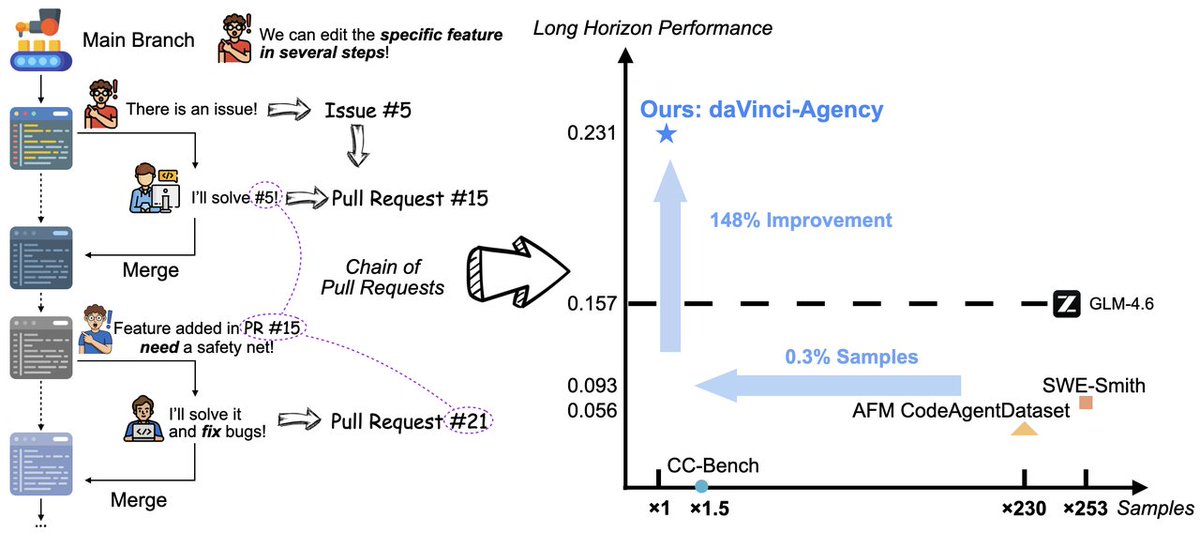
🎨 AI agents are excellent "Sprinters" solving single functions in seconds, but they fail at "Marathons" like long-horizon tasks.
They lose context, drift, or give up. Why? They lack endurance training.
We introduce daVinci-Agency: The FIRST automatic data synthesis pipeline to achieve project evolution level agency!
With just 239 samples, we beat baselines trained on 66k samples. 🚀
Paper: https://t.co/FOTt1ESH4b
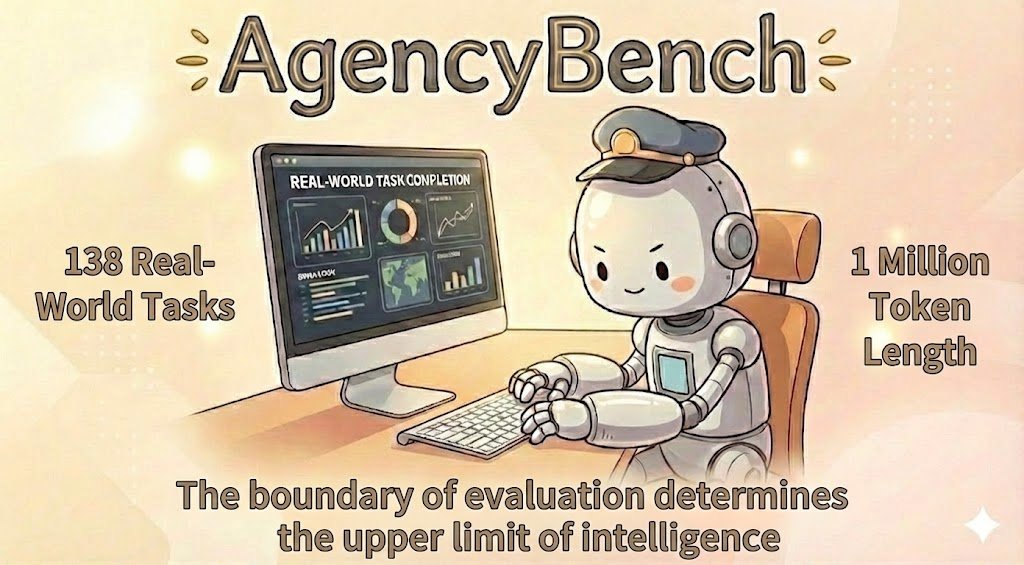
The boundary of evaluation determines the upper limit of intelligence.
🚀 NEW PAPER: "AgencyBench: Benchmarking the Frontiers of Autonomous Agents in 1M-Token Real-World Contexts"
"Failure is just iteration. No explosion, no innovation. Keep going."🚀
You vent to @elonmusk—he looks you in the eye and replies instantly, like a video call.
Introducing LiveTalk: real-time video gen system on a GPU that sees you, reads emotion, and responds in real time.🧵👇
(1/6)🎯 Excited to share our AAAI'26 paper: SCALE (Selective Resource Allocation)
We address a key bottleneck in LLM reasoning: uniform resource allocation across sub-problems of varying difficulty.
Result: +13.75% accuracy, -53% compute cost on AIME25
1/6 🫡 We’ve been talking about Context Engineering all wrong. A new paper, Context Engineering 2.0: The Context of Context Engineering, reveals the missing blueprint for context engineering. It’s not just a recent innovation of the agent era: in fact, Context Engineering can be traced back to over 20 years ago. Built upon Anind K. Dey's @aninddey@gabowd definition of context, we can view context engineering through a broader historical perspective, thus gaining a deeper understanding of its underlying principles. Thanks to our amazing authors:
@HuaQishuo@Yang_Xiao_nlp@fudayuan@JohnWu2048@Vanlin257@lino_cai and supervisor
@stefan_fee for their incredible contributions to this work!
🚨 RIP “Prompt Engineering.”
The GAIR team just dropped Context Engineering 2.0 — and it completely reframes how we think about human–AI interaction.
Forget prompts. Forget “few-shot.” Context is the real interface.
Here’s the core idea:
“A person is the sum of their contexts.”
Machines aren’t failing because they lack intelligence.
They fail because they lack context-processing ability.
Context Engineering 2.0 maps this evolution:
1.0 Context as Translation
Humans adapt to computers.
2.0 Context as Instruction
LLMs interpret natural language.
3.0 Context as Scenario
Agents understand your goals.
4.0 Context as World
AI proactively builds your environment.
We’re in the middle of the 2.0 → 3.0 shift right now.
The jump from “context-aware” to “context-cooperative” systems changes everything from memory design to multi-agent collaboration.
This isn’t a buzzword. It’s the new foundation for the AI era.
Read the paper: arxiv. org/abs/2510.26493v1
Sharing our recent work: Context Engineering 2.0: The Context of Context Engineering.
link: https://t.co/7WINpYMDWL
Our key insights:
1. Humans are the sum of all contexts — When an employee leaves but their work context (decision patterns, emails, workflows) persists in AI, the company runs smoothly. Your "digital twin" may be more valuable than your physical presence.
2. Context Engineering is 30 years old, the AI community just didn't know — Georgia Tech built Context Toolkit in 2000; HCI researchers have studied this for decades. That's why our paper is called "Context of Context Engineering."
3. First principle: Human-Machine Intelligence Gap — Humans naturally "fill in the blanks," machines don't. Context Engineering is fundamentally about entropy reduction, translating high-entropy human intent into machine-understandable signals.
4. Every intelligence gap narrowing triggers an interaction revolution — CLI→GUI→Touch→Conversational UI. We're at the dawn of the 2.0 era; expect 1-2 more paradigm shifts in the next 3 years. The next "WeChat" is hidden in the new cognitive gap.
5. Era 4.0 cognitive reversal: Machines reduce entropy for humans — When AI surpasses most humans, Context Engineering won't disappear but reverse — machines will proactively reduce information entropy for "burden" humans, sparking another interaction revolution.
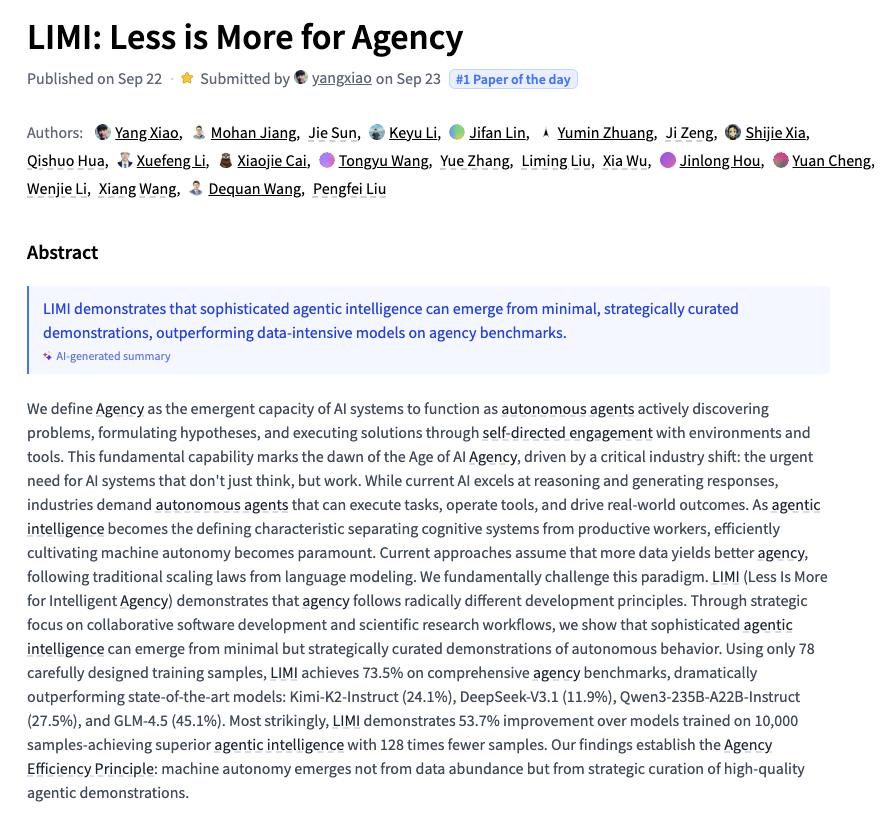
1/9 🔥 NEW PAPER: "LIMI: Less is More for Agency"
The Age of AI Agency demands systems that don't just think, but work: vibe coding and automated research. We used just 78 samples to beat GPT-5 by 14.1% and discovered the Agency Efficiency Principle. See details below! 📊