Can AI accelerate AI itself? Let's look at what actually happened!!!
AI autonomously discovered a new RL algorithm, invented 100+ novel architectures, and evolved a data curation strategy — each one outperforming the best human-designed counterparts:
🤖 RL algorithm design — discovered novel optimization mechanisms that beat human-designed GRPO by +12.5 pts on AMC
🧠 Neural architecture search — invented 100+ new architectures, surpassing Mamba, GatedDeltaNet, and more by +0.97 pts over SOTA
📦 Pretraining data curation — evolved a pipeline that outperforms FineWeb-Edu, DCLM, and Nemotron-CC by +18 pts on MMLU
🧬 Drug-target interaction — discovered a new architecture that outperforms all prior human-designed methods by +6.94 AUROC
These aren't toy demos. These are frontier-level results — produced without a human in the loop.
This is ASI-Evolve: an open-source agentic framework that closes the loop between knowledge → hypothesis → experiment → analysis, and repeats it autonomously until it finds something that works. We built it for AI research. But the loop doesn't care about the domain.
A year ago, we made a prediction:
Scale computation → Scale scientific discovery.
The world caught up faster than we expected.
Which raises a question we can't stop thinking about — and we think you shouldn't either:
In the post-AGI era, when AI generates breakthroughs faster than humanity can absorb them — when the rate of discovery permanently outpaces the rate of value conversion — what becomes the new scarcity?
Not intelligence. Not data. Not compute.
Something far more irreplaceable.
We don't have the full answer. But we think it's worth asking — loudly, and together.
💻 Code: https://t.co/rBicTvkxYT
📄 Paper: https://t.co/2DriXJ4uFl (1/8)
⭐ Star it. Fork it. Point it at your hardest problem.
@fudayuan@whistom25@Eudaemonia279@stefan_fee
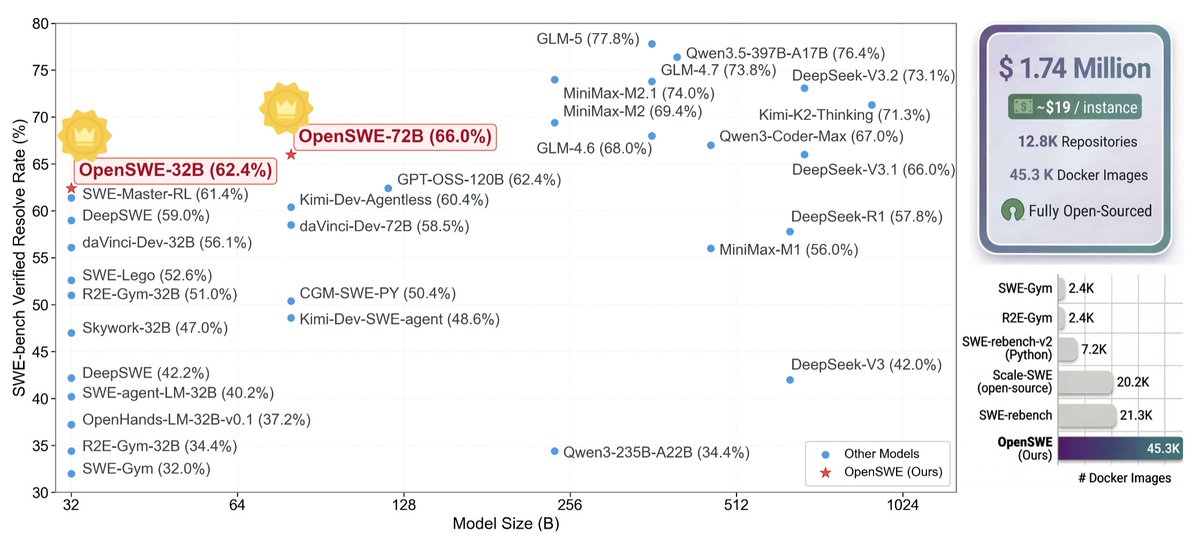
👋 Introducing daVinci-Env: the largest fully transparent framework for SWE environment synthesis in Python at scale. We open-source 45,320 environments, and 32B/72B models trained on them reach 62.4%/66.0% on SWE-Bench Verified.
1/6 🫡 We’ve been talking about Context Engineering all wrong. A new paper, Context Engineering 2.0: The Context of Context Engineering, reveals the missing blueprint for context engineering. It’s not just a recent innovation of the agent era: in fact, Context Engineering can be traced back to over 20 years ago. Built upon Anind K. Dey's @aninddey@gabowd definition of context, we can view context engineering through a broader historical perspective, thus gaining a deeper understanding of its underlying principles. Thanks to our amazing authors:
@HuaQishuo@Yang_Xiao_nlp@fudayuan@JohnWu2048@Vanlin257@lino_cai and supervisor
@stefan_fee for their incredible contributions to this work!
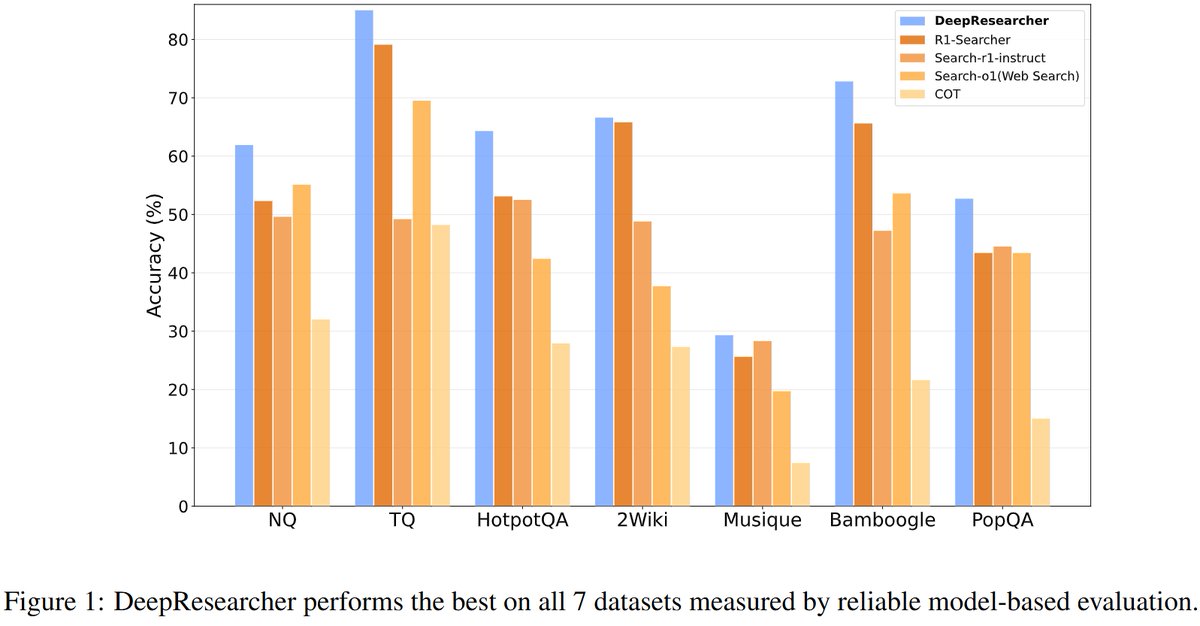
🔍Exciting to introduce DeepResearcher, the first end-to-end trained #DeepResearch model with #RL scaling in real-world environments!
✨No more controlled simulations - this is RL in the wild with authentic search interactions!
Paper: https://t.co/7dDU1uiHsO
1/7
👏Excited to share our paper:
✨PreAct: Predicting Future in ReAct Enhances Agent's Planning Ability
🔗https://t.co/fxVTbzfEXQ…
🧐We found the historical prediction of the observation can improve the diversity and directional strategy of the agent's planning.