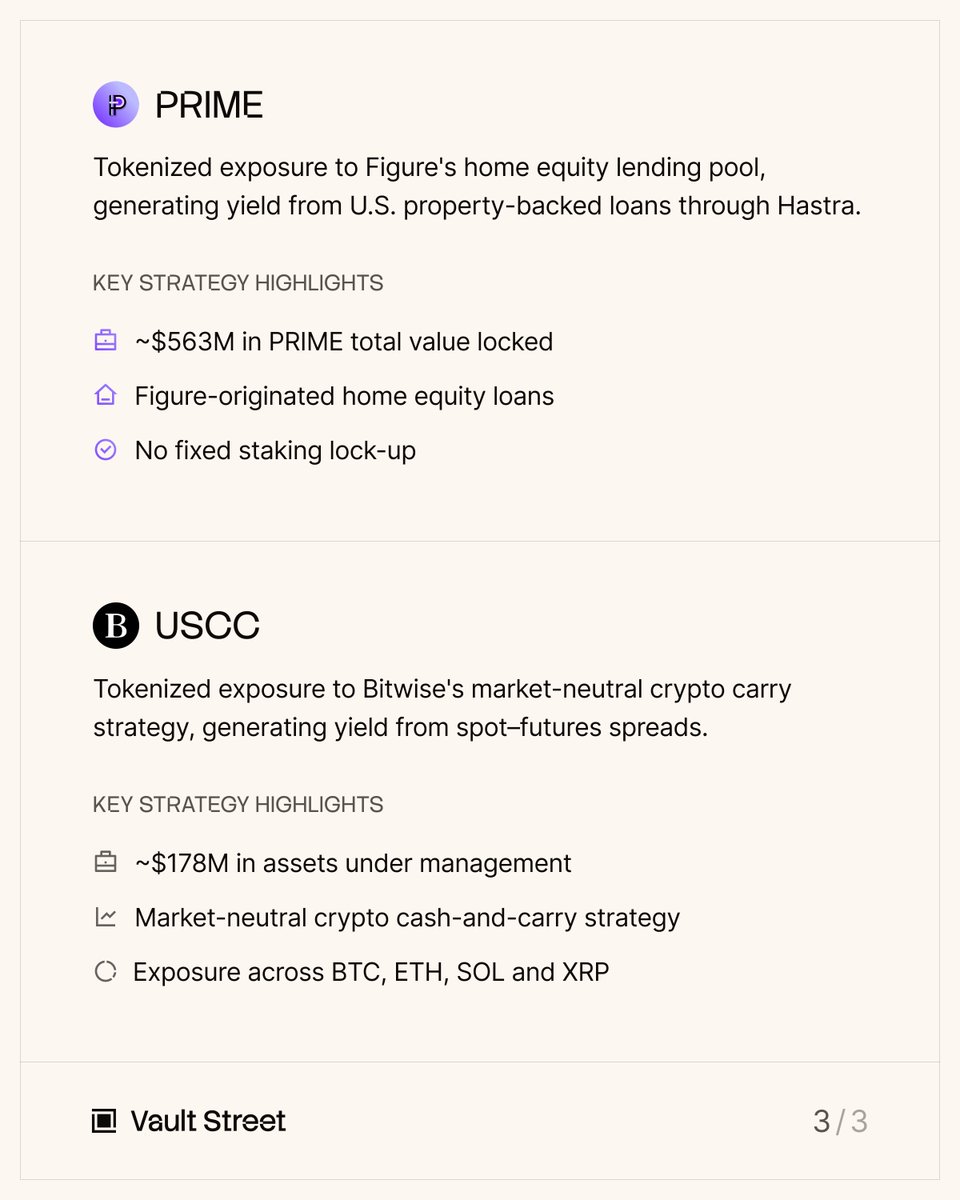
Most vaults are a black box.
CARRY lets you look inside: every asset, every strategy.
Live allocation → https://t.co/J2cbybaGb4
Due diligence on each asset → https://t.co/6z6lJV6u47
How do you actually get your money out of a tokenized fund?
$USTB is a good example. Its redemption process combines three layers:
1. An onchain buffer
A smart contract holds up to ~$10M in USDC, allowing smaller redemptions to settle instantly. Return your USTB tokens and receive $USDC in the same transaction. The available balance is publicly verifiable onchain.
2. Fund-level redemptions
Larger requests are handled by the fund itself. Redemptions are processed twice daily, usually settling the same day, with T+2 as the maximum. The portfolio holds short-term US Treasury bills with an average maturity of around one month, providing a steady stream of maturities converting back into cash.
3. A credit line from Invesco
Behind the buffer, a credit line from the fund manager pre-funds instant redemptions. As with most funds of this type, redemptions can still be paused or limited in extreme conditions, though this mechanism has never been needed.
The result: instant exits for smaller amounts, fund-level settlement for larger ones, and a short-dated portfolio supporting both.
We hold USTB in primeUSD.
Full report: https://t.co/R6ktvRIuyQ
@ShieldifySec Morpho is using our fundamental oracle under the hood. The price is already smoothed and has upper and lower bounds to prevent unexpected price spikes.
Inside @Vault_St’s monitoring stack:
→ 260 agents, tested and shipped as code
→ Exploit signals trigger an automatic pause
→ Economic signals go to PagerDuty or Slack
→ A heartbeat confirms the pipeline is live
Learn more: https://t.co/AMeHG22ag4
The Resolv Foundation is preparing an upgrade to the $RESOLV token contract on Ethereum to strengthen its ability to respond to exceptional security situations, such as theft, fraud or other illicit activity.
1/
How do you actually get your money out of a tokenized fund?
$USTB is a good example. Its redemption process combines three layers:
1. An onchain buffer
A smart contract holds up to ~$10M in USDC, allowing smaller redemptions to settle instantly. Return your USTB tokens and receive $USDC in the same transaction. The available balance is publicly verifiable onchain.
2. Fund-level redemptions
Larger requests are handled by the fund itself. Redemptions are processed twice daily, usually settling the same day, with T+2 as the maximum. The portfolio holds short-term US Treasury bills with an average maturity of around one month, providing a steady stream of maturities converting back into cash.
3. A credit line from Invesco
Behind the buffer, a credit line from the fund manager pre-funds instant redemptions. As with most funds of this type, redemptions can still be paused or limited in extreme conditions, though this mechanism has never been needed.
The result: instant exits for smaller amounts, fund-level settlement for larger ones, and a short-dated portfolio supporting both.
We hold USTB in primeUSD.
Full report: https://t.co/R6ktvRIuyQ
primeUSD performance has climbed fast recently. Yield is smoothed over time, so the visible APY is only starting to reflect it.
Behind it: higher collateral yields, rotation into the best performing loops & gains captured from recent market dislocations.
https://t.co/cFdLkTeXGa
A real case study from the Binance incident.
- Binance hack reported
- Everything moves at once: rates squeeze, liquidity leaves lending markets, every team tweets about its Binance exposure
- Our alerts fire, including on second and third order effects like stablecoin volatility
- We close our short on a moderately depegged stablecoin and book the gain into the primeUSD vault
- primeUSD prints 11.5% annualized this week on investment grade underlyings
This is what @HypernativeLabs agents are for.
Vault Street is hiring a Sales Manager.
We're looking for someone who knows the onchain ecosystem and can build relationships with allocators, funds and investors.
If you are excited by the future of RWAs and onchain yield, this is for you.
https://t.co/5ovIEhsF6x
How did our agent monitoring system perform during the Binance incident?
It enabled the team to react quickly and even increase the PrimeUSD vault yield.
A real case study from the Binance incident.
- Binance hack reported
- Everything moves at once: rates squeeze, liquidity leaves lending markets, every team tweets about its Binance exposure
- Our alerts fire, including on second and third order effects like stablecoin volatility
- We close our short on a moderately depegged stablecoin and book the gain into the primeUSD vault
- primeUSD prints 11.5% annualized this week on investment grade underlyings
This is what @HypernativeLabs agents are for.
@Vault_St is looking for a powerful Sales Manager to drive our product offerings to those who are (for whatever reason) yet unaware of these great opps.
If you have 1-3 years of well-proven sales experience and enjoy building relationships with sophisticated clients - check out the job description below!
https://t.co/ZdrLmU2mNf
Every layer of our security model assumes another could fail.
With @HypernativeLabs, 200+ agents watch every chain and venue we’re deployed on, 24/7.
🔴 High-confidence threats → automatic vault pauses
🟢 Market signals → our control room
See how our real time security works
How @Vault_St built security into the product with Hypernative:
→ 260 agents across nine chains, tested as code
→ Watchlists for every venue it allocates into
→ Automatic freezes on high-confidence signals
→ A heartbeat proving the pipeline is live
Read the case study: https://t.co/XxvfGTeDVG