We usually justify expert interaction (à la DAgger) by the factor-H savings, but there is much more.
Interaction lets you learn even when you can only model the expert's Q, and it's necessary.
New ideas for on-policy distillation too.
Link: https://t.co/dsfKi9niUZ
We have now crossed the threshold where developing theory has become orders of magnitude faster. It is now possible to rapidly develop theory that can drive AI research, not just explain it post-hoc. https://t.co/9OsBzGAWFZ
3. Now, to the math. In 2016 I proved a polynomial-decay theorem; the exponential-decay theorem was left open and has since remained one of my favorite problems. I always intended to come back to it. Actually, a month ago I tried to set GPT 5.5 on it, and it didn't make very much progress.
A couple days ago Lijie Chen (@wjmzbmr1) sent me and a couple others a writeup. Life was busy so I didn't get a chance to look, but I guess now the cat's out of the bag so I probably should opine a bit.
I presume the proof is correct (there's supposedly a Lean formalization, after all), but it will take me some time to digest it. I am gratified that it starts from where my paper left off, but goes beyond the limitations of my proof strategy by using some tricks and techniques that are probably known, in some collective fashion, to operator theorists and functional analysts. The reasoning document furnished by OpenAI is interesting but opaque: it states the problem, and then there's a leap of intuition on how to find the right purification using the "resolvent", and then does some exotic matrix entropy calculations to show that it works out.
I don't understand it yet. Maybe it'll take me an afternoon to check all the calculations, but what would still be missing is _why_ this was an approach that would've made sense in the first place. Is there some broader context or theory within which this would've been the obvious thing to do? What other results can be proven using these techniques? What is it telling us about quantum information or operator theory? I have no idea. I spent about an hour this morning asking ChatGPT these questions, but it's somewhat frustrating because it speaks with a mishmash of physicist, operator algebraist, quantum information theorist-lingo, plus the usual LLM breezy lilt that annoys everybody.
I would love to hear from experts who find these calculations familiar. I might write about this again when I understand better.
🚨Typical RL algorithms and on-policy distillation methods are blind samplers: they use privileged info to score rollouts, but not to *find* them.
We ask: can we use privileged info to *actively sample* the rollouts RL wishes it can stumble upon with compute?
⤵️ Pedagogical RL
new post on harness engineering for AI self-improvement: https://t.co/ZYvGfVs61k
It is hard to forecast how much the future of RSI will rely on harnesses. Likely harness engineering will evolve in the direction of self-improvement and enable auto-research, and, in turn, smarter models keeps harnesses simple.
Even when many harness improvement get eventually internalized into core model, the need to specify goals and context will not disappear.
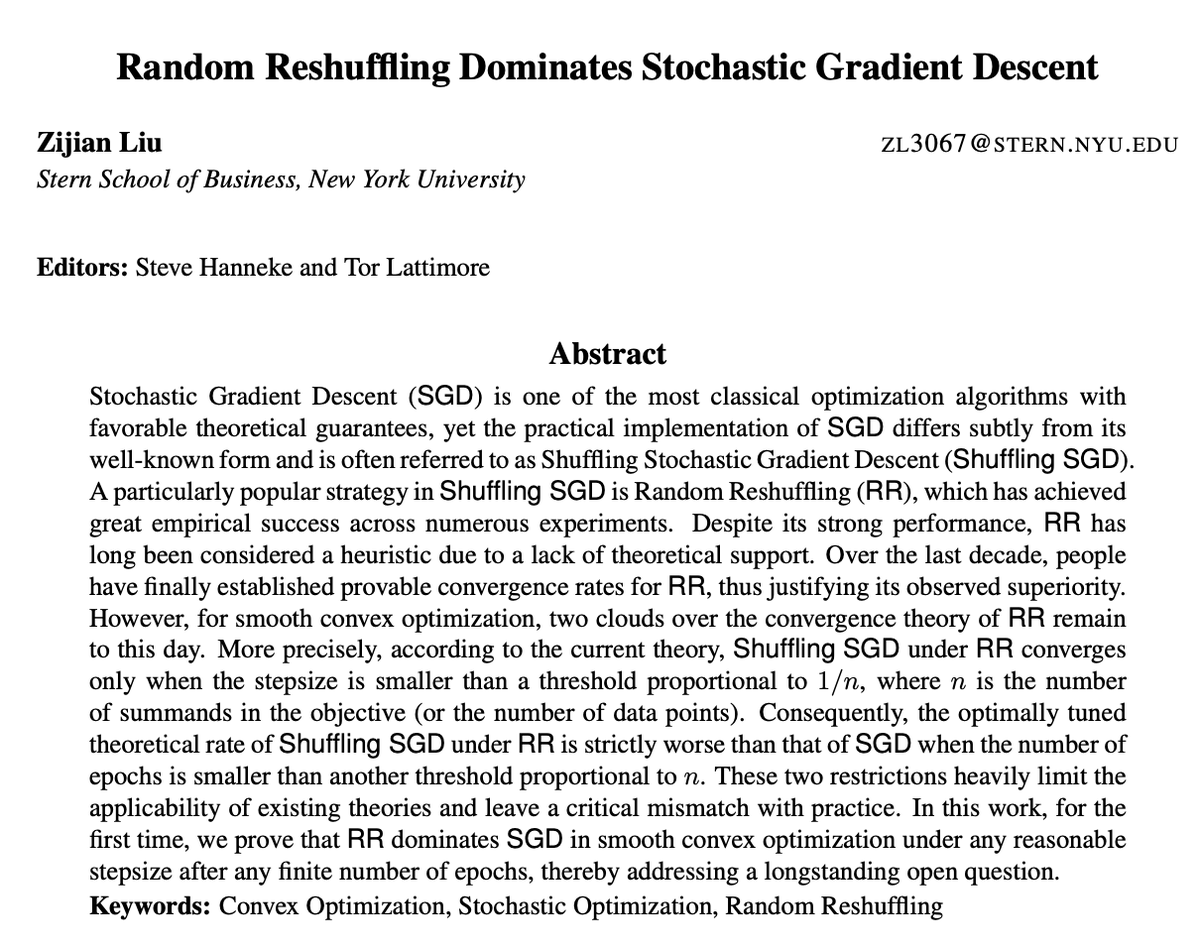
Quite enjoyed reading the proofs in this paper.
For anyone who doesn't know, you're no longer using SGD when doing multiple passes over your data. Most papers studying SGD essentially assume infinite amount of data, which isn't always the case in practice. The real algo is RR.