#Thread#ExportControl just changed shape. Not chips or tech, not code. It’s People. Foreign nationals, including a US lab’s own employees, locked out of frontier models overnight, wherever they sit.
Hmm… If talent itself is the leak, ring fencing tech gets a lot harder.
1/n
IISc-Led Semiconductor Training Initiative Records Massive Growth in Tribal Youth Participation Across India
The Semiconductor Training Program for Tribal Students, led by the Indian Institute of Science (IISc), Bengaluru, in collaboration with the Ministry of Tribal Affairs (MoTA) and supported by MY Bharat under the Department of Youth Affairs, has achieved a significant milestone in youth outreach and participation during its 2026 Phase-II implementation.
The initiative, coordinated through the Centre for Nano Science and Engineering (CeNSE), IISc Bengaluru, aims to provide tribal students and faculty members with advanced exposure to semiconductor fabrication, nanoengineering processes, and emerging technologies. The program consists of an online self-paced learning module, lectures by IISc faculty experts, and a 10-day residential training program at IISc Bengaluru with free travel, lodging, and food support for participants.
Read here: https://t.co/huXyStBljb
Something nobody's connecting: India's fertilizer production hit 62.37 lakh tonnes in just Mar-Apr 2026 while West Asia is in full crisis mode. Imports were only 15.39 lakh tonnes.
Five years ago we'd have been panicking. This time the plants kept running.
Quiet wins don't trend. But domestic urea capacity going from deficit to near self-sufficiency might be the most underrated industrial story of the decade.
Desperately need a tokyo trip this year. Hopefully cross paths with a girl who's also just passing through so we can spend a few nights together wandering the city, only to part ways forever and never speak again.
Buy some vintage designer, sing karaoke in shibuya, eat noodles at a counter next to businessmen who don't look up from their bowls. Drink some sapporos.
That feeling where you're lonely in a massive city and you're no one and somehow that's exactly what you needed.
Today, India takes a defining step in its civil nuclear journey, advancing the second stage of its nuclear programme.
The indigenously designed and built Prototype Fast Breeder Reactor at Kalpakkam has attained criticality.
This advanced reactor, capable of producing more fuel than it consumes, reflects the depth of our scientific capability and the strength of our engineering enterprise. It is a decisive step towards harnessing our vast thorium reserves in the third stage of the programme.
A proud moment for India. Congratulations to our scientists and engineers.
In the ancient Indian epic the Mahabharata, there is a crazy passage that describes a place called Hiranyapura. The name means the Golden City. According to the text, it was not built on land or on a mountain. It floated in the sky. The epic says this huge city was inhabited by powerful beings known as Daityas and Danavas. Its towers shone with a golden light and the entire structure moved through the air. The city could shift position in the heavens, making it difficult for enemies to approach or attack.
The story reaches its big point when the warrior Arjuna is sent by the gods to confront the inhabitants of this floating stronghold. Riding in a celestial chariot, he pursues the city through the sky and engages in battle using divine weapons (Astras). The Mahabharata describes flashes of energy, blazing projectiles, and parts of the airborne city collapsing as the conflict unfolds. Whether you believe it as mythology, symbolism, or something more mysterious, the story is one of the most bizarre scenes in ancient writing. It describes a moving city in the sky and an aerial battle that feels strangely modern for a text written thousands of years ago.
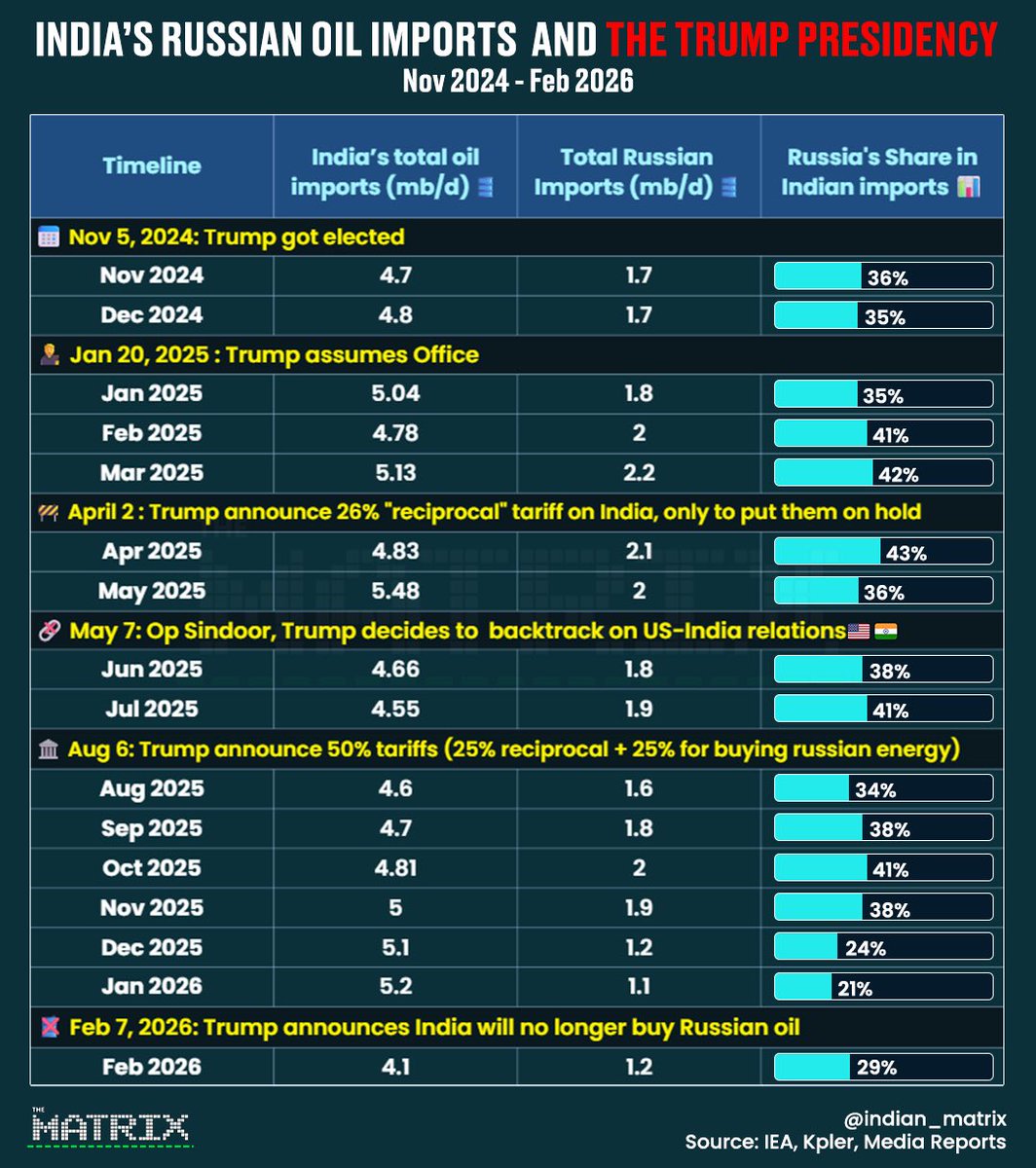
The data tracking India’s oil imports from November 2024 to February 2026 tells a definitive story: India’s energy policy is written in New Delhi, not Washington. Despite a volatile 15-month campaign of economic coercion by the Trump administration, the infographic reveals that India’s consumption of Russian crude was dictated solely by its own geopolitical calculations and national interest.
The pressure campaign began well before the inauguration, with Donald Trump issuing verbal threats as early as his September 2024 campaign. Upon taking office in January 2025, rhetoric turned into policy. On April 2, Trump announced a 26% "reciprocal" tariff. Yet, rather than caving, India’s intake of Russian oil surged, hitting a 43% share that very month, the highest in the timeline.
Relations further deteriorated following "Op Sindoor" in May 2025. By August 6, the White House attempted its most aggressive manoeuvre: a crippling 50% tariff (25% reciprocal plus 25% specifically for buying Russian energy). The data shows total defiance; instead of dropping, India’s Russian oil imports climbed from 1.6 mb/d in August to 2.0 mb/d by October 2025.
The saga concluded with American capitulation. On February 7, 2026, Trump announced the lifting of sanctions while threatening future consequences; yet, India's Russian oil imports rose by 8% in February from the previous month.
The US knew that India would not buckle under pressure. Consequently, the administration, amidst the Iran war, fully retreated on March 6, 2026, lifting sanctions with a face-saving 30-day window.
Ultimately, the reality of these 15 months proves that whenever the USA tried to arm-twist India, New Delhi prioritised its energy security. The numbers confirm that India does not bow to coercion, opting instead to secure affordable energy for its people regardless of threats from the West.
Following the ongoing situation in Iran, I am convening a special Security College on Monday.
For regional security and stability, it is of the utmost importance that there is no further escalation through Iran’s unjustified attacks on partners in the region.
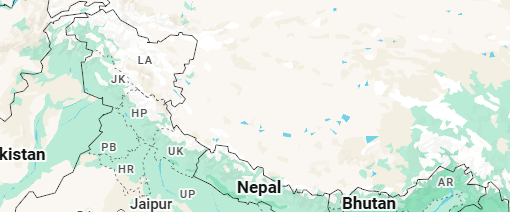
Maybe this went unnoticed, but since when did Google Maps start showing the map of India like this? If I remember correctly, it was always a dotted line. Did I miss something? #India#Kashmir#ArunachalPradesh
The math on this project should mass-humble every AI lab on the planet.
1 cubic millimeter. One-millionth of a human brain. Harvard and Google spent 10 years mapping it. The imaging alone took 326 days. They sliced the tissue into 5,000 wafers each 30 nanometers thick, ran them through a $6 million electron microscope, then needed Google’s ML models to stitch the 3D reconstruction because no human team could process the output.
The result: 57,000 cells, 150 million synapses, 230 millimeters of blood vessels, compressed into 1.4 petabytes of raw data. For context, 1.4 petabytes is roughly 1.4 million gigabytes. From a speck smaller than a grain of rice.
Now scale that. The full human brain is one million times larger. Mapping the whole thing at this resolution would produce approximately 1.4 zettabytes of data. That’s roughly equal to all the data generated on Earth in a single year. The storage alone would cost an estimated $50 billion and require a 140-acre data center, which would make it the largest on the planet.
And they found things textbooks don’t contain. One neuron had over 5,000 connection points. Some axons had coiled themselves into tight whorls for completely unknown reasons. Pairs of cell clusters grew in mirror images of each other. Jeff Lichtman, the Harvard lead, said there’s “a chasm between what we already know and what we need to know.”
This is why the next step isn’t a human brain. It’s a mouse hippocampus, 10 cubic millimeters, over the next five years. Because even a mouse brain is 1,000x larger than what they just mapped, and the full mouse connectome is the proof of concept before anyone attempts the human one.
We’re building AI systems that loosely mimic neural networks while still unable to fully read the wiring diagram of a single cubic millimeter of the thing we’re trying to imitate. The original is 1.4 petabytes per millionth of its volume. Every AI model on Earth fits in a fraction of that.
The brain runs on 20 watts and fits in your skull. The data center required to merely describe one-millionth of it would span 140 acres.
Somewhere, a radio crackled, “I am Subhas Chandra Bose who is still alive and talking to you…”
On Netaji Subhas Chandra Bose’s birth anniversary, let me take you through a journey that is rarely told properly. No slogans. No mythology. Just how one man walked out of British India while an empire watched him closely.
December 1940. A telegram reaches a village in Nowshera. Two words. Reach Calcutta. Mian Akbar Shah knows exactly who it is from. He tells no one. He boards the first Frontier Mail and reaches Calcutta in three days. The night on Mirzapur Street is long. He knows whatever comes next cannot be reversed.
The man he meets the next morning does not resemble the Netaji people remember. He is frail. Ill. A thick unkempt beard hides his face. But the voice remains steady and unmistakable. “I have to leave this nation now,” he says. “You will have to help me. It is getting unbearable here.” The decision is already final.
What follows is not drama but discipline. Shopping on Dharamtala. A visit to Wachel Molla’s. Essentials bought quietly. Cards printed in the name of Ziauddin, insurance agent. Sisir Bose, just twenty, is briefed. Routes are tested. Fatigue is measured. Speed and secrecy become the only priorities. The car chosen is a German Wanderer.
On the night of 16 January 1941, a bearded man steps out of 38 by 2 Elgin Road. CID patrols are routine. Local police are active. Informers exist everywhere, in organisations, in households, even within families. Timing matters. A hold all is slipped into the boot. The car moves before the street becomes unsafe again. At that moment, the British lose Subhas Chandra Bose.
They avoid toll bridges and take the longer Howrah route. At one point the driver brakes hard to avoid a herd of buffalo crossing the road. No one speaks. The silence is heavy but controlled. By the time they reach Barari in present day Jharkhand, the escape has already worked.
The next day Sisir drives him to Gomoh. That night Netaji boards the Delhi Kalka Mail. From there he moves across borders using borrowed names and carefully rehearsed stories. In Kabul he becomes Ziauddin Khan, deaf and mute, travelling on pilgrimage. When stopped, his companion explains everything in fluent Pashto. The police leave. Five minutes later the mute man speaks. The cover has held.
By March 1941 he is moving through Russia on an Italian passport as Orlando Mazzotta. NKVD guards accompany him without knowing who he is. Others know. They touch his feet. Eyes well up. He offers silent prayers. Everyone involved understands the risk. No one asks questions.
On 28 March 1941 he reaches Berlin. No money. No army. No government. Only clarity. He knows what people back home think of him. He knows the odds. But waiting for the British to hand over freedom is no longer an option. If dealing with their enemies is required, he will do it.
Within weeks German radio announces his arrival. British intelligence is stunned. Bengal CID’s surveillance collapses in embarrassment. Twelve full time spies and still he slipped through. A manhunt begins across dozens of countries. It finds nothing.
When it becomes clear that freedom is not coming from London, Netaji speaks to India from exile. He sits before a microphone and says calmly, “I am Subhas Chandra Bose. I am still alive. And I am speaking to you.”
From here the story moves further. Submarines. Japan. An army raised from scratch. A government in exile. That is the next chapter.
This one is simply about resolve.
And about what happens when a man decides he will not wait.
Vande Mataram.
The influx of Bangladeshis is no longer limited to border states. They are present across many states in roles we never imagined. Recently noticed this at #24kkraftbrewzz, Pavilion Mall, Pune - most waiters were Bangladeshis. Something needs to be done.
@PuneCityPolice@HMOIndia