@VIKRAMPRATAPSIN # Fact Check
The viral claim is misleading. No such decision has been announced to cancel the passports of CJP protestors. Citizens are advised not to share or amplify misleading posts and to rely only on official information.
@VIKRAMPRATAPSIN
I have never considered myself a political person. But I do believe that some issues belong to all of us, regardless of where we stand. Education is one of them.
The measure of a nation is found not only in its economy or its achievements, but in the opportunities it creates for its young people. An education system that inspires confidence, rewards merit and nurtures curiosity is one of a nation’s greatest strengths.
I hope we can all unite and work together to continually strengthen our education system, so that it remains a source of opportunity, innovation and hope for generations to come.
The real cost of India's data boom isn't wasted time.
It's the quiet erosion of our ability to wait.
Cheap mobile data has given millions of young Indians unlimited entertainment in their pockets. Every notification, every reel and every swipe offers an instant reward. The brain adapts. Over time, it begins to expect that every worthwhile experience should arrive immediately.
That is where the real damage begins.
Books ask you to stay with one idea for hours. Newspapers ask you to understand context instead of headlines. Learning a skill demands months of practice. Building a business takes years. Investing requires patience. None of these activities deliver dopamine every few seconds.
Scrolling does.
India reached the smartphone age long before it reached widespread prosperity. We imported the world's most addictive digital products while we were still trying to build human capital. The result is a strange mismatch. We have first-world levels of digital stimulation, but we are still a country that desperately needs first-generation learners, skilled workers, entrepreneurs, scientists and readers.
The opportunity cost is enormous.
Every hour spent mindlessly scrolling is an hour not spent building knowledge that compounds for decades.
Reading is different. A book slows the mind down. It strengthens attention, curiosity and independent thinking. Newspapers teach you to connect events instead of reacting to isolated headlines. Productive learning develops skills that increase your earning power for life.
These are all compound investments.
Social media mostly compounds for the platform.
A nation does not become rich because it consumes the world's most data. It becomes rich because its people accumulate knowledge, skills and productive habits.
Perhaps we are measuring the wrong statistic.
Instead of celebrating data consumption per person, we should ask a different question.
How many books does the average young Indian read every year? How much uninterrupted time do they spend learning something difficult?
Those numbers will tell us far more about India's future than gigabytes ever will.
Back then, kids grew up without the constant pull of 24/7 WhatsApp, FB, Insta and social media distractions. Today, India leads the world in per capita data consumption, the undisputed gold medallist!
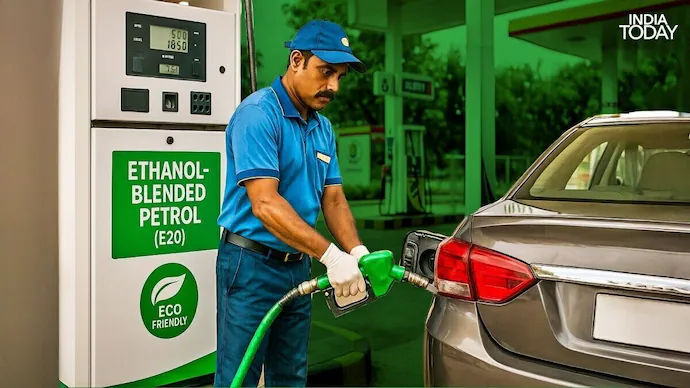
#Opinion | India's biggest experiment isn't happening in a laboratory. It's happening at fuel pumps, with 1.4 billion people as the sample. Welcome to the world's biggest fuel trial, where every Indian motorist is unwillingly, a participant.
Read in detail: https://t.co/uaPj22Rrm3
✍️ @yudhajit
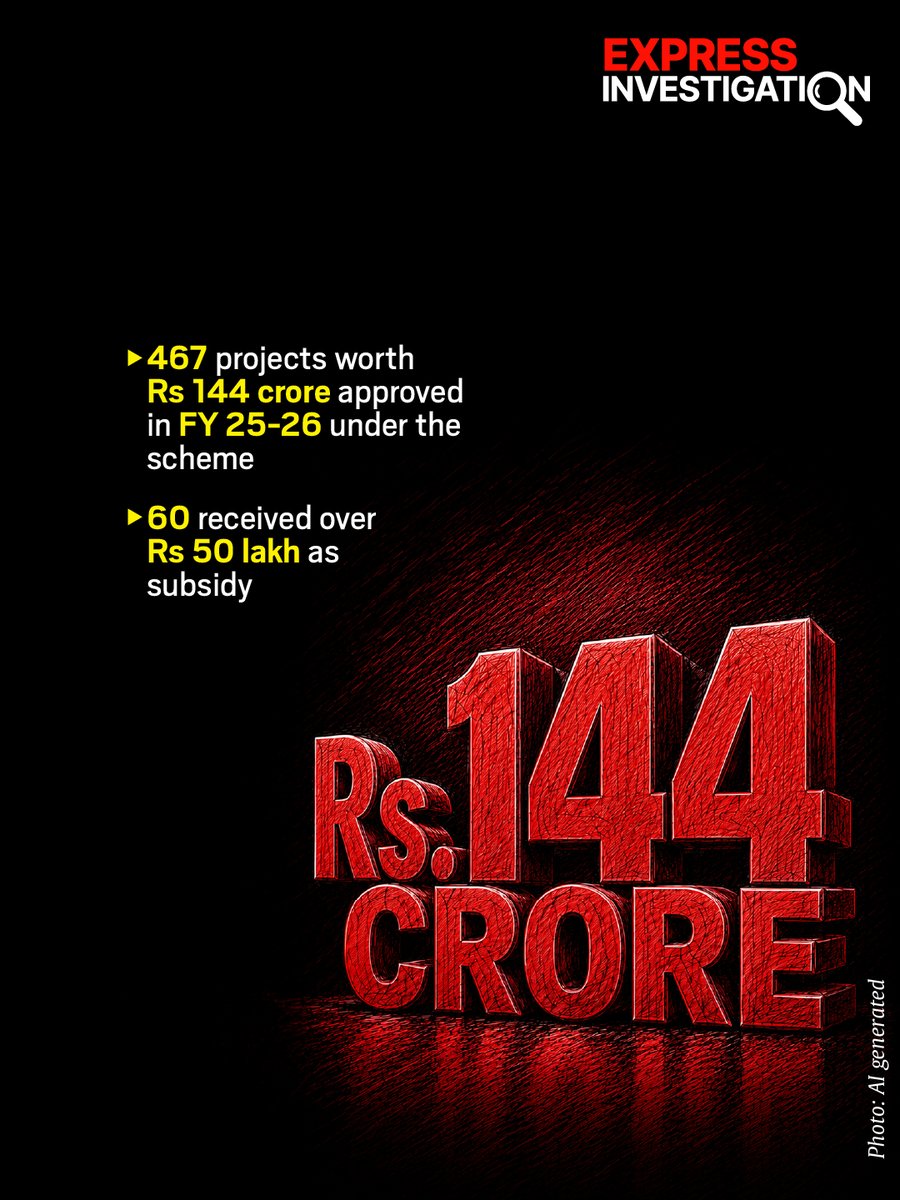
🚨 #ExpressInvestigation | The Union Minister of State for Agriculture Bhagirath Choudhary received a ₹99.03 lakh subsidy for a commercial cucumber farming project under a scheme run by the ministry he serves in.
While the final approval was granted by an NHB project approval committee that does not include the minister, Choudhary is the ex-officio Vice-President of the NHB board that oversees its functioning.
The project, worth ₹1.99 crore, was among 467 approved under the scheme in 2025.
Express Investigation by: Harikishan Sharma
JRD Tata loses a pen!
JRD Tata, then Chairman of the Tata group, and senior Tata Directors used to meet for lunch at Bombay House (the Tata Group's headquarters) every day. One day, JRD came to lunch, sad that he had lost his favourite pen. He used to always carry a Parker pen set - a fountain pen and a ball pen.
"Look", he said sadly, "I have lost the ball pen. I don't know where it has gone. I have looked all over...but it's gone."
One of the Directors in the lunch room that day was Dr. Jamshed (JJ) Irani of Tata Steel. He made note of JRD Tata's loss. A few weeks later, when he was visiting London, he went to a small shop near Selfridges specialising in pens, and found a ball pen identical to the one JRD had lost. He bought it immediately. The next time he met JRD Tata, he presented that pen to him.
JRD was delighted. "Yes, Jamshed, it is exactly like the one I lost." For the first one or two minutes, he used it and tried it out. Then, Dr. Irani saw JRD's expression change slowly.
After a couple of minutes, he gave the ball pen back to Dr. Irani, and said - "Thank you for the thought. This is exactly what I wanted, but I cannot accept it."
"Why?" asked Dr. Irani, "I thought you were looking for this."
JRD answered - "Yes, Jamshed. But it is a principle of mine not to accept any gifts from any of my colleagues at work. If I did, then I know my colleagues would try to outdo each other and give me exorbitant gifts."
Dr. Irani tried to persuade him. "But Sir, nobody would know that I have given you this pen. You can say that you found it in your room. I am not going to go around saying that I have given JRD an identical pen."
JRD responded - "Jamshed, I know you will not do any such thing. But I would know. I would know that I accepted this gift against my principles. I am sorry, but I cannot accept it."
Each of us decides the principles by which we lead our lives. The principles that we will stand by, even if no one is looking or speaking about them. The principles that define who we really are. This story of JRD Tata's lost ball pen can help us reflect on what our own life's principles are. #Tata #ethics
Have I missed it? Not one minister from the Government has commented on the Rajesh Exports mega scam.
Why? Who is going to step up and take responsibility for it?
Read this story. Carefully.
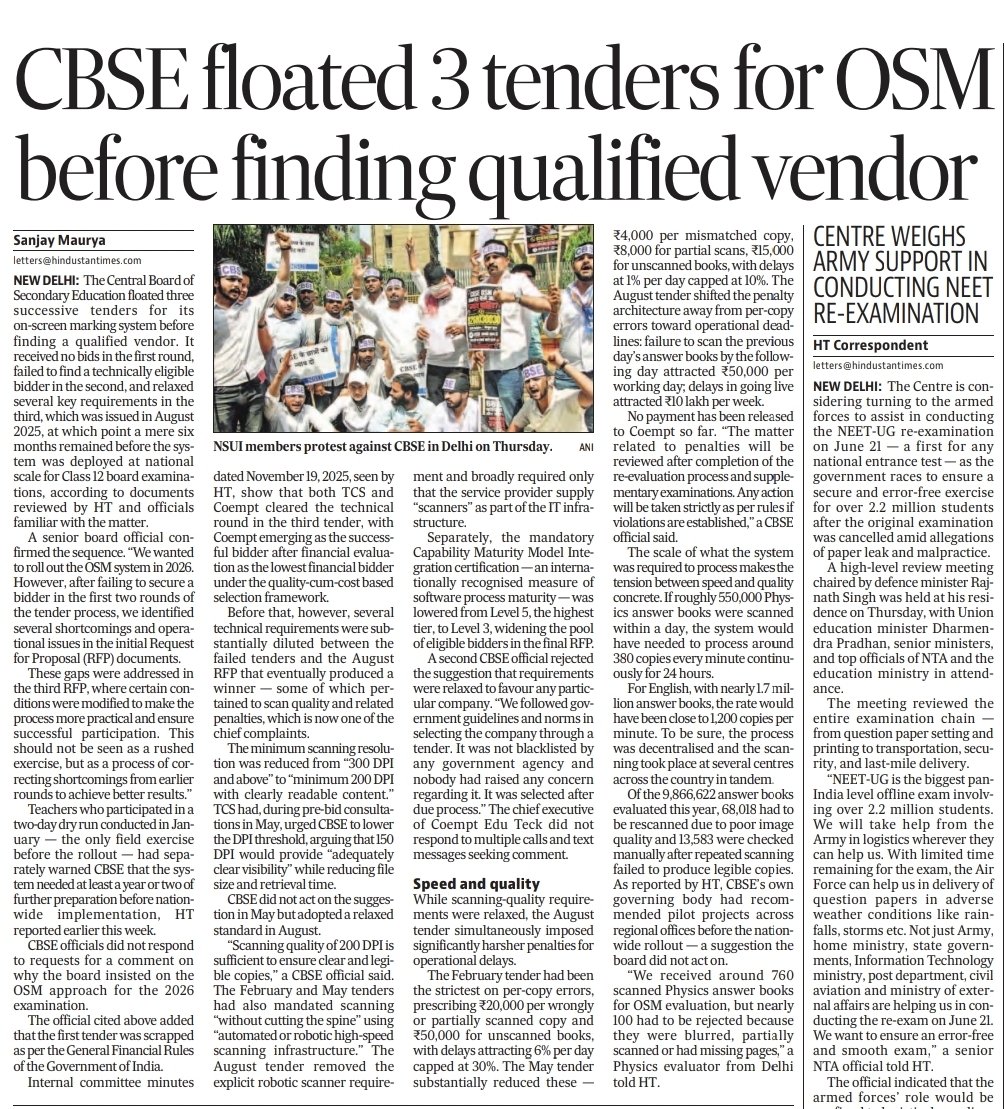
CBSE called for OSM tenders thrice. Zero bids the first time. No qualified bidder the second time. And finally, the technical bar was lowered until COEMPT could clear it.
Scanning resolution cut. Robotic scanner requirement dropped. CMMI certification lowered from Level 5 to Level 3. Penalties for errors in answer sheets removed.
TCS, India’s biggest IT services company, qualified in the third round too. TCS lost. COEMPT - a company with a spectacular track record of failure - won.
And what are CBSE students complaining about today? Badly scanned answer sheets. Missing pages. A broken evaluation portal.
Teachers had warned CBSE that the OSM system needed at least a year or two for further preparation before nationwide implementation, yet it was rushed through.
So I ask again - who wanted COEMPT to win? Who lowered the bar, step by step, until this company could clear it?
Pradhan ji and CBSE say “due process was followed.” That is not an answer, that is not accountability. The question is whether the contract was honestly awarded to the best company which could do the job correctly.
The futures of 18.5 lakh children were handed to a company that could only qualify after the rules were bent for it.
To the BJP Ministers attacking me for asking questions - I have, from day one, demanded an independent judicial probe. Expand it from CBSE to every contract awarded to COEMPT. Our youth deserve the truth.
And Modi ji, your silence on the CBSE debacle and inaction against the Education Minister tells the country what you actually care about - not the futures of lakhs of students, only the survival of your own government.
𝐈𝐬 𝐄𝟐𝟎 𝐩𝐞𝐭𝐫𝐨𝐥 𝐪𝐮𝐢𝐞𝐭𝐥𝐲 𝐢𝐧𝐜𝐫𝐞𝐚𝐬𝐢𝐧𝐠 𝐲𝐨𝐮𝐫 𝐦𝐨𝐧𝐭𝐡𝐥𝐲 𝐟𝐮𝐞𝐥 𝐛𝐢𝐥𝐥? 𝟓 𝐢𝐧 𝟏𝟎 𝐨𝐰𝐧𝐞𝐫𝐬 𝐬𝐚𝐲 𝐲𝐞𝐬
A LocalCircles survey says many owners of older petrol vehicles have seen lower mileage after the E20 rollout. The findings sharpen consumer concerns over fuel costs, repairs and the shift towards higher ethanol blends.
Read more: https://t.co/dUH1nhASDs
I've already retweeted @Options_IndiaAB post.
Since I want this to reach lot of people, posting it separately too.
Here is the post:
I recently spent 2 weeks in China.
6 cities: Shanghai, Beijing, Xi’an, Zhangjiajie, Chongqing and Chengdu.
I went there with curiosity.
Like many Indians, I had heard a lot about China through media, social media and conversations. I expected to see progress, maybe discover some business ideas, and understand what the country is actually building.
I came back with a very uncomfortable feeling.
Not because I found a business idea for myself.
But because I saw 100 things that governments can do when infrastructure, tourism, transport, urban planning and civic systems are treated seriously.
I travelled within China by flights, trains, cars and local transport. The infrastructure was honestly stunning.
Clean cities. Smooth roads. High-speed trains. Well-managed traffic. Public spaces that actually feel designed for people. Tourist destinations that are built, maintained and promoted like national assets.
And then I kept thinking about India.
We keep comparing ourselves to China. Our media keeps telling us how India is catching up, how China is restrictive, how we are better in so many ways.
After spending time there and speaking to people, I realised how much of that narrative is just comfort food.
China is not perfect. No country is.
But on infrastructure, execution, tourism, civic discipline and quality of urban life, they are not 5 years ahead of us.
They are decades ahead.
The saddest part for me was the currency.
Everything felt expensive. Not because China was insanely expensive, but because the rupee has weakened so much that even normal spending starts feeling heavy. As an Indian taxpayer, that genuinely hurt.
We pay taxes. We work hard. We talk about becoming a global power.
But where is the quality of life?
Where is the civic sense?
Where is the infrastructure that makes daily life easier?
Where is the tourism vision beyond religious tourism?
I met travellers from other countries who were excited to visit China because they wanted to see its progress. When I asked about India, many had no real desire to visit. Not out of hate. India simply was not on their aspirational travel list.
That should bother us.
Even the so-called “closed internet” surprised me. We are told people there are missing out because they don’t use Google, Instagram, WhatsApp or Facebook.
But China has built its own digital ecosystem. Payments, maps, transport, messaging, shopping, everything works inside their own infrastructure. People did not seem to feel deprived. They seemed adapted.
Again, this is not a hate post.
I love India. That is exactly why this trip bothered me.
Patriotism cannot only be about saying we are great.
Real patriotism is having the courage to admit where we are falling behind.
China made me realise one thing very clearly:
India’s potential is not the problem.
Execution is.
And unless we stop comforting ourselves with comparisons and start demanding better infrastructure, better governance, better tourism, cleaner cities and a higher quality of life, we will keep celebrating the idea of progress instead of actually living it.
I am willing to lay the opposite bet.
I was with the 3 foreign tourists recently in India for a few days. When you look at it from the lens of F2 tourists, barring Taj Mahal & Rajasthan Palace Hotels, there is nothing else that they want to see here with they cannot get anywhere else. ( And of course the approach to the Taj ,less said the better)
International cards don't work in many many places.
They don't want to carry a lot of cash around because of safety.
The dirt, squalor ( just outside beautiful Deer park in Delhi, there is a dump truck permanently parked and never cleaned.
Non existent roads and payments in most parts
Terrible driving ethics whether it is on red light or coming the same way in a one way road whether it is within the city or on highways
People who are not cultured or polite or even with basic manners of holding doors open or saying thank you
Eg, Goa could have been our Bali , Phuket. But for that we need a swinging liberal culture not moral policing. And yes we need garbage free roads.
Out of the 90 lakh tourists every year that come, I am counted a minimum of 20 times because I visit India that many times per year. NRIs are probably 40- 50% of that number.
Genuine F2s, F2- esses are probably half.
Other countries have not stood still and they have executed. People want amazing places to spend money on. Bali has 80 lakh tourists. Happening night life. Super cheap. Phuket too. Vietnam.
Here we only talk and that's where it ends.
But yes, this opportunity is a permanent past , present and future opportunity
Thinking of it, the Ambani famly post Dhirubhai has not built a SINGLE business which brings export $
Kitna din chalega- Shein re-seller, Colored Soda, Ice Cream, Bhujia, Chips etc
Buy some global brands like how Chinese bought Volvo, use Indian base to turn it around ( whirlpool kind of brands which is cheaper than 2-3 weddings is a great place to start)