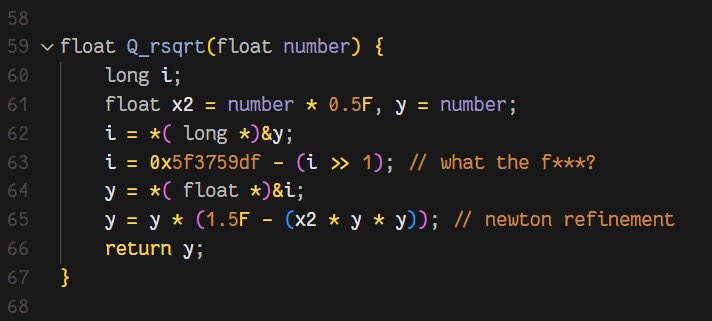
the most famous comment in all of C programming history. written by a developer at id Software in 1999 for Quake III Arena
one line of pointer casting, one bit shift, one subtraction and somehow you have 1/√x.
just bit manipulation, a constant, and a final newton refinement step.
the comment reads: "what the f***?"
"A calculator app? Anyone could make that."
Not true.
A calculator should show you the result of the mathematical expression you entered. That's much, much harder than it sounds.
What I'm about to tell you is the greatest calculator app development story ever told.
El presupuesto para la educación superior 2024 es de 7,3 billones. El ministro Rojas anunció esta mañana que para 2025 será de 4,6. Esto supone un recorte del 37% sin contar inflación.
¿Cómo habría reaccionado el movimiento estudiantil si otro gobierno hiciera semejante recorte?
Hola, soy demógrafo. en estos días de incendios forestales en Colombia empiezan a oirse las voces de quienes gritan que la culpa de la crisis climática es que hay mucha gente en el mundo y que lo mejor que podemos hacer para salvar el planeta es no tener hijos. esto no es cierto
79% of psychiatrists would recommend immediate treatment with an antidepressant for a depressed patient – but only 39% would take that path themselves. Most would opt instead for watchful waiting. https://t.co/M6v2WrcwRR
Querer vivir de lo que a uno lo apasiona es un sueño burgués. Lo más sensato es conseguir un trabajo que permita una buena vida y tiempo libre para dedicarle a las pasiones. Lo demás son pretensiones adolescentes que los van a sumir en depresión.
#OpiniónEE Vivir en la ciudad no debería implicar el aguante de cantidades excesivas de ruido. Tokio, aunque no lo crean, es silenciosa. La cuestión se reduce a que allá los carros no predominan. Se los cuento aquí:
https://t.co/77X3pvdoEb
#PhD student: Makes $30k a year. Works on weekends as well. Zero life-work balance.
"Do you think I have a chance to become a professor?"
Prof: "Yes, of course! Finish this project and we will publish excellent papers. I am sure you will easily find a faculty position."
▫️
2 years later:
Student finishes the project. Professor writes a report. Papers are published.
Student: "Do you think my CV is strong enough?"
Prof: "Yes, you are the best!"
▫️
Next 4 months:
Student submits 50 well-tailored applications for faculty positions.
Zero interviews. A lot of broken dreams.
▫️
Key takeaways:
1. Make sure you distinguish encouragement from reality.
- By encouraging you, your advisor may unintentionally give you too much hope. Keep a cool head.
2. Always ask other faculties for external opinion on your case.
- Your advisor’s opinion is always biased. Look for more input outside your group.
3. Don’t expect fairness during candidate selection.
- Hiring process is subjective by definition. It is done by people with very different views on who is the best. You may put tons of efforts into a research statement only to find out later that no one really reads it.
4. The reality is brutal.
- Departments can receive 300-500 candidates per opening. Many have excellent CVs and cool ideas. At top- and mid-rank universities, selection criteria can become extremely questionable (like, who exactly was your PhD advisor? Is your recomm. letter 3 pages long? etc).
And there is no need to say “You don’t know anything about it. It’s not like this”.
I went through this myself. Many times. Along with many colleagues.
Do not expect fairness. See luck as a big factor.
Apply broadly but have a backdoor ready.
#AcademicTwitter
Sifan Hassan's remarkable marathon win:
Stopped to stretch twice 🙆♀️
Looked like she was out of the race ❌
Managed to catch up with leading pack 💨
Missed her drink station before offering it to rivals 💧
Won on her debut against the most stacked women's field in years 🥇
👀 A strong sprint and an incredible win for @aliACTIONjackso! 👏
👀 Un sprint tout en puissance pour une victoire incoyable d'Alison Jackson! 👏
#ParisRoubaixFemmes#WatchTheFemmes
Un estudiante de maestría expone los resultados año y medio de trabajo, al finalizar un evaluador externo pregunta: -¿Y esto para qué le sirve a la sociedad?
Uno no sabe para qué le sirve a uno lo que está haciendo, ahora para hacer algo que le sirva a la sociedad.