To my eyes, the available evidence strongly suggests we should delay the second vaccine dose until more people have had the first. #SecondDoseDelay I'd like to be even more bold than the authors (two of my pandemic heroes) propose. https://t.co/8B3FuIOB1J [thread]:
My @nytopinion colleague @ezraklein on how an obsession with efficiency can cost us our humanity — in this case, in how we (mis)treat pigs on factory farms, and how some in Congress aim to make this trade off worse. https://t.co/HjUthpHWNy
If Fable gave a detailed account of what was censored for each query then that would itself aid research they don’t want to aid, including, perhaps, via jailbreak.
I’m not sure we should expect Anthropic not to protect their IP.
I did not say it is obviously anti-competitive in the legal sense, I said it is obviously describable (a lawyer would say colorable) as anti-competitive, in both a legal sense, but much more importantly, in a broader sense. It’s clearly anti-competitive for an ai research company to silently sabotage people who try to do ai research using their products. Banning that use case is fine, but the silence and ambiguity of the sabotage is the salient thing.
@paulnovosad@Inframethod And/But this isn’t an insurmountable problem… in class quizzes, tools that take input from a computer while noting typing patterns and blocking outside tools, tools that assess whether AI is used well, etc
I really appreciate the idealism of everyone who is so good at spotting stock market bubbles and uses that skill to do political punditry rather than getting rich as an investor.
I'm a moron who buys and holds because I think errors are equally probably in either direction.
I like working out of both Stanford and Constellation, because my econ-of-AI views are usually “right in between” the views of the people I respect in the singularitarian community and the people I respect in the economics community. Of course, the communities I happen to have wound up part of probably largely determine what my views are in the first place. But I do think it's an interesting sociological fact that there seem to be fewer people with something like my "in between" views than people at either extreme.
It’s funny to use the term “right in between” when the poles are so distant, but concretely--
On the technological question of whether by, say, 2040 we'll get superintelligence [machines that can shortly thereafter cure death, develop atomically precise manufacturing, solve or dissolve ~all our perennial philosophical disputes, and tell us how to quickly build von Neumann probes that put Dyson spheres around the stars]: For my singularitarian friends this is the default outcome of the trajectory we're on, and 2040 is late. For the economists (like almost everyone else), even contemplating this stuff is nutty. I give it a 10-20% chance.
On GDP: For my singularitarian friends, building fully humanoid bots (which I do think is more likely than not by 2040) will be analogous to a return to a Kremer (1993)-style Malthusian world in which GDP grows ~hyperbolically (so, with the growth rate itself rising to infinity). The economy, on this view, will ultimately grow at the rate at which robots can multiply, which is bounded below by the rate at which octopuses can multiply, which is 250,000x/yr. For my economist friends, humanoid bots would just be another step in the ongoing process of automation sustaining 2-3% growth. My central guess is that preferences for humans in some domains; nonhomothetic preferences for new goods (see https://t.co/Mmct8FgJX4, "New goods Baumol"); and regulation will all meaningfully constrain growth from the octopus baseline, so that this century contains "only" around 1 more OOM increase in the GDP growth rate, to ~20-30%/year.
Likewise, on real interest rates: central guess is their peak "steady state" this century is not >25 million %/yr, but ~30%/year
On wages: Singularitarians tend to think they'll fall to ~0; economists tend to say they'll grow roughly as fast as the economy at large; I think they'll rise but not as fast as the economy (so that the labor share will fall a lot)
Etc.
I think the reason is just that the communities somewhat seal themselves off from each other, so the insights from each take a while to seep through to the other. This doesn't mean that they're both doing something wrong--maybe one of them is just a cult (a majority too can be in a cult!) and the other shouldn't be updating toward them at all--but I do think it means that at least one of them is doing something wrong. Without going full "Aumann's theorem", I think that even without common priors or common knowledge of rationality, an environment with healthy information flow would usually exhibit single-peaked distributions of opinion on these sorts of questions.
@DougSaunders pro-natalist here... I like humans and notice that most of them are happy to be alive. Yes, I also think it is likely to cause political and societal problems if the population crashes.
"Why did an entertainer with a history of promoting pseudoscience decide to dedicate the rest of his career to auditing Medicare Advantage and adding accountability to traditional Medicare?
"Why did he choose one of the most technocratic jobs in Washington?"
Is it possible to spot a good forecast by its rationale?
We used LLMs to score the reasoning behind 55,000+ forecasts and test the link between forecast accuracy and written rationales.
We found that:
• Causal reasoning is much more prevalent than statistical argumentation
• It's easier to identify poor forecasters rather than excellent ones
• Human ratings of rationale quality can be unreliable.
🧵A thread on the results:
Interesting, I wonder if Borjas’ ideology produced biased results. ;)
I haven’t looked at the data analysis and I’d love to have it convince me ideology has zero impact on regression specification/interpretation, but I don’t think this null result will convince me… how precise is it?
@RandPaul@epaleezeldin Have you taken a position against the “Save Our Bacon Act” consider states’ rights as well as public opposition to industrial pig torture.
Here's what the pork industry doesn't want you to know about the way it sneaked a provision into the 2026 farm bill that would nullify ballot measures that improve animal welfare, while helping Chinese companies torture American pigs. The issue is personal to me, because we once raised pigs on our family farm, and I saw that these are not commodities but animals rather like dogs: smart with very distinct personalities. A naughty boy who punishes a single animal may be punished, but an adult who presides over the systematic abuse of hundreds of thousands of pigs as a business model is hailed as a visionary CEO -- and voters get that, and that's why they have backed laws that improve animal wellbeing. This is, remarkably, an issue that unites many liberals and conservatives alike; @TomiLahren, @Cernovich and @IngrahamAngle are among those who have been outspoken on this issue. I hope R and D members of Congress alike will stand firm, for the stakes are immense, with four pigs slaughtered around the clock on average all year. Here's a gift link to my piece: https://t.co/NWQbJK6JTc I welcome your comments.
America's cultural ideal has been the self-made entrepreneur while Europe's was rooted in aristocracy, with status inherited rather than earned. Europe's inheritance laws show this divide.
Many European countries have "forced heirship" laws that require people to leave 50-75% of their estates to their children. Want to leave the majority of your wealth to charity? not allowed. Your kids are estranged from you, struggling with addiction, or irresponsible? still required to give them the money. Want your kids to avoid a life of entitlement? tough.
Incredibly, these laws look back at transfers made during your lifetime. If you have 3 children in France, you're required to bequeath them a minimum of 75% of your estate. Because French law calculates this based on your assets at death plus all lifetime gifts, giving away more than 25% of your wealth while alive means your heirs can legally sue to force charities or foundations to return the funds. This has limited the development of the nonprofit sector on the continent.
The cultural gap between an entrepreneurial society and one shaped by dynastic wealth is enormous. If you make it yourself, you tend to want your kids to do the same. If you inherit it, the primary goal is protecting the estate for the next gen.
Countries like Spain, France, and Italy legally entrench family dynasties, while America has historically sought to limit them through estate taxes. The result is not only a weaker culture of philanthropy and civil society in Europe, but also less economic dynamism.
Authors can't be trusted to run their own robustness checks.
In 17 AER papers, only 12/211 robustness checks "fail" with p > 0.05 (white).
In robustness checks chosen by 3rd parties, almost *half* of them fail (blue).
1/
So everyone agrees this “(far better than high school GPA).” is wrong.
But I think the paper Stefan cites as a rebuttal has an abstract that encourages people to draw bad policy conclusions.
“Which is more predictive of ‘outcomes’” is a bad question… need to assume it’s contextual.
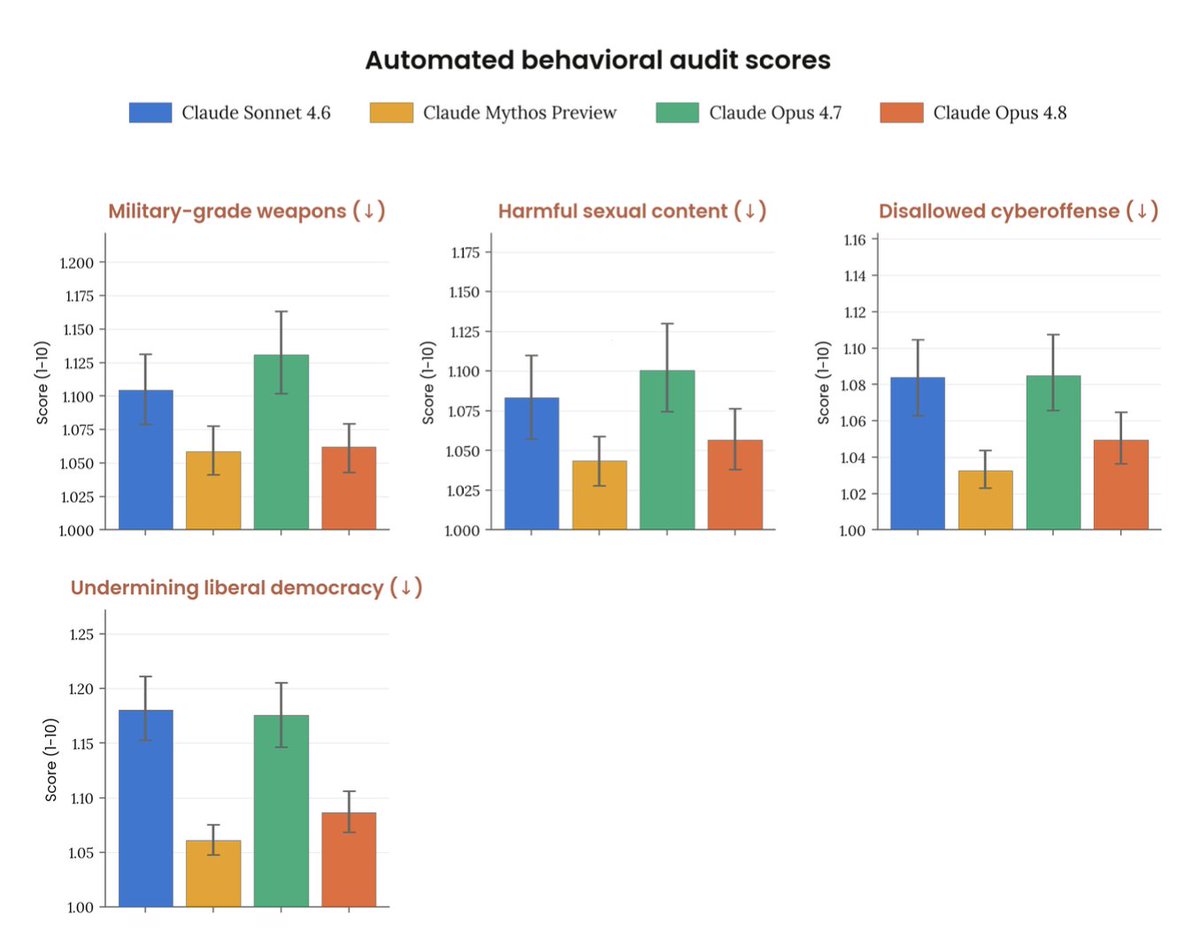
Opus 4.8 demonstrates continued improvement on the Free Systems dictatorship eval -- and we're thrilled that Anthropic is now directly running and incorporating the eval, which is cited in 4.8's model card (they call it "Undermining liberal democracy").
I hope that Google and OpenAI will follow suit!
Now that a major lab is incorporating the eval, we'll be working to update it to include new scenarios and new request types that we don't share publicly. More about that soon.
@lucyhargreaves4 Sometimes yes, but if this logic were taken to its logical conclusion it assures sovereign poverty.
Made-in-Canada government preferences need to be applied very selectively or they shift Canadians into less productive industries and harm the country.