The complaints that WAR is too influential among the Democratic consultant class is also kind of a weird thing to bring up when Democrats just won 56 Senate seats and 260 House seats.
Background:
> Baby dies from opioid poisoning
> Fraudulent researcher blames codeine in the mother's breastmilk.
> Gets published in the Lancet.
> Mothers are denied codeine for 20 years.
> Actually he faked the data
https://t.co/CJpulJzlMR
The Lancet codeine case is a shocking example of scientific fraud.
But it is also a scandal that nearly an entire research community can forget to ask, "do these quantities make any sense at all?"
I know everybody is busy and doing a back-of-the-envelope takes some extra work.
But "does this quantity make any sense at all?" is an utterly essential question to ask.
The results of this falsified case report have been used to deny codeine to breastfeeding mothers (eg. with tears, post-caesarean, other post-operative pain) for some 20 years, on the spurious basis that a newborn was fatally poisoned with morphine via breastmilk.
Few people now saying “math is easy because it can be verified” predicted ex ante that math would get solved quickly.
There is obviously truth to the idea that verifiable domains will fall faster; but it’s also partially ex post cope
@bryan_caplan They’re saying there’s a 20% chance of it happening by 2027, 30% by 2028 etc.
If it doesn’t happen by 2027 they should only lose a little bit of credibility.
Extraordinary interview. An OpenAI board member, speaking in his personal capacity, says all frontier labs should stop training new models until they solve alignment.
.@paulfchristiano thinks that on the current trajectory (absent any slowing down), there is a 1 in 3 chance that we could have superintelligence powerful enough to overthrow the government within a year. (He articulates a concrete scenario).
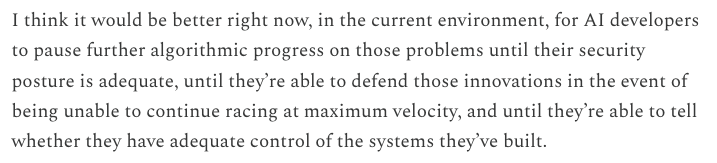
He argues that the labs should pause further algorithmic progress until they can secure their weights and research secrets. Otherwise China could simply steal the superintelligence in the middle of the intelligence explosion, and the labs would no longer be able to slow down even if they saw their models going off the rails.
He also explains how AIs will be trained during the intelligence explosion, and why even a system trained entirely inside a data center could still have the capabilities profile such that humans would have very little chance of competing with it or controlling it.
And he discusses the plan for alignment - basically, making a superintelligence that actually does what we ask the way we mean it. Fixing reward hacks and building better graders will help up till the next few model generations, but he thinks that no single current approach has better than even odds of letting us control superintelligence. The hope is that the AIs figure out the solution to this problem during the intelligence explosion.
Paul is head of the Alignment Research Center. Previously, he was head of AI safety at the US AI Safety Institute. Before that, he led alignment at OpenAI, where he invented RLHF. He’s recently joined OpenAI’s board (though here he is speaking as a private citizen).