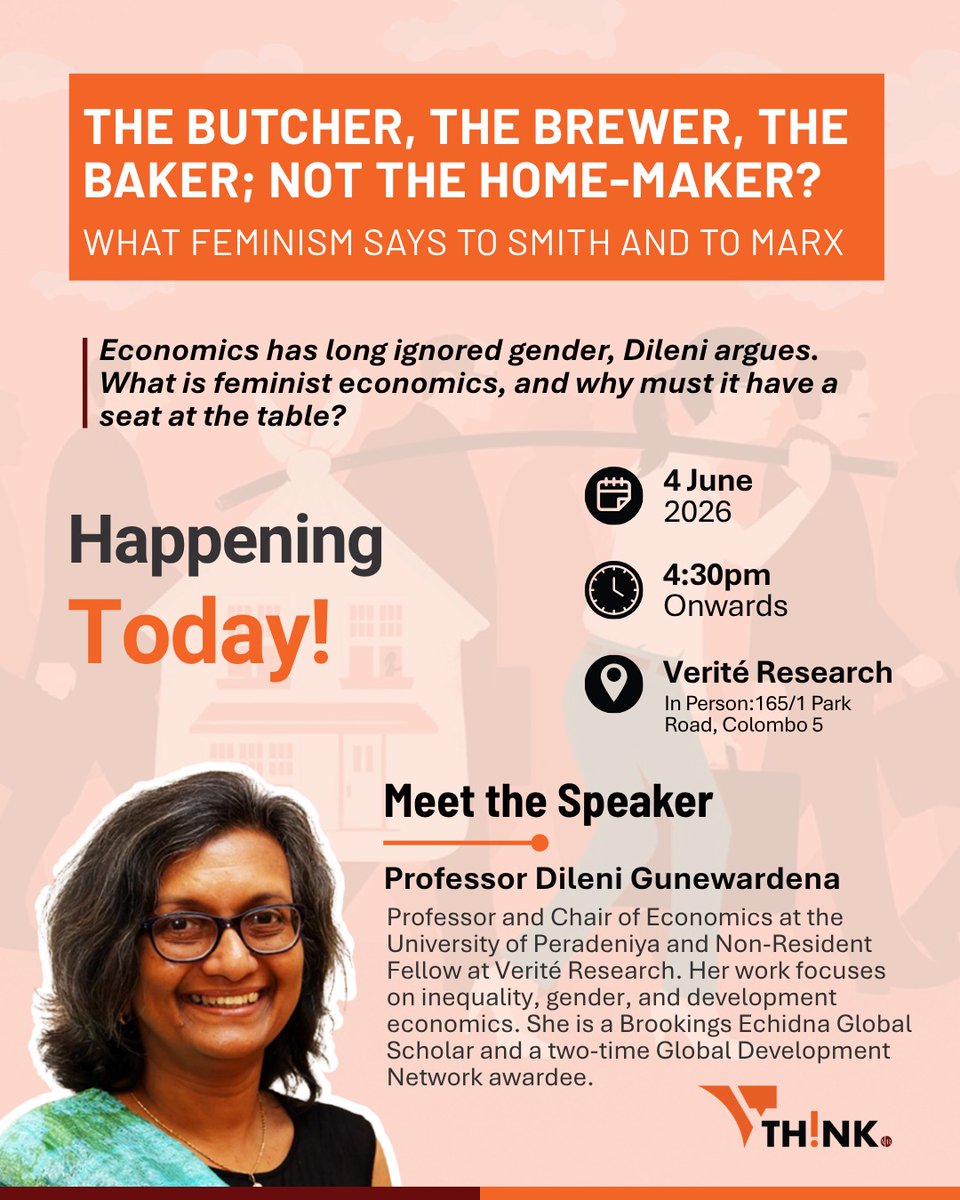
Economics has long ignored gender, Dileni (@dilenigun) argues.
What is feminist economics, and why must it have a seat at the table?
Join us at our next VThink, where Prof. Dileni explores where neoclassical and marxist economics miss the bus, and what feminist economics has to offer.
Professor Dileni Gunewardena is the Professor of Economics (Chair) at the University of Peradeniya and a Non-Resident Fellow at @VeriteResearch.
Her research is at the confluence of inequality, gender and development economics. She is a PEP Research Fellow, and a former Fulbright Scholar, Brookings Echidna Global Scholar, and two-time Global Development Network awardee.
Register: https://t.co/eREe6A122R
#developmenteconomics #feminism #marx #srilanka
No new law. No new tax. not a rupee more from any household buying essentials - just an end to a tax subsidy that's been quietly costing the Treasury Rs. 17.3 billion a year.
Full piece: https://t.co/br1iPSW9en
Between 2021 and 2026, Sri Lanka raised the tax on almost everything - incomes, biscuits, gas cylinders, soap.
The tax on a pack of cigarettes was quietly allowed to fall.
A new opinion piece by @VeriteResearch's @NCdeMel and @R_R_Prabu:
#srilanka#notobacco
The @WHO recommends tax on a cigarette to be at 75% of price .
Sri Lanka currently stands at 66.8%.
The gap is worth Rs. 17.3 billion in foregone revenue this year alone.
That's 2.4 times the cost of paying maternity leave benefits in the private sector. 1.3 times the country's nutrition budget. 1.2 times the disaster management ministry's allocation.
Economics has long ignored gender, Dileni (@dilenigun) argues.
What is feminist economics, and why must it have a seat at the table?
Join us at our next VThink, where Prof. Dileni explores where neoclassical and marxist economics miss the bus, and what feminist economics has to offer.
Professor Dileni Gunewardena is the Professor of Economics (Chair) at the University of Peradeniya and a Non-Resident Fellow at @VeriteResearch.
Her research is at the confluence of inequality, gender and development economics. She is a PEP Research Fellow, and a former Fulbright Scholar, Brookings Echidna Global Scholar, and two-time Global Development Network awardee.
Register: https://t.co/eREe6A122R
#developmenteconomics #feminism #marx #srilanka
On World No Tobacco Day, the same case was made by @VeriteResearch in two different rooms in Colombo this month: Sri Lanka is under-taxing tobacco, and it's costing the country in both lives and revenue.
On 15 May, our Lead Economist Raj Prabu Rajakulendran (@R_R_Prabu) took the argument to the RESPIRE roundtable on tobacco control - convened by the University of Edinburgh with the University of Sri Jayewardenepura and the University of Peradeniya, alongside the Ministry of Health, NATA, SLMA, and the Sri Lanka College of Pulmonologists.
His case: taxation remains one of the most effective tools available for tobacco cessation.
Earlier this week, our Executive Director Dr. Nishan de Mel (@NCdeMel) took the same argument to the press, and surfaced a striking anomaly.
Through Sri Lanka's economic crisis, taxes on virtually every good rose. Cigarette tax rates actually fell.
Correcting that - bringing rates up to the WHO benchmark of 75%, with no change in the retail price - would generate an additional Rs. 17.3 billion in revenue this year alone.
@ADICsrilanka@WHO
#srilanka #worldnotobaccoday #NoTobacco
Today is World No Tobacco Day.
Did you know that tax rates on cigarettes in Sri Lanka have actually decreased this decade, even as tax rates on everyday essential goods have risen?
Raj Prabu Rajakulendran (@R_R_Prabu), Lead Economist at @VeriteResearch, explains this trend at a conference organized by the Alcohol and Drug Information Centre (@ADICsrilanka).
Stay tuned: Tomorrow, we will break down the specific tax rates, the massive revenue the government missed out on, and what that public money could have funded for your benefit.
#srilanka #WorldNoTobaccoDay #notobaccoday #NoTobacco
I am hearing a lot of voices demanding removal of the fuel price subsidy.
For the discerning, I like to recommend this analysis published in March:
Showing why and how fuel prices could be reduced/subsidized from the price calculated by the existing formula used to do that.
Let me say why we don't agree.
#SriLanka ISB borrowing was all due to paying back concessional debt amassed previously.
@R_R_Prabu and I called it
"Borrowing from Peter to Pay Paul"
links below to our paper published in peer reviewed Palgrave Macmillan Journal of Development.
Statistics show that youth mental health has worsened over recent years. Our speaker, Kiara, talks about her research in trying to understand the causes and new types of interventions that could respond to the emerging crisis.
Kiara Wickremasinghe is a Research Fellow at the Centre for Anthropology and Mental Health Research. Her PhD in Anthropology at SOAS University of London focused on Open Dialogue, a social network approach to psychiatric crisis care, as part of an ESRC-funded research project. She also trained and worked as an Open Dialogue practitioner within the NHS.
With a background in geography, music, and anthropology, Kiara is also an opera singer, violinist, and composer. Her current research explores operatic storytelling as a response to Sri Lanka’s youth mental health crisis.
Register: https://t.co/4fHgbg5Ucr
#srilanka #youth #mentalhealth
Repeated incidents have shown that no one is immune to being misrepresented through AI-generated false content — not even public figures or institutions.
So, have you started using Trace-It yet?
It is a simple safeguard to help protect your content and prove its authenticity.
If you can’t trace it back to the original source, don’t trust it.
Happening today - and there's still time to register.
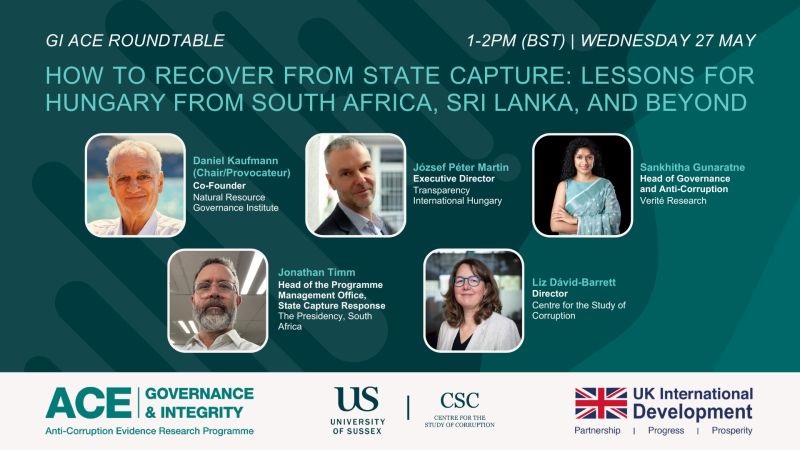
Every few years, a country gets a rare political moment - the kind where the institutions that were quietly captured can actually be rebuilt. Most countries miss it.
This afternoon's GI ACE Roundtable looks at the ones that didn't. South Africa, Sri Lanka, and others have all walked some version of this road already, and Hungary is the latest country approaching the threshold. The conversation is about what reformers actually do once the window opens - and how often it stays open.
Our Deputy Director and Head of Governance and Anti-Corruption, Sankhitha Gunaratne, joins speakers from Transparency International Hungary, the South African Presidency, and the Centre for the Study of Corruption. Chaired by Daniel Kaufmann (Natural Resource Governance Institute).
🗓️ Today, 1:00 - 2:00 PM BST / 5:30 - 6:30 PM Sri Lanka time.
Register and join: https://t.co/v5AMRyWLTD
#srilanka #anticorruption #governance
Is the EPF actually safe?
That's the question Pathikada takes on this Wednesday - and one that's harder to answer than it should be, given how little the country's largest financial institution discloses about what it's doing with the money it holds.
Our Deputy Director and Head of Governance and Anti-Corruption, @SankhithaG, joins this week's Pathikada to walk through the EPF's transparency record and what reform could look like.
🗓️ Wednesday, 27 May. AM on Sirasa TV, AM on TV1
#srilanka #EPF #Governance
Statistics show that youth mental health has worsened over recent years. Our speaker, Kiara, talks about her research in trying to understand the causes and new types of interventions that could respond to the emerging crisis.
Kiara Wickremasinghe is a Research Fellow at the Centre for Anthropology and Mental Health Research. Her PhD in Anthropology at SOAS University of London focused on Open Dialogue, a social network approach to psychiatric crisis care, as part of an ESRC-funded research project. She also trained and worked as an Open Dialogue practitioner within the NHS.
With a background in geography, music, and anthropology, Kiara is also an opera singer, violinist, and composer. Her current research explores operatic storytelling as a response to Sri Lanka’s youth mental health crisis.
Register: https://t.co/4fHgbg5Ucr
#srilanka #youth #mentalhealth
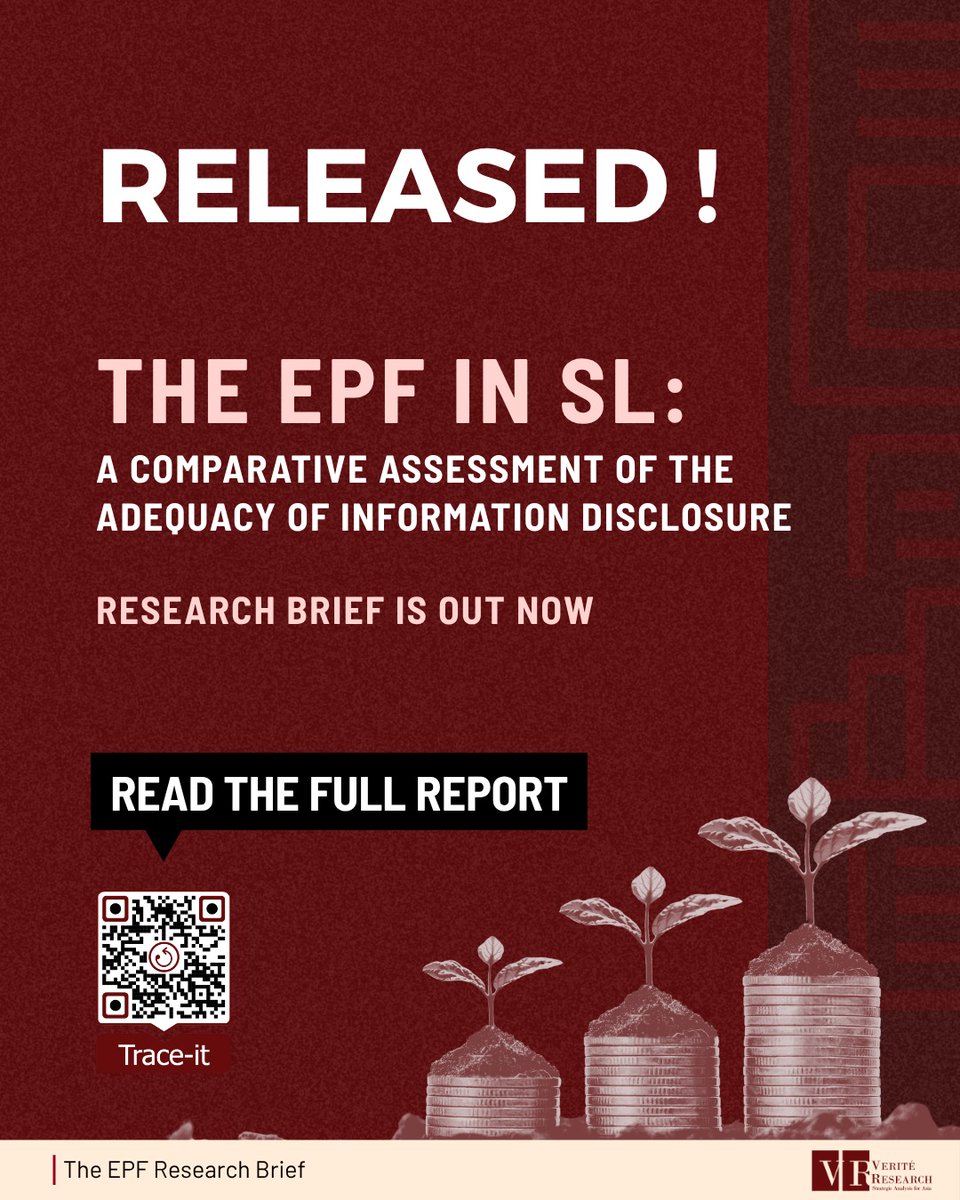
Sri Lanka's EPF is bigger than any bank in the country - nearly 15% of GDP. And yet it tells the people whose money it holds far less than any of those banks tell their customers.
Every private-sector worker in Sri Lanka is required by law to contribute to the EPF. They can't withdraw their savings at will, they don't get a say in how the fund is managed, and the only protection they have is the fund's own transparency.
Our new research brief benchmarks the EPF against listed companies, commercial banks, unit trusts, and international standards. It discloses less, in less detail, less often, and with less timeliness than all of them.
Full brief is here: https://t.co/DesXiL8q20
#SriLanka #EPF #Transparency #CBSL #Accountability #Economy