Financial Sector Consultant, Attorney, Author w/@FreemanWSJ of "Borrowed Time." Former @fdicgov, @federalreserve, @USTreasury, @IMFnews. Views are my own.
1/ I will combine my comments regarding the Friday @FDIC Signature report in light of the Monday sale of First Republic Bank ($FRC). I spent 7 years at the FDIC & most of the Twitter focus has been on the Fed report, so it would be more useful discussing FDIC, Signature, $FRC :https://t.co/aeANjOpXfD
Secretary of State Marco Rubio this morning in #Iceland recreated one of the most iconic photos of Ronald Reagan's presidency.
The moment came exactly 40 years after the Gipper and Soviet leader Mikhail Gorbachev met for the #Reykjavik Summit that signaled the beginning of the end of the Cold War.
Can only imagine what the moment was like for Rubio, who grew up idolizing Reagan.
As we wrote in our October cover story for Businessweek, in his 2012 memoir, "An American Son," Rubio recalled that his elders despised President Jimmy Carter for the humiliations of the 1979 Iran hostage crisis. They threw their support behind Reagan’s 1980 election campaign, in hopes he’d confront the Soviet Union, Cuba’s patron, and restore American strength.
“I’ve been a Republican ever since,” Rubio wrote.
Read the full story here:
https://t.co/U2Z1mMX6aD
Scott Bessent’s Rosy Forecasts Are Putting His Credibility at Risk
The US Treasury Secretary risks boxing himself in with his prognostications on gasoline prices, the housing market and the economy. https://t.co/MlEyXaO2FP
3/ Instead Trump pursued this ridiculous path of criticizing the cost overruns and tried to remove him on that basis. Price stability is at the core of what the Fed does.
1/ Reality here is that if Trump would have tried to get rid of Powell "for cause" based on the 2022 inflation spike, he could have successfully pursued removal on the true merits of his job performance (based on Section 2A of the Federal Reserve Act). https://t.co/2oubk5ZP1T
@GeorgeSelgin Yes Hassett was an economist at the Fed, but when he was there he focused on tax and public finance issues, not monetary policy or financial markets issues
3/ Questionable whether McWilliams or current chair Hill did any better in unearthing the details of this scandal. This is what you get when you appoint chairs whose major qualification is that they worked on Capitol Hill rather than those with hands-on banking or FDIC experience. Kudos to @rebeccaballhaus for uncovering this mess and following through with multiple stories on the scandal and the FDIC response.
1/ Very embarrassing chapter for the FDIC. From the FDIC press release: "The agency’s leadership has undergone significant transition, with a complete turnover of its Board of Directors, widespread changes among senior agency leaders, and new Directors leading most Divisions, Offices, and Regional Offices." https://t.co/h6GgYVyQ1l
2/ The reality is that current chairman Travis Hill has been with the FDIC since 2018 when he became a senior advisor to then FDIC chair Jelena McWilliams and then Chair (acting or confirmed) since 2025. My sense is that FDIC Chair Gruenberg was a product of Washington and stayed at HQ for so much of his tenure, possibly venturing out to the major regional offices, but rarely going to the field offices where the on-site bank examinations and training occur and the scandalous behavior happened.
Good to be reminded of these massive supervisory breakdowns. To me it was a good thing to go from a bailout of Wachovia (and Citi which failed weeks later) to an unassisted transaction through Wells Fargo. Kudos to Chairman Bair for ignoring Geithner/Paulson who wanted to keep the Wachovia/Citi bailout in place. For another anniversary reminder see my comments on the 40th anniversary of Continental Illinois' failure: https://t.co/SP3xVChauh
18 years ago, on Sep 29, 2008, marked the end of Wachovia. At the time, Wachovia was the fourth largest bank in the nation with assets of $812 billion. The FDIC announced that Citigroup would acquire the banking operations of Wachovia. In its press release, the FDIC stated that “Wachovia did not fail; rather, it is to be acquired by Citigroup Inc. on an open bank basis with assistance from the FDIC.”
On October 3, 2008, the FDIC announced a change. Wells Fargo would acquire Wachovia instead of Citigroup. The Wells Fargo acquisition did not require FDIC assistance. Citigroup filed suit.
#OnThisDay, #OTD
Sources:
https://t.co/u9U4N9jpSN
https://t.co/8WMcOQTRkr
https://t.co/Hc9WlUtJt2
I think the Starling report on SVB is well done overall, and I am happy it exists. (I had the same view re: the Barr report, fwiw.) That said, there were a few statements in the report that I would highlight as a little odd or maybe deserving more exploration. (1/9)
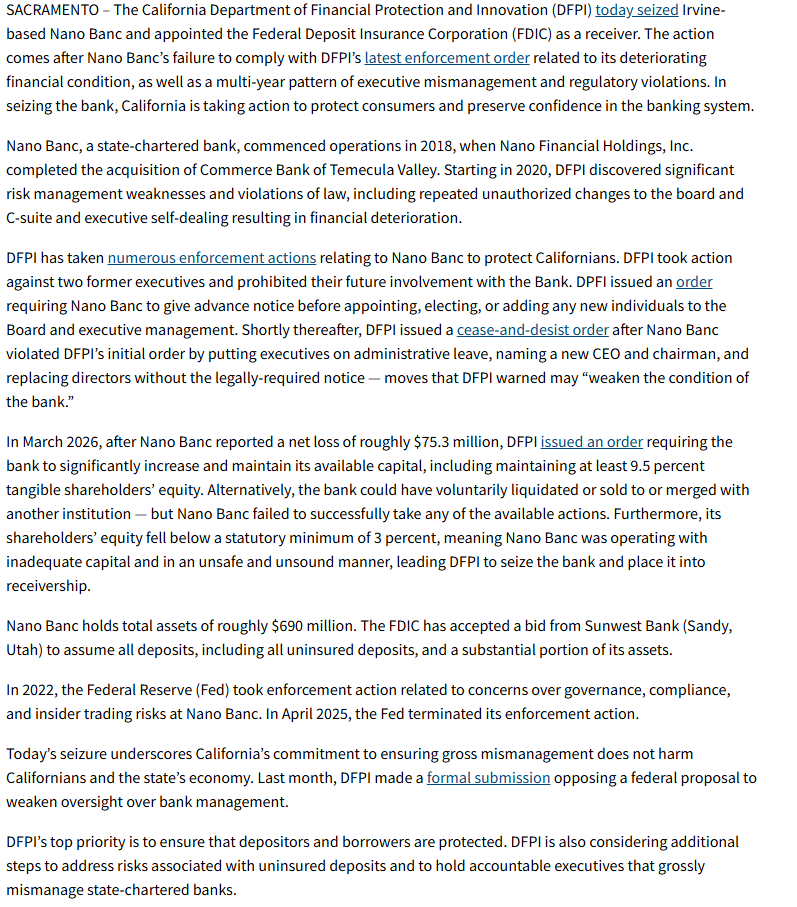
6th bank failure of 2026
The one-branch Nano Banc was closed today by California regulators, and the FDIC arranged for Sunwest Bank in Utah “to assume substantially all deposits and acquire certain assets of Nano Banc,”
Nano Banc had “total assets of $736 million and total deposits of $686 million.” It was the largest bank to fail so far in 2026. The next largest had less than half of Nano Banc’s assets.
“The FDIC preliminarily estimates that the failure will cost the Deposit Insurance Fund approximately $114 million.”
Nano Banc was closed today by @CaliforniaDFPI, which appointed FDIC as receiver. Sunwest Bank will assume substantially all deposits and acquire certain assets of the failed institution.
https://t.co/5a1CDjtgiK
Many state regulators opt for a terse press release when they seize a bank. Fair to say today's California DFPI press release adopts a different approach. https://t.co/Q0ES9csZxr
Even adds in some criticism of the federal regulators' CAMELS ratings proposal (2nd last paragraph)