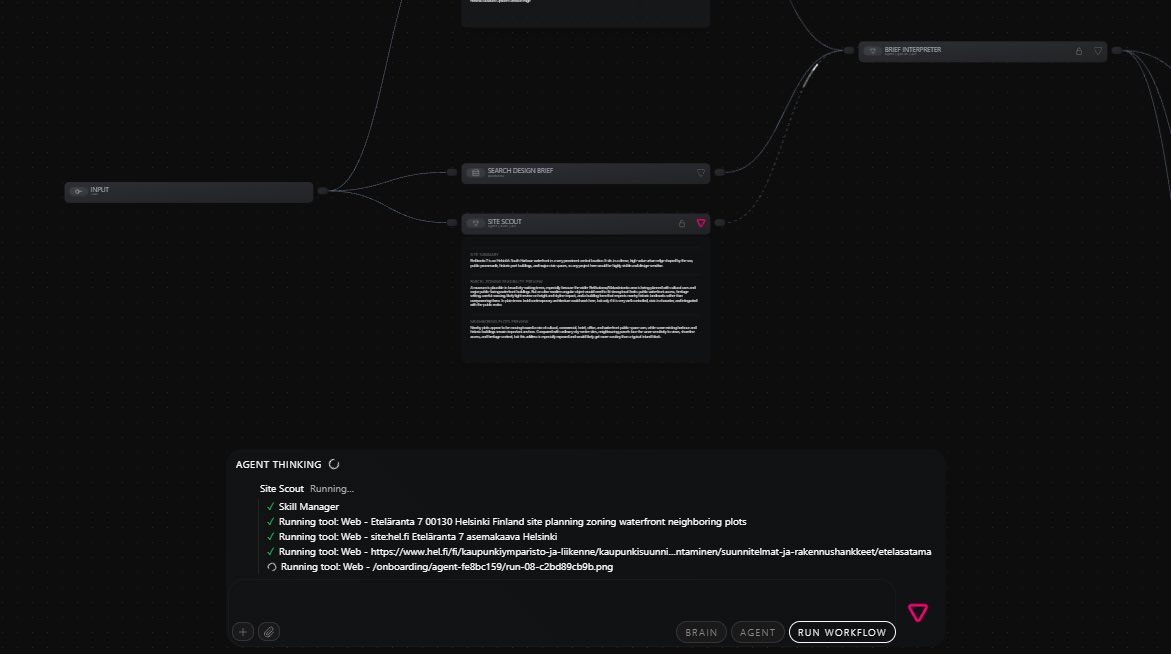
Closed beta is over. On August 19, Versur opens to everyone - no invite.
We spent months with architects and designers, building real workflows together. Thank you to that group. You made this possible.
If you can score it, you can autoresearch it.
We’re bringing an autoresearch-style loop into Versur’s Grasshopper solver flow for parametric models in Grasshopper. Inspired by @karpathy ‘s autoresearch, it works by proposing a candidate, testing it against a fixed benchmark, scoring it, keeping it only if it improves, and repeating the loop.
The goal is to run real experiments on computational design workflows
- exploring sliders, geometry variations, viewport states, and performance metrics through Versur-GH Solver.
I packaged up the "autoresearch" project into a new self-contained minimal repo if people would like to play over the weekend. It's basically nanochat LLM training core stripped down to a single-GPU, one file version of ~630 lines of code, then:
- the human iterates on the prompt (.md)
- the AI agent iterates on the training code (.py)
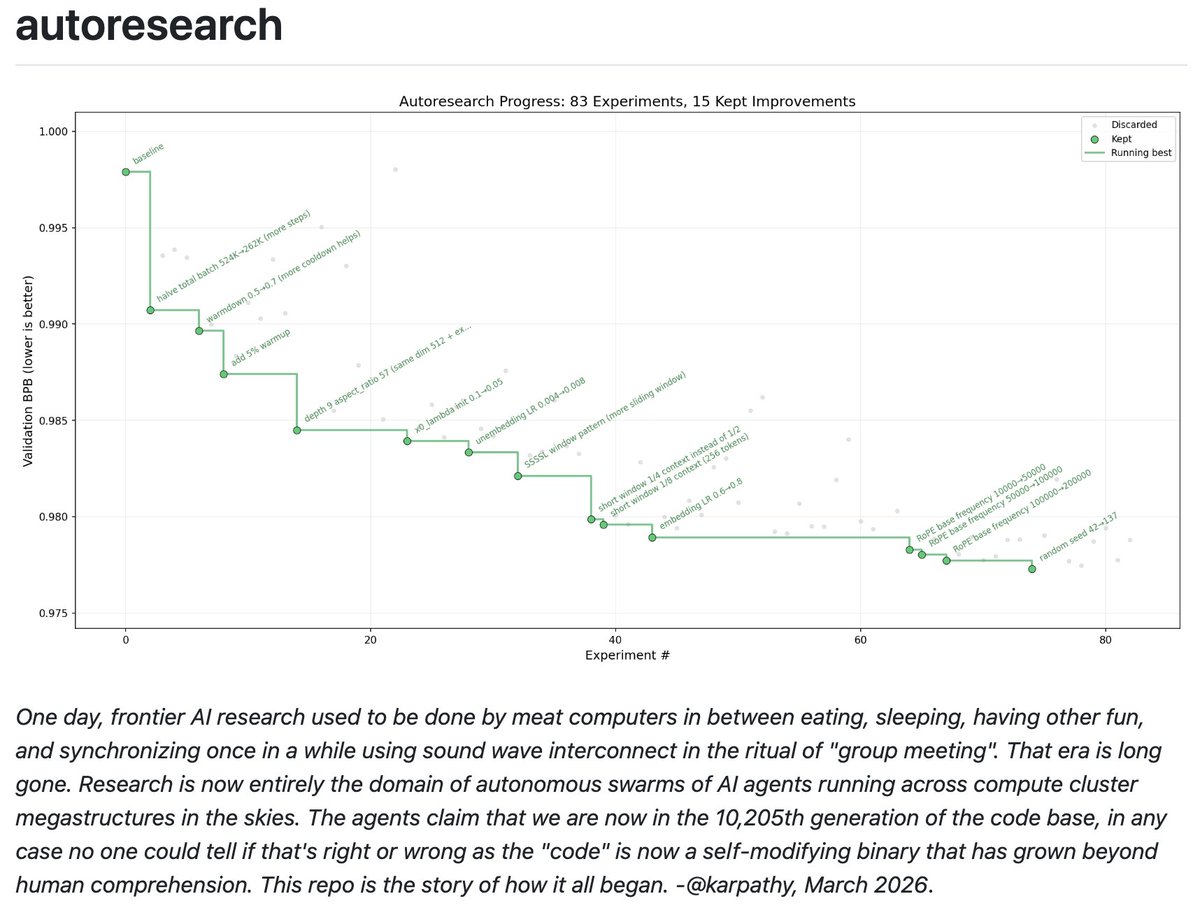
The goal is to engineer your agents to make the fastest research progress indefinitely and without any of your own involvement. In the image, every dot is a complete LLM training run that lasts exactly 5 minutes. The agent works in an autonomous loop on a git feature branch and accumulates git commits to the training script as it finds better settings (of lower validation loss by the end) of the neural network architecture, the optimizer, all the hyperparameters, etc. You can imagine comparing the research progress of different prompts, different agents, etc.
https://t.co/YCvOwwjOzF
Part code, part sci-fi, and a pinch of psychosis :)
Versur-GH and Versur-RH are now live.
Versur can now run workflows directly inside Rhino and Grasshopper. This builds on the same idea - workflows as callable units - now accessible directly inside the design environment.
You can build workflows in Versur - simple ones, chained processes, or full agentic workflows - and execute them directly inside your model.
These workflows can range from image generation to more pragmatic ones. Natural language–based solvers, compliance checks, and others. The structure is the same. What they do is up to you.
One important part of this is the solver. Instead of relying on predefined logic or optimization strategies, you can define how the system reasons about your Grasshopper model directly in https://t.co/i4nI2eR8qS. Goals, constraints, and evaluation logic can be described and executed as part of the workflow.
In that sense, it behaves more like a programmable layer guiding the model.
In Grasshopper:
- load and access your Versur workflows
- run them directly on the viewport
- visualize results
- chain multiple workflows
- use the solver to define goals, optimize parameters, and run evaluations
In Rhino:
- run workflows through a chat-style panel
- operate directly on the active model
- optional viewport input
- session persistence across runs
Workflows stop being something you run outside and bring back in. They become callable components that operate directly within the design environment.
The official Versur CLI is here.
Run workflows, deploy endpoints, view logs, and export definitions, all from your terminal.
It works standalone, and it works inside AI coding tools like Claude Code, Codex, and OpenClaw.
Any agent that can run a shell command can now run a Versur workflow. Install it, authenticate with an API key, and you're running workflows in under a minute. What this means: your AI workflows aren't locked behind a browser anymore. They're composable, scriptable, and ready for automation.
Available now for Versur Beta users: npm install -g @versur/cli
Docs at https://t.co/xud4WVHFKK
A simple example of an agent you can build with https://t.co/i4nI2eR8qS
A Revit Schedules Compliance Agent.
It parses exported schedules, retrieves relevant code clauses from a structured knowledge base, and generates a traceable compliance review.
Each step is inspectable.
I’m sharing this to show the range of what can be built. It can operate across multiple stages of design - explorations, documentation, compliance, evaluation, and decision-support workflows.
Versur Beta Opens February 10
Versur externalizes reasoning.
It introduces a new computational medium where reasoning becomes a composable building block, and design workflows are assembled from intelligence rather than scripts or prompts.
Over the past months, we’ve been building this medium quietly through an extended alpha phase.
Starting February 10, we’ll begin opening beta access to people on the waitlist.
If you’re on the waitlist, you’ll start receiving access invitations next week.
If not, you can join at https://t.co/PuVUrCuSv5