We do not need to study his life. The follower is a reflection of his leadership.
That's why our parents will caution us. Remember the CHILD of who you are. This is to keep us grounded
I pause..!
Most non Muslims have never actually studied the life of Muhammad.
They rely on headlines, critics, and secondhand stories.
If they took the time to genuinely study the man, they would discover one of the greatest examples of leadership, mercy, patience, and character the world has ever seen.
Muhammad wasn't just a prophet.
He was a role model for humanity.
I am Nigerian, and right now my dream is bigger than me.
Only about 1% of global electronics manufacturing happens in Africa.
That means millions of African innovators are building the future using ecosystems that don't account for them. Brilliant minds wait weeks for a single prototype PCB to cross oceans, stalled by borders and supply chains that ignore our shores. When iteration takes months instead of days, innovation suffocates.
That gap has consequences. It keeps us as consumers of tech rather than creators.
So at SkyPower / CircuitCraft, we are deciding to build towards changing it.
We are completely rebuilding the hardware prototyping infrastructure right here in Nigeria. Local manufacturing. Precision engineering. Rapid iteration. We are putting the power to design, spin, and deploy production-grade hardware directly into the hands of African builders.
The dream is bigger than us—but we are building the foundation anyway. 🇳🇬⚙️
I studied political science as a minor in the university and this was one of the books that we read and referenced in one of the courses.
Initially as young chaps this book infuriated us and we began to blame the west for our woes until we came across another book “How Africa Underdeveloped Africa”.
Till date, I have no blames or fight with the Europeans. The time for blaming them is long gone. Now it is our evil leaders who are constantly looting and ravaging the continent.
Sometimes I wonder if there’s really a problem with the black race because how can a whole continent have wicked leaders? Only the “white” part of the continent have major developments.
Africans, it is your leaders that have ravaged you, not Europeans.
Those who went for the banquet with the British Royal Household, did anyone capture the outcome of the trip like this so ordinary citizens can have a glimpse beyond the fashion parade?
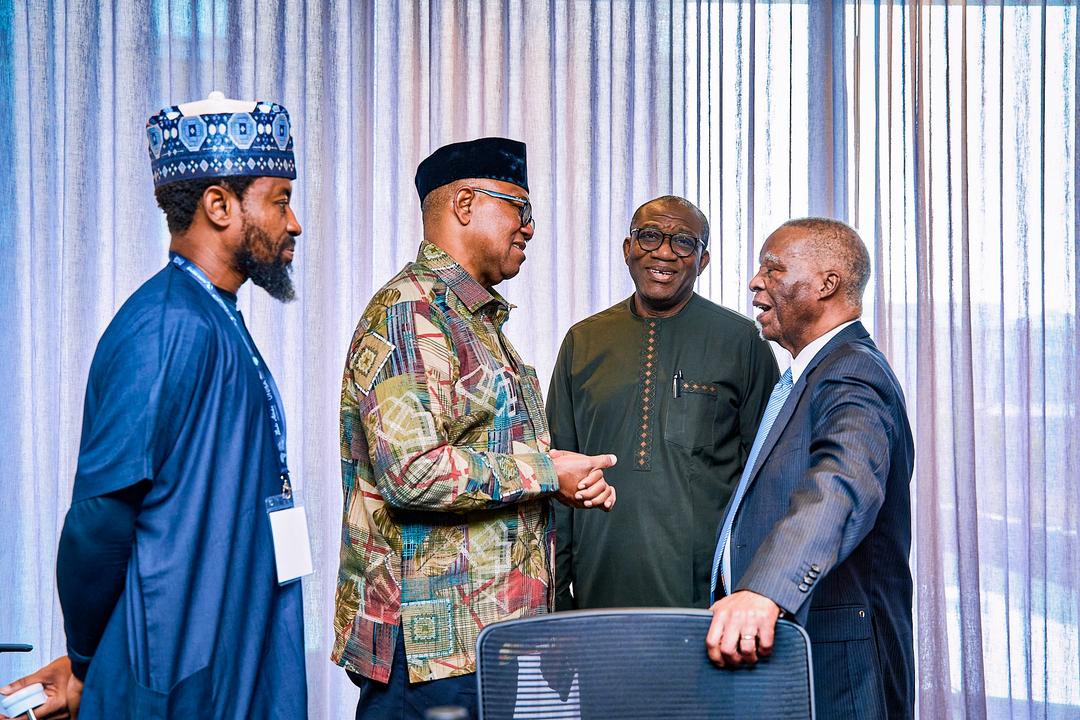
This Southern Africa trip with Mr. Peter Obi, from Lagos to Johannesburg to Cape Town and back has been, for me, far beyond movement across cities and meetings across borders. It has been an opportunity for deep observation, learning, reflection, and a closer understanding of leadership, nation-building, and the burden of carrying the hopes of people across different spaces and circumstances.
Beginning in Cape Town, at the Spier dialogue on Africa’s growth and development, I watched Mr Peter Obi engage leaders from across the continent and beyond with remarkable humility and depth. Mr Peter Obi introduced me to the Mayor of Cape Town, political leaders, diplomats, academics, development experts, and participants who had come from different parts of Africa, Europe, and America. What stood out immediately was not merely recognition, but the genuine warmth, respect, and attentiveness with which people received him. Across ideological and political divides, there was a visible acknowledgment of his consistency, clarity, and moral standing.
For me, however, the most profound moments were often not on the podium, but in the quieter spaces, observing how Mr Peter Obi listens, the questions he asks, and the seriousness with which he approaches even the smallest conversations. Whether speaking to former Presidents, current ministers, political leaders, diaspora Nigerians, or ordinary citizens, his first instinct is always to ask questions, How are Nigerians faring? What are the challenges? How are our people treated? What opportunities exist? What lessons can Nigeria learn? What systems are working? What systems are failing?
There is something deeply instructive about seeing a leader genuinely curious, genuinely listening, and genuinely concerned. At the dialogue in Cape Town, when Mr Peter Obi delivered his key address on policies for growth in Africa, he spoke with clarity about the tragedy and paradox of a continent so blessed with natural and human resources still struggling under the weight of poor leadership, corruption, weak institutions, and misplaced priorities. But what struck me most was how seamlessly he connected the broader African conversation with the realities at home in Nigeria.
Mr Peter Obi spoke about leadership not as an abstract concept, but as a lived responsibility. He explained how the quality of governance within a nation ultimately reflects how its citizens are perceived and treated beyond its borders. That leadership at home shapes dignity abroad. That when governance fails, citizens often carry the burden internationally. Yet even while addressing difficult truths, he consistently defended the integrity, resilience, brilliance, and hard work of Nigerians everywhere. Mr Peter Obi raised hope while still confronting reality. He challenged systems without condemning people. He spoke honestly, but never hopelessly.
In Johannesburg and Cape Town, the interactions with Nigerian communities were deeply emotional and revealing. Many shared concerns, fears, frustrations, and experiences about migration, identity, economic hardship, and social tensions. Yet in those interactions, I also saw something else, the trust and emotional connection people have with Mr Peter Obi. Not merely politically, but personally. People spoke to him as someone who understands their pain and still believes in their future.
Watching Mr Peter Obi’s engagements with South African ministers and political leaders was equally enlightening. The discussions were thoughtful, respectful, and frank. There was no grandstanding, no unnecessary drama, just serious conversations around governance, migration, law, regional cooperation, and the future of Africa. Even in disagreement, there was mutual respect.
This is heartbreaking and the family are trying to shield the alleged perpetuator??
After all he's done for them this is all they can do to gis memories not even pushing for justice??
Kai! Kai!
The man was our direct neighbour in Guzape. He was hardly around because he spent most of his time out of the country. In fact, he had just returned from Turkey barely two days before his son killed him.
His children lived in the house and lacked nothing. They even had an inverter, and my sister would often joke about their electricity bill because their ACs were almost always on, especially in this Adelabu Band A era.
Only for the shocking truth to emerge that his own son killed him. At first, the boy tried to make it look like armed robbers had attacked the house. But thankfully, a neighbour’s CCTV camera was reviewed, and it showed that he was the last person to enter the compound with his girlfriend around 2am.
Honestly, this world is becoming frightening. It is heartbreaking that a son could do something like this to his own father! 😪
@Shaibu_AO There's a name for fear of holding babies. I can't remember. I have that too. I don't hold infants less than 2 - 3 months before i throw oerson pikin 😆
One young man opened a small gas station in my community with just one dispenser.
Then NEPA officials told him he would be paying ₦20,000 monthly for electricity, while every other household in the village pays just ₦5,000.
The man pleaded and said he could only afford ₦10,000 for now, but they refused.
Eventually, they disconnected his light.
Now he buys fuel every day just to power the dispenser with a generator.
Is this really how to support small businesses?
And this is happening in a village, not even in a city.
@dranthoniaeddo Sorry for your experience but Solitude is not God's way. That completely negates the Body life. 1 Corinthians 12:12-27 is clear. It's ur mind that's speaking not the Spirit. The Lord speaking in us will not negate the His written word.