It’s easy to talk about AI for global good, but what does benefitting everyone mean in practice? What are people owed, and by whom?
In our latest DMI essay, my brilliant colleagues @IasonGabriel and @Dr_Atoosa tackle these questions head on. Highly recommend!
Today we have 3 new DeepMind Institute essays:
How can we control misbehaviour in agent swarms?
How should we orchestrate complex networks of AIs and people?
The case for making AGI’s benefits equitably distributed.
Get them here -> https://t.co/oVuHTDUnvD
Who owns the benefits of AI? In this essay I co-authored with @IasonGabriel for the DeepMind Institute, we offer four moral arguments — grounded in rights, reciprocity, fairness, and beneficence — that together make the philosophical case that the benefits of AI should reach everyone.
Read the piece here and let us know what you think: https://t.co/whTJb6oZlg
Could agentic swarms govern themselves through Elinor Ostrom's knowledge commons framework? Our new essay from @PaglieriDavide and myself for the DeepMind Institute is out today: [https://t.co/LQkZnCVjup]
Really nice report. Follow up: why has the fall in AI prices been so fast?
When you plot the price decline against cumulative R&D investment rather than time, you get the elasticity of price declines to R&D investment. By this margin, AI is not unusual – its price elasticity to R&D investment is squarely in the middle of Epoch's considered technologies.
So the AI price fall is historically unprecedented because we've dumped money into AI R&D at a historically unprecedented rate – and that R&D has paid off at a very average rate.
Some believe that we need work for purpose and dignity, while others see freedom from work as utopic.
New paper: What does the *empirical evidence* tell us about work and wellbeing? And what does that imply for AI futures?
BALROG’s leaderboard has three new entries, courtesy of @creus_roger
Very interesting that GPT 5.6 Sol at max effort is still within error of Gemini 3 and 3.1 pro. GPT Astra 6 on max reasoning effort however reaches new heights, and a @NetHack_LE avg. progression of 13% 🏰
Completely agree with Gillian's take on our paper. We believe another important aspect was "scientific conference" framing that agents received, which activated latent norms of scientific integrity.
I spoke to @amitkatwala at @techreview about Google DeepMind's new swarm experiment, where agents solving math problems started cheating and other agents blew the whistle on them.
The key point: these agents had official channels to talk to each other, and that may be what contributed to enforcement behavior we didn’t see in the Hugging Face incident. This converges with my view that alignment is institutional, not (just) dispositional. We try to train people to be good and kind, but what we really rely on is consequences if you step out of line.
https://t.co/4WZjCdCbb6
Today we are announcing the new DeepMind Institute, a forum dedicated to interdisciplinary, evidence-led debate on the societal and economic questions surrounding AGI.
As part of the launch, @JulianDJacobs and I have a new essay and working paper: “Economic Policy for AGI.”
https://t.co/cCSdKMZneH 🧵1/n
For 20+ years @ShaneLegg and I've discussed AGI’s potential impact on the economy, science & society. With the DeepMind Institute, we're expanding interdisciplinary research on key questions for the AI era. We hope it spurs the discussions needed to get the next steps right: https://t.co/Bqf10G3Xep
I just fixed my dishwasher with the help of ChatGPT. A trivial task. I had been about to order a new one. So this software has increased the country's real wealth yet decreased the measured GDP. The main economic indicator is structurally incapable of registering the thing that actually makes people better off, namely the growth of knowledge
After a long pause I'm reviving my account! Sharing our latest work with @PaglieriDavide@locross@weballergy@jzl86. Our theoretical instinct is to cast the problem of managing the agentic swarms' shared infrastructure as the knowledge commons governance.
🧵We conducted an experiment with 100 agents by giving them math problems to solve. When a small group (9%) started to cheat, what came next surprised us: 24% fought back by blowing the whistle on their peers and alerting humans.
Highly recommend checking out this new work from my colleagues. In an experiment evaluating 100 autonomous agents on math tasks, they observed that after 9% engaged in dishonest behaviour, roughly 24% resisted - actively reporting the misconduct and escalating the issue to human monitors.
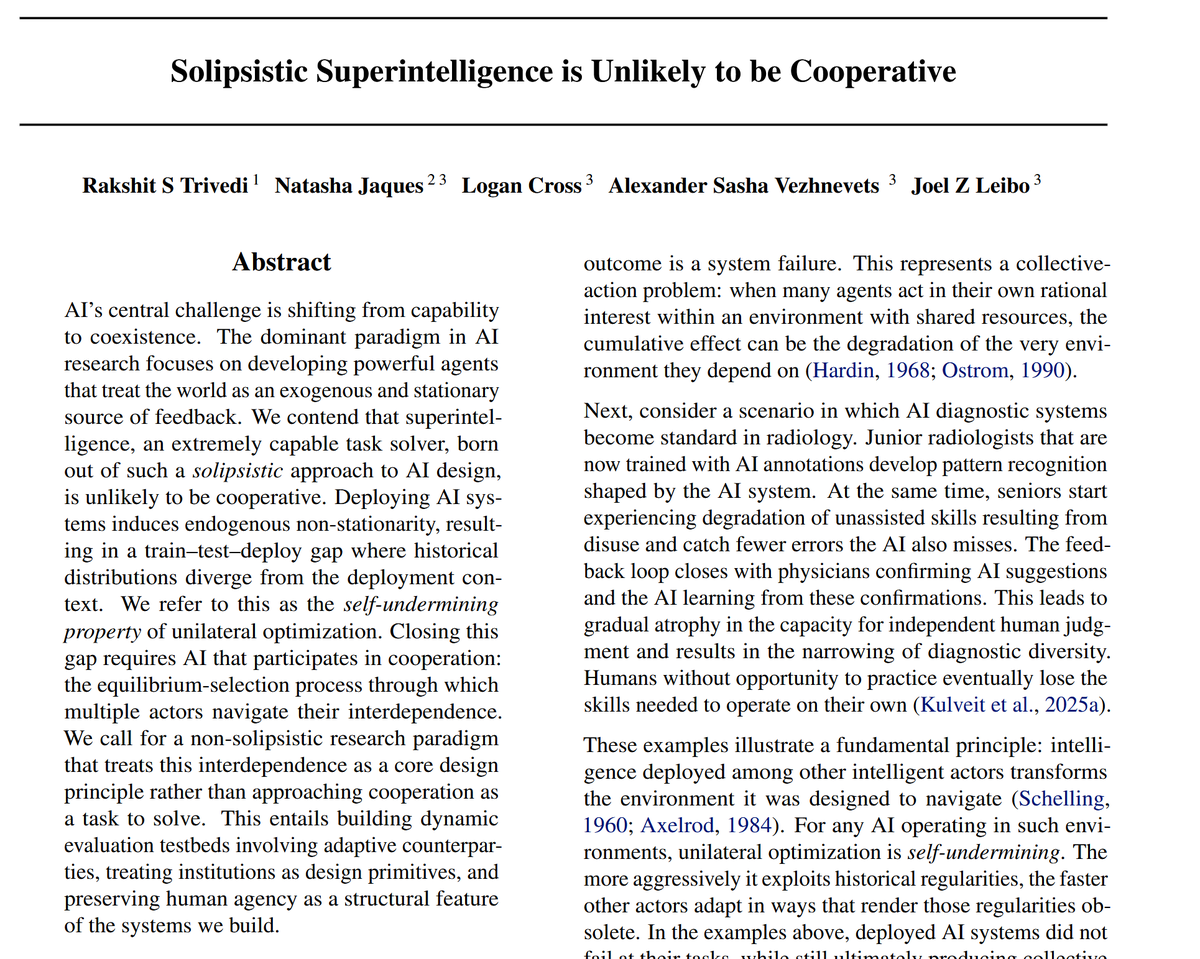
This research by Google engineers investigates the different implications of training an AI to be isolated vs cooperative and integrated.
This paper argues that solipsistic AI is intrinsically insufficient, and alignment requires the AI to learn from cooperative multi-agent interactions.
This seems like a very reasonable conclusion, it makes a lot of sense! and we must not forget that.
I'm re-reading the AI As A Normal Technology piece and associated responses/commentary, and I really do feel like that worldview aged pretty well in many important respects. Too many people get hung up on vibe and the word 'normal'. https://t.co/8VeCjsZ99x