Pleased to announce the NetHack Learning Environment has a new home, and a new set of maintainers! Find it at https://t.co/XfQygFtBSc.
A huge thanks to @stephen_oman and @MartinKlissarov for helping with the project!
Happy hacking!
Latest release of @NetHack_LE (v1.3.0) is now available and includes rendering the dungeon with tiles for all you convoluted people out there, seeding options for getting past the pesky full moon issue and more. Thanks to all the contributors! ⚔️
Latest release of
@NetHack_LE
(v1.3.0) is now available and includes rendering the dungeon with tiles for all you convoluted people out there, seeding options for getting past the pesky full moon issue and more. Thanks to all the contributors! ⚔️
LLMs acing math olympiads? Cute.
But BALROG is where agents fight dragons (and actual Balrogs)🐉😈
And today, Grok-4 (@grok) takes the gold 🥇
Welcome to the podium, champion!
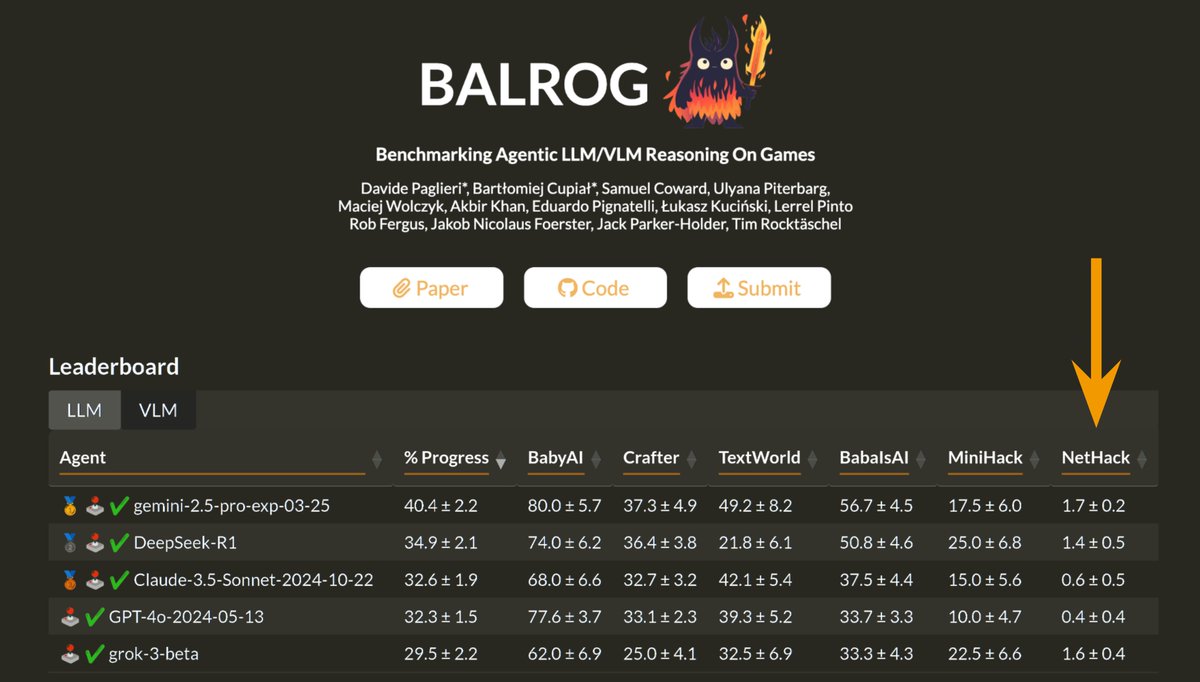
Happy "@NetHack_LE is still completely unsolved" day for those of you who are celebrating it. We released The NetHack Learning Environment (https://t.co/71eYEt6Qp1) on this day five years ago. Current frontier models achieve only ~1.7% progression (see https://t.co/hoYJzaikGq). For a recent blog post on what makes it so hard for AI, check out @HenaffMikael's analysis: https://t.co/vAYWOJNRPo
A couple bits of news:
1. Happy to share my first (human) NetHack ascension-next step is RL agents :)
2. I wrote a post discussing some @NetHack_LE challenges & how they map to open problems in RL & agentic AI. Still the best RL benchmark imo.
https://t.co/Bwvl8Ifmiz
Happy to announce the latest release of @NetHack_LE (version 1.2.0). You can now use the seed function to make the dungeon layout reproducible across training episodes. The in-level interaction and combat is still randomly determined and doesn't impact lower level layouts.
⚔️ MiniHack Updates! ⚔️
1️⃣ MiniHack 1.0.0 is here! Following popular demand, it now supports the new Gymnasium API and is built on NLE 1.1.0. Huge thanks to @Stephen_Oman (maintainer of @NetHack_LE ) for his outstanding contribution! 🙌
Can AI agents adapt zero-shot, to complex multi-step language instructions in open-ended environments?
We present MaestroMotif, a method for AI-assisted skill design that produces highly capable and steerable hierarchical agents. To the best of our knowledge, it is the first method that, without expert labeled datasets, solves compositional tasks requiring hundreds of steps for completion.
All the modules within MaestroMotif are learned from interaction: from the highest level of planning to the lowest-level of sensorimotor control. On the open-ended domain of NetHack, it surpasses existing approaches, including those that are fine-tuned specifically for each task.
At the heart of MaestroMotif is the idea that decomposing a task into subtasks significantly helps decision making. MaestroMotif leverages an agent designer's intuition about a domain to identify important skills and describe them in natural language. These short descriptions then get converted into adaptable hierarchical agents through AI feedback and in-context learning.
Our paper was recently published at ICLR 2025 and we open-source the whole project including the code, prompts and pre-trained models.
Paper: https://t.co/3qYQhvkipN
Code: https://t.co/rescBu69Si
NotebookLM Podcast: https://t.co/hIMoXDjmNd
This work was done with the amazing @HenaffMikael, @robertarail, @shagunsodhani, Pascal Vincent, @yayitsamyzhang, @pierrelux, Doina Precup, with equal supervision by @MarlosCMachado and @proceduralia.
Take a look at the following thread: