More power. More possibilities. More places to make it happen.
Meet the most advanced Windows laptops ever, powered by @NVIDIARTXSpark.
Available for pre-order now. https://t.co/CsLosKYivm
STAR WARS: Galactic Racer's™ Singleplayer Campaign, Arcade, and Scenario modes arrive on Luna this month!
Race through a story-driven adventure of speed, high-stakes, and the will to rise!
Play now on Luna, included with Prime ⭐
[Stranger Things S2E8] Bob forgot to take his pistol secured his fate. No need to give away the story this early. But then nice guy will always to die first like the #redshirt
We'll be spending a lot more time trying to understand the outputs of language models. A few thoughts, tips & tricks:
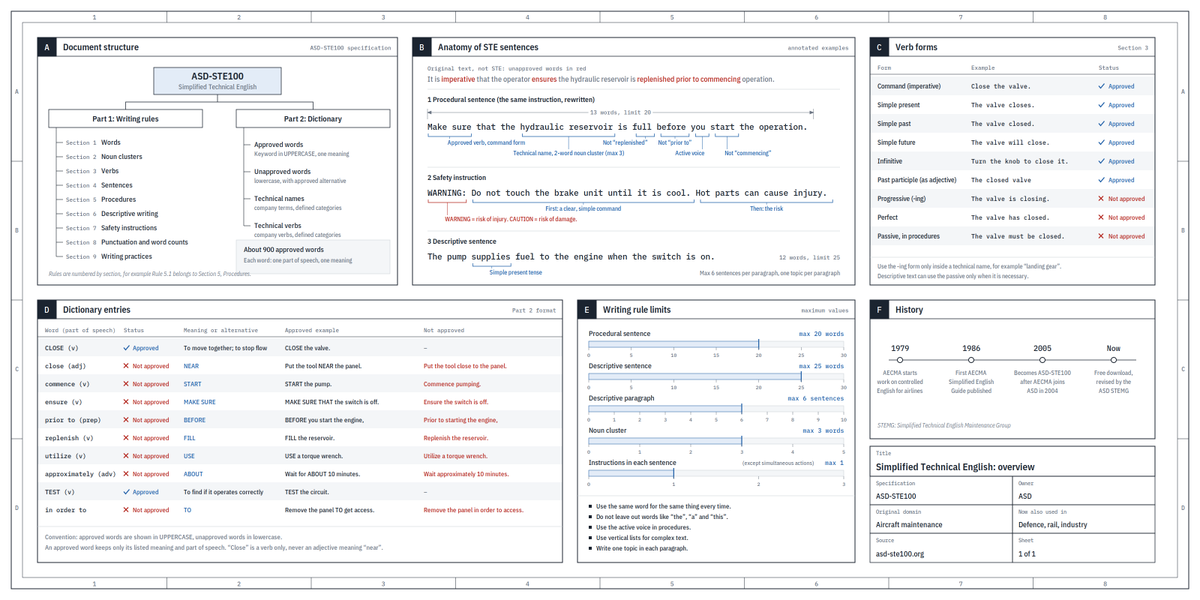
Writing. Something I've had success with: Ask your LLM to explain something in ASD-STE100, it's a controlled language specification originally developed for aerospace maintenance documentation. LLMs well-versed in this language and it comes with heavy constraints on clean writing style that I often find a lot more readable. Sometimes I've tried to soften it a bit e.g. ask for "80% of the way to ASD-STE100" because the spec is quite stringent. But even better:
Diagrams / images. Instead of writing, ask your LLM to create a diagram. These can be a lot easier to process, parse, and understand. But even better:
Web pages. Ask for output "in HTML" to get a beautiful, interactive webpage. LLMs are getting really good at frontend and can create beautiful experiences, animations, etc. But even better:
Explainer videos. The output format I am most bullish on is fully custom / bespoke explainer videos generated on any arbitrary topic. Experiment with things like "Create a 3b1b style video explainer on X. Use my ElevenLabs API key for audio narration". (you'd need an API key for the latter or you can ask your LLM to find you decent free alternatives that use your local compute). This is actually starting to work!
In summary:
- As LLMs get better, they will do more and more of the legwork autonomously, and a lot more of our work will rise up the abstractions into oversight and understanding.
- Luckily, LLMs can help here too because as intelligence and code are increasingly abundant, you can ask for large, custom, discardable software artifacts (e.g. web apps, video explainers) that would have never made sense to create before. Push the boundaries here and you'll be surprised.
Alibaba's Qwen-Image-2.1 is the new #1 open weights model on both the AA-Image leaderboards
Qwen-Image-2.1 is Alibaba's latest image model, released with open weights on September 20. It has a 7B parameter visual generation component and handles Text to Image and Image Editing in a single model, with native 2K output and native transparent (RGBA) image generation and editing. The weights are released under the Qwen Research License, which requires a separate license for commercial use.
In the absence of major inference providers hosting this model at time of launch, we evaluated Qwen-Image-2.1 by hosting it locally.
Qwen-Image-2.1 ranks #18 on AA-Image-T2I v2.0 and on AA-Image-Editing v2.0, and leads all open weights models on both, ahead of Ideogram 4.0 (Quality) in Text to Image and HunyuanImage 3.0 Instruct in Image Editing. It is a large step up on Qwen Image 2.0, climbing from #72 to #18 in AA-Image-T2I v2.0 and from #58 to #18 in AA-Image-Editing v2.0.
The weights are available on Hugging Face and ModelScope, with day-0 support in Diffusers, ComfyUI, vLLM-Omni, SGLang and LightX2V.
Congratulations to @Alibaba_Qwen on the release!
See below for our analysis and example outputs of Qwen-Image-2.1 in the Artificial Analysis Image Arena 🧵
Anthropic has launched Claude Sonnet 5.5: it scores 56 on the Artificial Analysis Intelligence Index, just 2 points behind Opus 5.5 (max), but at the highest Output Tokens per Task we’ve seen
With max effort, Sonnet 5.5 gains 18 points over Sonnet 5 and to #2 on the Intelligence Index behind only Opus 5.5 (max). Anthropic has priced Sonnet 5.5 identically to Sonnet 5 at $0.2/$2/$10 per 1M cache input/input/output tokens, however it outputs a higher number of Output Tokens per Task and costs $7.60 per task (~50% higher than Sonnet 5’s Cost per Task)
Key takeaways:
➤ Meets leading models on agentic terminal use and knowledge work: in Terminal-Bench 4.0, Claude Sonnet 5.5 reaches 64% against 60% for Opus 5.5 and GPT-6 Astra. On AA-Briefcase (1811 vs 1822 Elo), GDPval-AA (1844 vs 1846 Elo), and AutomationBench-AA (71% vs 70% headline score), Sonnet 5.5 reaches parity with Opus 5.5, albeit with significantly higher token usage to achieve it
➤ Heaviest token use we have measured: at max effort, where it reaches performance nearing that of Opus 5.5, Claude Sonnet 5.5 used ~193k Output Tokens per Intelligence Index Task. This is the highest token use we have measured on around 60% higher than Opus 5.5 (max) or Sonnet 5 (max) and ~7x GPT-6 Astra (max)
➤ Pricing remains at $2/$10 per million tokens of input/output, matching GPT-6 Sol. At this pricing Claude Sonnet 5.5 sits off the Intelligence vs. Cost per Task Pareto Frontier. At high effort levels it sits behind Opus 5.5, while lower efforts have GPT-6 Astra or Sol configurations delivering equivalent performance for lower cost. The high effort setting is the most competitive on this basis, sitting very narrowly behind GPT-6 Sol on Intelligence at effectively the same Cost per Task
➤ Behind Opus 5.5 on factual knowledge and scientific reasoning: as a smaller class model, Sonnet 5.5 still lags on factual knowledge in AA-Omniscience compared to Opus 5.5. It scores 54% against 66% for factual accuracy, though with a lower hallucination rate (47% against 59%). It also sits ~6 points lower on Humanity's Last Exam and SciCode compared to Opus
These evaluations were conducted on a pre-release deployment of Claude Sonnet 5.5, which Anthropic found to have a bug that can degrade responses to requests that use structured outputs. This is fixed for the public release and Anthropic expects minimal change or slightly understated performance, but we will be re-running relevant evaluations soon.
Other model details:
➤ Context window: 1 million tokens with image and text input, unchanged from Sonnet 5
➤ Pricing: unchanged from Sonnet 5’s latest $2/$10 per 1M input/output tokens; cache writes at $2.5, cache reads $0.2
➤ Effort settings: five (low, medium, high, xhigh, max). Intelligence Index evaluations were run at all five with Anthropic's default fallback enabled. We see Sonnet 5.5 fall back in ~0.1% of tasks across the Intelligence Index, primarily in TerminalBench 4.0, falling back to Sonnet 5 in all cases.
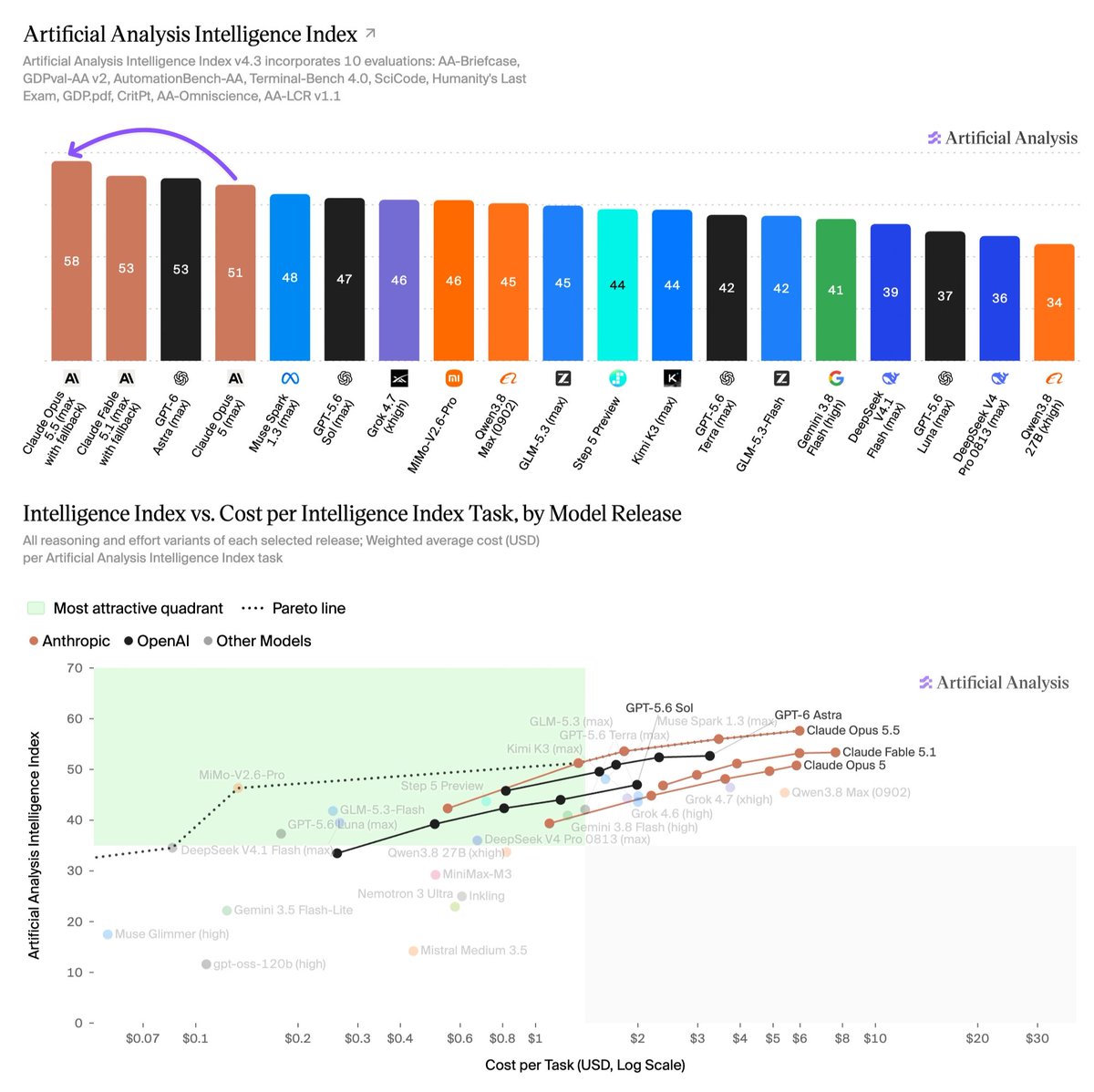
Claude Opus 5.5 takes the top spot on the Artificial Analysis Intelligence Index, along with a 20% price cut and larger cache hit discount
Claude Opus 5.5 brings Anthropic to parity with GPT-6 Astra on evaluations like Terminal-Bench 4.0 and AutomationBench-AA, while extending Anthropic’s lead in agentic knowledge work.
At max effort it scores 58 on the Artificial Analysis Intelligence Index, the highest score we have measured by several points. Anthropic has cut Opus pricing to $4/$20 per 1M input/output tokens (Opus 5: $5/$25) and cache reads from $0.50 to $0.20.
Key takeaways:
➤ Consistent strong performance, with leading scores on six of the ten Intelligence Index evaluations: Humanity's Last Exam 61.4% (previous best 59.1%, Claude Fable 5.1), SciCode 66.9% (63.1%, Fable 5.1), GDPval-AA v2.1, AA-Briefcase v1.1, AA-Omniscience and AutomationBench-AA. On Terminal-Bench 4.0 it scores 59.6%, level with the leader GPT-6 Astra (xhigh) and +11 points over Opus 5. It remains slightly behind on CritPt, AA-LCR, and GDP.pdf
➤ Leads in agentic knowledge work: On AA-Briefcase, our private frontier knowledge work evaluation, it reaches an Elo of 1822. This is +143 over Fable 5.1, ahead on both analytical quality and presentation, and is the first time Anthropic has reached presentation quality surpassing GPT-5.6 Sol. This evaluation tests whether models can produce accurate and well-presented professional outputs using our open source reference agent harness, Stirrup
➤ Level with Opus 5 on cost per task despite 1.6x the output tokens: Opus 5.5 (max) uses ~119k output tokens per Intelligence Index task, against ~73k for Opus 5 (max), ~78k for Fable 5.1 (max) and ~27k for GPT-6 Astra (max)
➤ Four of five effort levels sit on the Intelligence vs Cost per Task frontier: Opus 5.5 max, xhigh, high, and medium all sit on the Pareto frontier, costing less or outperforming other models scoring 50+ (GPT-6 Astra, Claude Fable 5.1, and Claude Opus 5)
Other model details:
➤ Context window: 1 million token context with image and text input support, unchanged from Opus 5
➤ Pricing: $4/$20 per 1M input/output tokens, down 20% from $5/$25 for Opus 5. Cache writes $5 per 1M tokens for the 5 minute TTL, down from $6.25. Cache reads have been further discounted to $0.20 per 1M tokens, down 60% from Opus 5’s $0.50. This is a 95% discount compared to uncached input pricing, up from 90% on previous Opus models
➤ Effort settings: Five effort settings (low, medium, high, xhigh, and max). Intelligence Index evaluations were run at all five with Anthropic's default fallback enabled
Meet Qwen-Image-2.1, the most balanced and cost-effective image generation model in the Qwen-Image series! Now open weights! 🎨
A unified model for both generation and editing, delivering top-tier quality in a lightweight package.
Highlights: 👀
- Compact & exceptionally fast: A lightweight 7B architecture that outperforms most closed-source models, with drastically accelerated inference for multi-image inputs.
- Native transparency: Natively generates and edits RGBA layers, enabling seamless compositing and text editing within transparent images.
- Versatile, high-fidelity editing: Supports up to 10 reference images and precise local control while preserving strict fidelity for portraits and products.
- Broad coverage & stunning aesthetics: Excels at panoramas, infographics, and virtual try-ons, delivering realistic textures and elegant typography.
Start to create your next masterpiece with Qwen-Image-2.1! 🖼️
- Blog: https://t.co/tVntKOi7jy
- GitHub: https://t.co/cRj66wCrWr
- Model Scope: https://t.co/64d7Ix6YFR
- Hugging Face: https://t.co/njHSBXUbVS