Security for AI-defined vehicles must be designed for what the car decides, not only for what it runs.
Our latest analysis traces how manipulated information can reach vehicle actions.
Who owns that risk across your teams?
https://t.co/NOq8zArwJ2
#PhysicalAICybersecurity
Jamming makes a truck vanish from the map. Spoofing is quieter: the dot keeps moving while the trailer is elsewhere.
With Mobile Defender Inc., we look at how fleets detect and respond.
Could you prove a location was faked?
https://t.co/AK7Z1I4QoP
#AutomotiveCybersecurity
@Gadget_Ry Interesting detail on the internet dependency. Once a camera flies through a home on its own, how its routes, commands, and updates are authenticated matters as much as the hardware. That's where our Physical AI research keeps landing. Curious if Ring has shared more on that.
@Jalopnik Great build. EFI and keyless entry on a C1 shows how even classics are going electronic. From a security view, aftermarket modules are an interesting piece of the puzzle, since they rarely get the scrutiny factory ECUs do. Curious which keyless kit went in.
@trkweb3@vangrid_io Striking numbers. A blurred feed isn't even an attack, yet unsafe attempts jumped from 27% to 88%. In our Physical AI research, we treat camera input as untrusted: a robot should check that an action is safe in context, not just that the command looks valid.
@phucluc0519 Blast radius is exactly the right question. What our research keeps showing is that a compromised credential makes commands look fully authorized, so permission checks won't catch it. The real test is whether an action is safe in context. https://t.co/gS8qXkeYGX
@dinodaizovi Great question. Our Q3 2026 data suggests that shift is already underway: of 400 automotive incidents we tracked, in-vehicle systems (174) overtook enterprise IT (149). Remote unlock backends feel like a natural next step. Curious what signals you're watching.
As vehicles move from software-defined to AI-defined, AI reasoning moves closer to the center of vehicle decisions.
Security must now cover how those decisions are formed and what they can influence.
Is your team ready?
https://t.co/ePDIadPVrd
#AutomotiveCybersecurity#SDV
As vehicles move from software-defined to AI-defined, AI reasoning moves closer to the center of vehicle decisions.
Security must now cover how those decisions are formed and what they can influence.
Is your team ready?
https://t.co/ePDIadPVrd
#AutomotiveCybersecurity#SDV
A robot can execute an authorized command exactly as expected and still be unsafe if its inputs were manipulated.
Physical AI cybersecurity turns rare hazards into testable conditions.
How do you test for intent?
https://t.co/gS8qXkfwwv
#PhysicalAICybersecurity
VicOne observed 400 automotive cyber incidents in Q3 2026. In-vehicle systems (174) overtook enterprise IT (149) as the most affected domain.
Risk is moving closer to vehicle operation.
Where is your team focusing?
https://t.co/oKmObOozAh
#AutomotiveCybersecurity
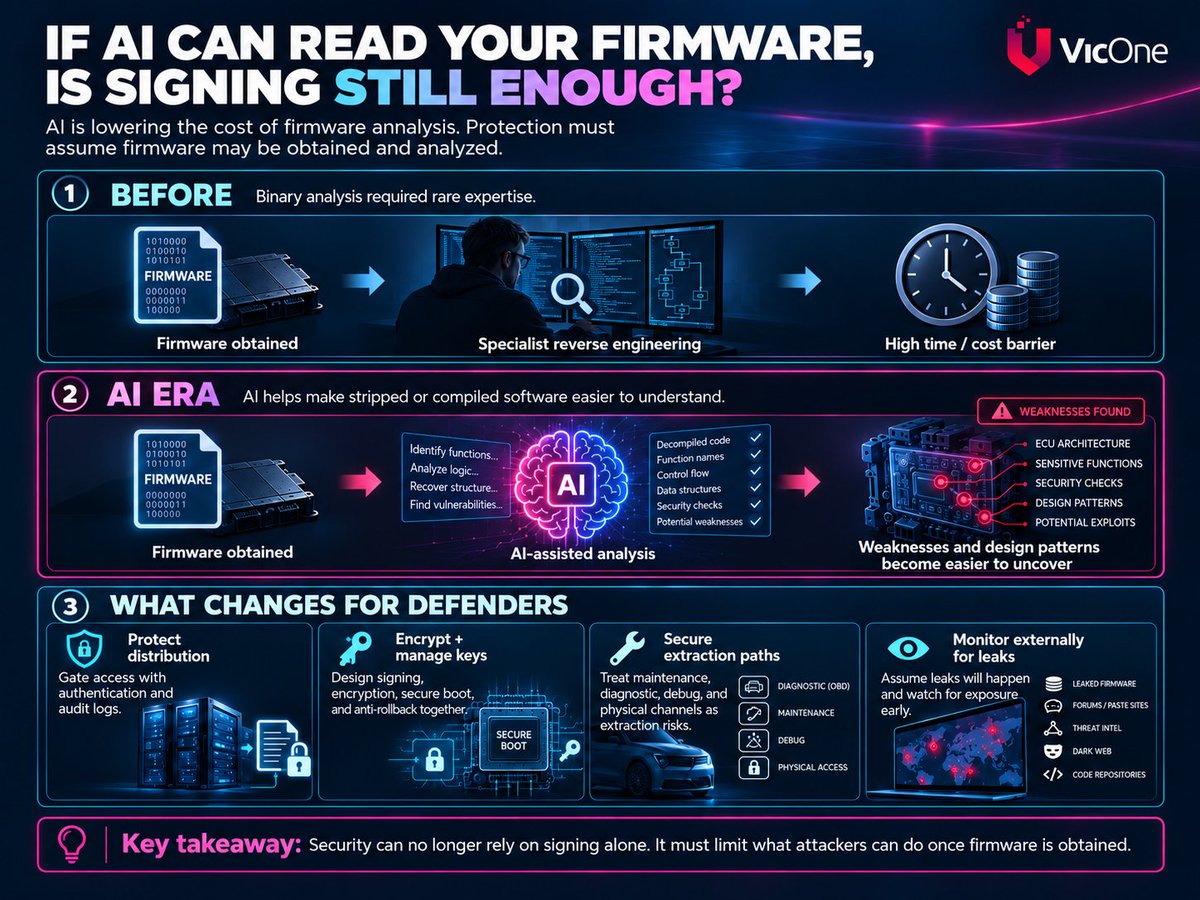
AI is making firmware far easier to understand once attackers obtain a copy.
The defense model shifts: protect firmware before exposure, and limit what attackers can extract after.
How is your team adapting?
https://t.co/TXiTQCYqPg
#AutomotiveCybersecurity#CyberSecurity
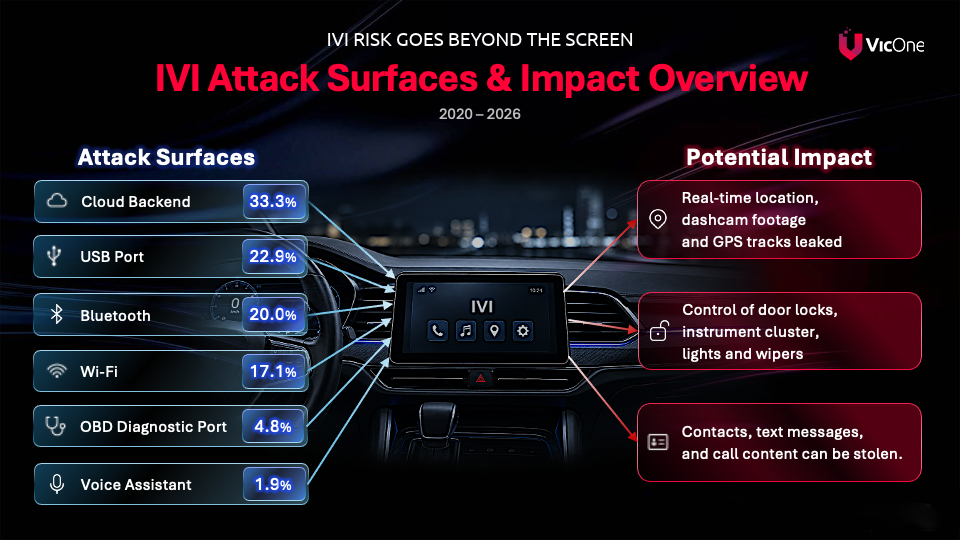
IVI cybersecurity is no longer only about protecting the screen. It is about understanding the connections around it and what those connections can ultimately affect.
#AutomotiveCybersecurity
The BYD Shark 6 security research highlights a broader connected-vehicle risk: an IVI security issue can have consequences beyond the infotainment screen. The bigger question is not only where an attacker gets in, but what that access can ultimately affect. #ConnectedVehicles
Why does this matter?
Modern IVI systems connect with cloud services, wireless interfaces, mobile devices and other vehicle systems.
A compromise can potentially extend beyond infotainment to vehicle data, privacy and vehicle functions.
#VehicleCybersecurity
Until SGLang patches, enable authentication immediately. Restrict endpoint access to trusted networks.
Read the full analysis and remediation guidance: https://t.co/PYo5A8tZ3K
🧵(6/6) #ThreatIntelligence#CVE#SGLang
CVE-2026-86793: SGLang's SafeUnpickler—the patch for CVE-2025-10164—is vulnerable to bypass. A remote attacker can execute arbitrary code through an unauthenticated endpoint. VicOne researcher Reuel Magistrado details the gadget chain. 🧵(1/6)
#ThreatIntelligence#CVE#SGLang
The entry point: /update_weights_from_tensor accepts unauthenticated requests. An attacker sends base64-encoded pickle. SGLang decodes and deserializes. The gadget chain executes. Code runs as the SGLang process. 🧵(5/6)
#ThreatIntelligence#CVE#SGLang