In my practice, I have kept IV ketorolac as the default NSAID in our TJA pathway. Once-daily convenience is not enough if patients need more opioids and go home later.
Have you made this switch, and did same-day discharge change?
https://t.co/P93k7trLVf
A newer IV NSAID is not automatically a better one.
In a double-blind RCT of 223 hip and knee replacements, we compared 30 mg IV meloxicam before incision with IV ketorolac (15 mg during surgery + two more 15 mg doses). 🧵
This does not prove the molecule is inferior in every protocol. We compared two dosing schedules, not the same dose at the same time. Pain (the primary outcome) did not differ. Opioid use and stay were secondary. We did not study GI safety or recovery after day 1.
"Doctor, am I behind?" I hear this often after knee replacement.
Our 566-patient study: recovery isn't a straight line. Largest gains came in weeks 1–3. Averages aren't deadlines.
Now on YouTube. Subscribe:
https://t.co/TxDvHtlCdM
General education, not medical advice.
Knee replacement recovery is not a straight line. In a study our group coauthored, we followed 566 patients through the first 6 weeks after surgery using wearable technology. 🧵
The largest measured gains came in the first 3 weeks, but that is not a finish line. Group averages are not personal deadlines. Talk with your surgical team about your progress instead of comparing yourself with someone else.
@AAHKS@nspiuzzi@carhigueramd@CleClinicArthGp Helmets (Paper #11, Ajay Premkumar, @JacobWilsonMD et al.): mean CO₂ 3,401 ppm across 132 cases; ≥2,500 ppm 68.3% of the time. Fan speed, masks and gowns are modifiable. Single-center, observational; performance impact not proven.
4/4
3) Data quality.
Billing codes aren't clinical truth. Miscoding, missing data, and definitions that change over time can drive a result. Ask how the exposure and outcome were defined and validated.
A big N doesn't guarantee the right answer.
1/4
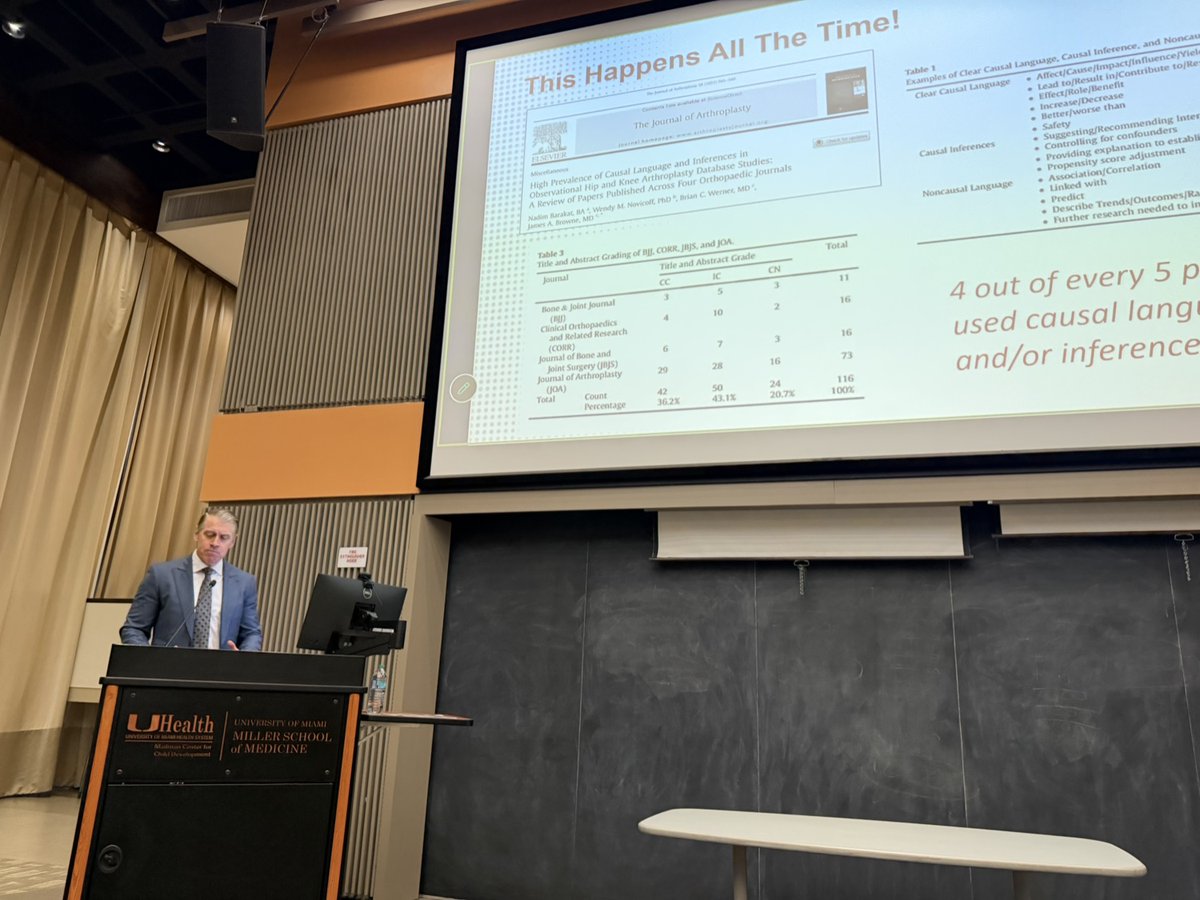
Thanks to Dr. James Browne (UVA) for a terrific Grand Rounds at UM: "Skepticism Required: Lessons from Working with Large Data and Clinical Registries in Arthroplasty Research."
3 keys I'm keeping in mind when I read registry and database studies 🧵
3/4
2) Confounding: the database only knows what was coded.
Frailty, function, surgeon judgment, patient goals, and why a treatment was chosen are often missing. Statistical adjustment can't fix variables that were never recorded.
Knees hurt and someone said "arthritis"? Don't panic. 🦵
Knee osteoarthritis is common — and it's not an automatic surgery sentence.
Start with what the AAOS guideline supports most: education + exercise, weight loss if needed, and anti-inflammatories only if they're safe for you.
Cortisone = short-term relief. Hyaluronic acid? Not recommended routinely. Skip opioids.
Follow @vhhernandez for clear answers on hips and knees every week.
What's the hardest thing your knees keep you from doing? Tell me below 👇
General education, not medical advice — talk to your doctor.
#KneePain #Arthritis #Osteoarthritis #Orthopaedics #KneeReplacement #Miami
Big data. Tough questions.
Association ≠ causation.
"Skepticism Required" Grand Rounds with Dr. James Browne (@UVAHealthNews) at @UMiamiMedicine.
Thank you, JB, for a superb talk and a great visit! 🦴 #Arthroplasty#OrthoTwitter
🚨 New publication in Journal of Orthopaedic Reports!
Cotinine testing reveals gaps in self-reported smoking cessation before joint replacement—especially in knee arthroplasty. Objective tools matter for better patient outcomes.
#Orthopedics#Research#Arthroplasty#Smoking