** IMMINENT STOCK MARKET CRASH OCTOBER 26, 2026-NOVEMBER 9, 2026 **
I am writing this message to give a detailed analysis, as to what I believe will be happening starting Monday October 26, 2026, and the main event to take place the following Monday November 2-3, 2026, with the bottom of the crash coming on November 9. I also want to explain what I believe the Federal Reserve is going to do as a means of trying to fix the crisis, and how it is going to lead to the end of the U.S dollar, bringing about a sovereign debt and currency crisis. This crisis will be the main focal point and issue that the Democratic Party is going to run on in the 26' midterms and the 28' elections, undermining the Republican Party and Donald Trump's populism, and eventually using it to try to usher in Communism, via a World Economic Forum/Black Rock policy and vision.
Before you rush to buy a stock that's down 15-20% after earnings, understand one important rule: The 3-Day Rule!
What is the 3-Day Rule, and why does it matter? Let me explain.
When a stock gaps down sharply after earnings or bad news, wait at least 3 trading days before considering buying.
Why? Large institutions managing millions of shares may need several sessions to reduce their positions. The initial gap down might be just the beginning of the selling pressure.
Day 1: An initial bounce could be driven by short covering and aggressive dip buyers rather than sustained institutional demand.
Days 2 and 3: Selling pressure may continue, and the stock could make new lows as investors reassess the news.
After Day 3: Look for signs that selling pressure is fading and price is beginning to stabilize.
Before buying, check:
- Selling volume is shrinking
- Price is holding above the recent low
- You understand why the stock dropped
- The fundamental thesis remains intact
Remember, three days don't guarantee a bottom. Some stocks need several weeks or even months to build a proper base before beginning another sustained uptrend.
If the business is fundamentally broken, the stock isn't necessarily on sale. It may simply be getting repriced.
The market doesn't reward you for catching the exact bottom. Let the selling pressure fade, let the stock build a base, and let the trend confirm itself.
Missing the bottom is far better than getting caught in a downtrend
🚨 Everyone is watching the wrong bubble.
And missing the greatest opportunity in 40 years because of it.
While the crowd argues about AI and crypto, the real story is the asset sitting in every "safe" portfolio on earth.
Bonds.
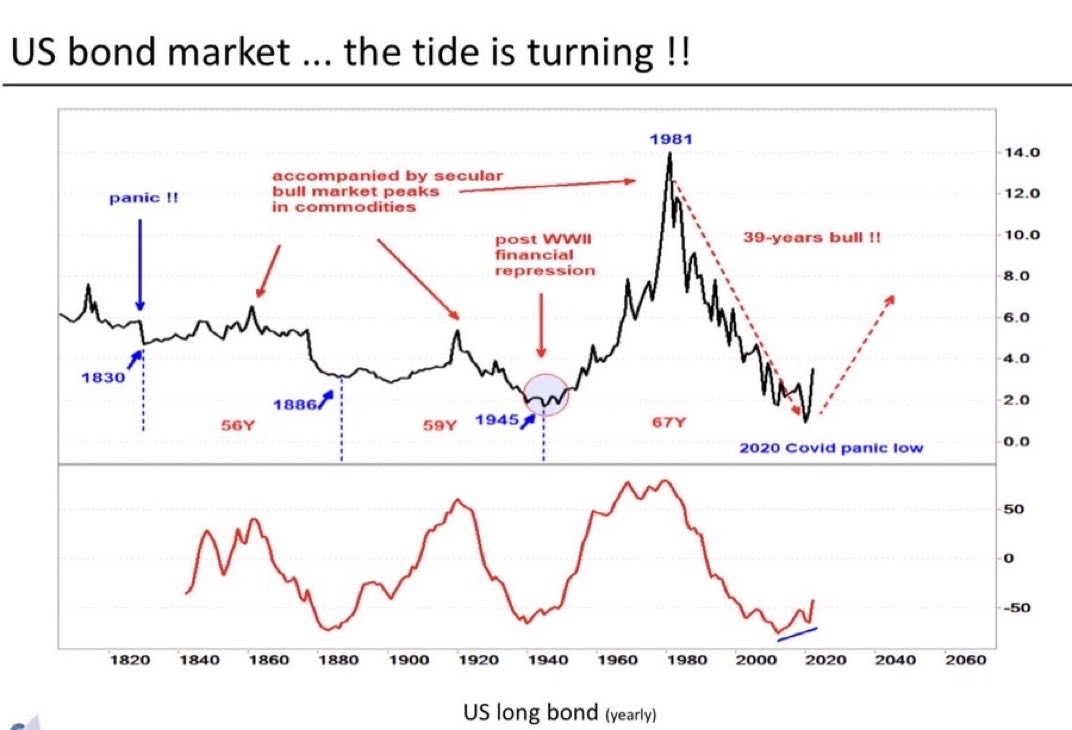
The 1981 top printed 14% yields. The 2020 bottom printed 0%. That was 39 years of falling rates, and it ended in a single Covid panic.
Covid was the turn. Rates hit zero, the system flooded itself with liquidity, and the 40-year bull in bonds quietly ended in the very moment everyone felt rescued.
That's reflexivity in the Soros sense. For four decades, falling yields lifted every asset, which convinced everyone yields would keep falling, which lifted assets again. Belief and reality reinforced each other all the way down to zero. Then the loop turned. And here's the part almost no one has grasped: a turn this big isn't the end of the game. It's the start of a far better one.
Here's why I'm genuinely excited.
For 40 years, falling rates lifted everything together. Correlations converged. The tide carried every boat, so owning the whole ocean beat knowing which boat was seaworthy. Index beat judgment. Skill was a rounding error.
That era is over, and what replaces it is the best environment for active investing in two generations.
When the secular tide reverses, dispersion comes roaring back. Winners and losers split apart violently. Suddenly the things that were invisible for 40 years, valuation, balance-sheet quality, real cash flow, pricing power, decide everything. The gap between the great business and the mediocre one stops being a footnote and becomes the whole return.
This is the world that made Buffett, Lynch, and Templeton. It's the world before 1981, where picking actually paid. It's coming back.
And it arrives at the most lopsided starting line imaginable, which is exactly what makes the opportunity so rich.
Concentration at a record. A handful of names carrying the entire index. Record IPOs listing at peak valuations and getting forced straight into peak index weights through mechanical, price-insensitive buying. The passive bid that everyone treats as ballast has become the marginal price-setter at the worst possible altitude.
JPMorgan's own Guide to the Markets makes the setup clear. Map starting valuation against subsequent ten-year returns, and today's level points to roughly zero percent per year from the S&P over the coming decade.
Sit with that. Zero from the broad index for ten years.
Now flip it over. If the average is zero, the spread around that average is enormous. Some things compound beautifully. Others go nowhere or worse. A flat index for a decade isn't a dead market. It's the richest hunting ground for active investors in living memory, because the distance between right and wrong has never paid more.
The whole architecture of modern investing was engineered for the era that just ended.
- Buy stocks and chill. Built on a discount rate going one direction. Down.
- The 60/40. Built on bonds rallying whenever equities fell.
- Just buy the ETF. Built on a 40-year tailwind no one managing money today has ever seen reverse.
That's the trap. And the mirror image of every trap is an opening for the people who see it first.
Strauss and Howe gave this moment a name. The Fourth Turning. The last of the four cycles, the Crisis, when the institutions built for the old era meet the conditions of the new one. These turns feel like danger to everyone clinging to the last playbook. They are the launchpad for everyone holding the next one.
The tide is turning. The old map is worthless.
And the greatest opportunity of our generation is hiding in plain sight, inside the thing everyone still calls safe.