We have partnered with @Peersyst to bring digital ledger infrastructure to Latin America and Spain.
The agreement formalizes a multi-year collaboration by designating Peersyst as a key provider of Cosmos-based solutions for central banks, financial institutions, and governments across the region.
Read the full story:
Babe wake up, anthropic dropped all these completely free courses on everything possible with Claude, from super basic beginner 101 stuff to advanced. (Seriously though, this isn’t an ad - this is me sharing information and if you haven’t got your head around Claude yet, you absolutely should) https://t.co/3dVjG2tGFx
Before you spend $2,000 on an AI course, read this.
A lot of people are buying expensive AI courses right now.
But honestly, most of them don’t need to.
Some of the best AI learning resources in the world are already free. And they’re not built by self-proclaimed AI experts online.They’re created by the companies actually building the models, chips, tools, and infrastructure behind this entire AI wave.
If you want to learn AI properly, it makes sense to learn directly from the source.
But before that, Check out 100+ such resources shared in this community of 200K+ AI/ML Engineers: https://t.co/1551GLLSyi
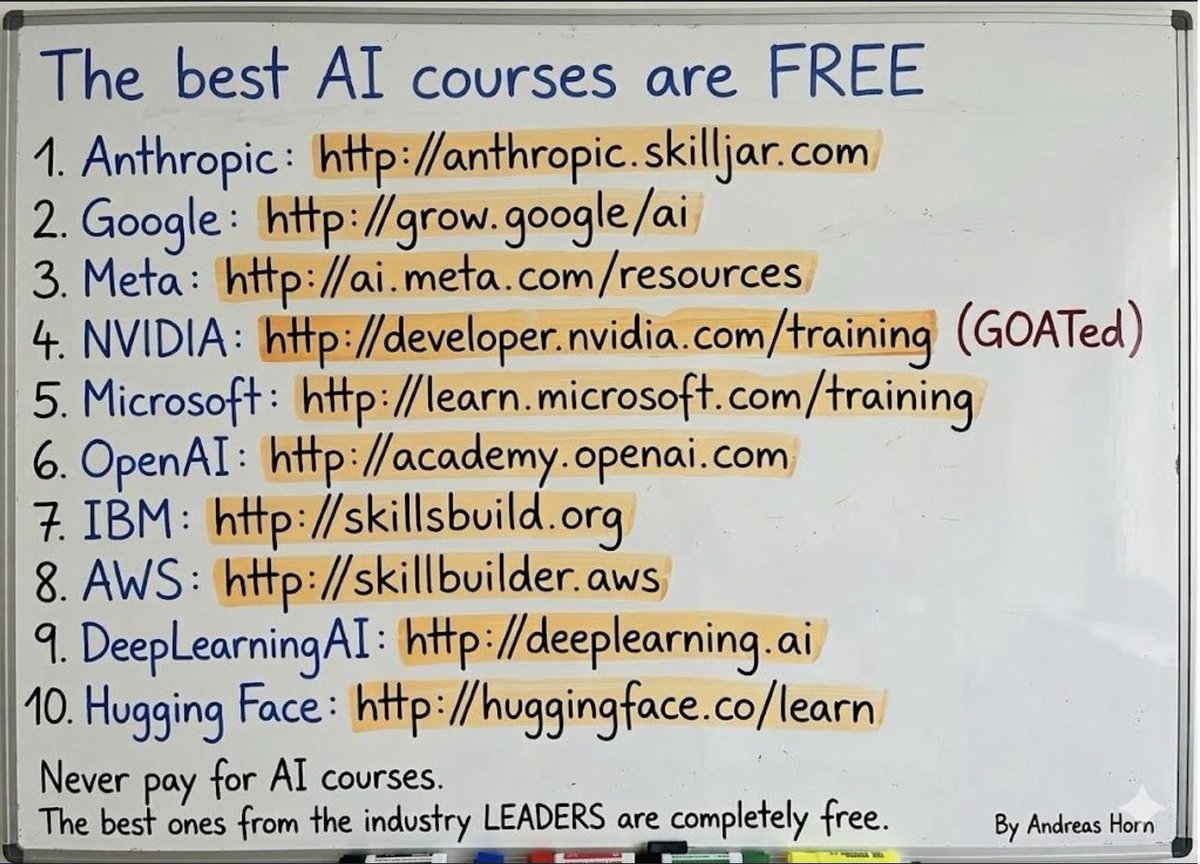
Here's a list of 10 free AI learning platforms from industry leaders:
𝟭 - 𝗔𝗻𝘁𝗵𝗿𝗼𝗽𝗶𝗰:
https://t.co/i11SbYMwsc
𝟮 - 𝗚𝗼𝗼𝗴𝗹𝗲:
https://t.co/AP7UJIWCZS
𝟯 - 𝗠𝗲𝘁𝗮:
https://t.co/Szgt9UZwEG
𝟰 - 𝗡𝗩𝗜𝗗𝗜𝗔:
https://t.co/jhKE77g8qA (GOATed)
𝟱 - 𝗠𝗶𝗰𝗿𝗼𝘀𝗼𝗳𝘁:
https://t.co/7oyuGNBso1
𝟲 - 𝗢𝗽𝗲𝗻𝗔𝗜:
https://t.co/SB5qSuOJND
𝟳 - 𝗜𝗕𝗠:
https://t.co/bivomoOsgU
𝟴 - 𝗔𝗪𝗦:
https://t.co/4XySMsxNbR
𝟵 - 𝗗𝗲𝗲𝗽𝗟𝗲𝗮𝗿𝗻𝗶𝗻𝗴𝗔𝗜:
https://t.co/wW9udDmT29
𝟭𝟬 - 𝗛𝘂𝗴𝗴𝗶𝗻𝗴 𝗙𝗮𝗰𝗲:
https://t.co/9llzeMmuAo
If you’re serious about learning AI, the biggest difference usually comes from consistency, not another course.
Skip/Interchain Labs is now Cosmos Labs: the core team driving development and growth of the @cosmos blockchain ecosystem and Cosmos technology stack.
200+ blockchains use the Cosmos Stack in production, the largest network of Layer 1 blockchains in the world.
By becoming Cosmos Labs, we are doubling down on the vision that customizable, connected blockchains are how the world will come on-chain.
Cosmonauts & Stream fam!
🔥 @StreamSwap_io is now live on @cosmoshub 🔥
Hub / ATOM alignment? Fuck yea!
Launches happen exclusively in $ATOM ⚛️
1⃣ NO snipers
2⃣ NO oracles
3⃣ predictable linear curve
4⃣ fairest launchpad
@IntentoZone && @quark_on_cosmos streams live now!
This isn't a 1 off. This is the start of a massive trend of real businesses building their own L1 blockchains. We're in talks with tons of other companies (including some major fortune 500s) who are considering launching their own L1s.
Years ago, enterprise blockchains failed and have been a 3rd rail for a long time. So why now? Why are mature businesses starting to build blockchains again?
And why are they building L1s above anything else?
There are two major reasons enterprise blockchains are coming back:
1/ Stablecoins are maturing: The finance teams we talk to are not afraid or unfamiliar with stablecoins anymore. Thanks to the Circle IPO and coming regulation, they see stablecoins as a powerful and safe technology that can help them cut costs, streamline operations, and earn more on their cash reserves or customer deposits. Most big companies are putting in place infrastructure to hold and move stablecoins. The U.S., Japan, and many other countries are pushing forward stablecoin regulations, and the dust is settling in our favor.
2/ Payments, not provenance: In the previous wave of enterprise blockchain hype most of the use cases were around provenance (aka tracking the origin and lifecycle of some multi-company process, like tracking raw materials across a supply chain or tracking the usage of donor capital). This was always a weird use case that could technically be done with a database. The problem was trust.
Now, the corporations we're talking to are looking at payments as their first use case, almost no matter what industry they're in. Most B2B and B2C payments providers and networks charge merchants and businesses high margins, take days to settle, and have real settlement risk. These problems are much worse as soon as you go cross-border or need to deal with FX. So for multinational corporations (especially marketplaces like Airbnb), in-house blockchain-based payment solutions could lead to billions in savings and better experiences for customers, employees, and gig workers.
And why are they building L1s, not L2s, or contracts?
1/ L1s are battle-tested and familiar to technical decision makers: L1s as a technology platform are well-understood and familiar after 10+ years of development. Ethereum, Bitcoin, Solana, Sui, Aptos -- every blockchain that people who don't work in the industry know about is an L1 (base maybe being the exception). Cosmos tech alone supports 200+ chains and $70b of assets across almost every vertical, and Hyperliquid, the biggest breakout of the last year, cemented this. (Plus the most successful enterprise blockchains like Canton are L1s).
L2s are exciting but they are still nascent and poorly understood by comparison. (Try explaining the difference between a stage 1 and stage 2 rollup or what a validating bridge is to the CTO of a consumer marketplace business). Decision makers who operate mature businesses usually don't want to take risks on emerging new platforms. They're already taking a big enough risk by getting into crypto, so they need to do it in the way that is most legible to their stakeholders.
2/ Minimizing platform risk: Most of these companies don't want to bet on ETH or SOL or TIA or anything else. They just want to bet on themselves. Building an L1 is the best way to do that. Remember, big companies usually use multiple cloud providers to avoid platform risk from AWS or Microsoft. And you can bet they see Ethereum or Solana as much riskier than those partners.
3/ Control and connectivity: Open, transparent L1s give these companies a great balance of control (so they can own their own platform) and connectivity (so they can plug into and interoperate with the broader crypto-corporate landscape as it evolves). Interop between L2s and other chains like Solana relies on 3rd parties, and often struggles from finality issues due to fraud / Zk proving windows and Ethereum's slow finality. L1s don't have this issue. Settlement happens instantly and deterministically, so interop can function the same way. That is a killer feature when combined with the ability to have your own walled garden where you implement any necessary KYC/AML and application specific logic.
Very excited for the next wave of the internet of blockchains
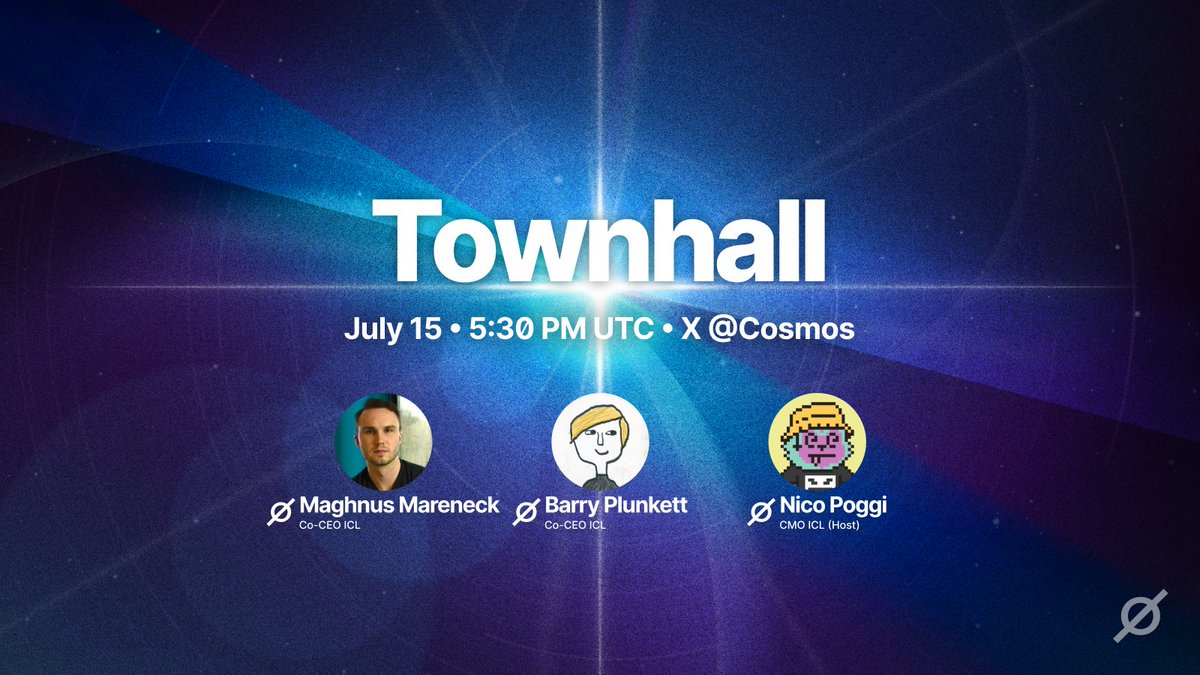
Join us tomorrow, we will cover these updates in a Townhall with @bpiv400 & @0xmagmar, CO-CEOs of ICL.
✦ July 15th · 5:30 pm UTC
Got questions for the Townhall's live Q&A?
Read the FAQ on the blog and submit other questions early in this form ➡️ https://t.co/tCSVyIept4
Join the Find Your Cosmonaut quest!
Cosmos is home to 120+ IBC-connected chains, each with its own culture, vibe, and frontier to explore. To celebrate IBC Eureka, we are exploring our universe!
100 Winners will share a $10,000 USDC Prize Pool 🏆
⚛️ How to participate 👇
IBC Eureka is LIVE!
→ Transfers faster than Ethereum finality
→ Send from Ethereum for as low as $1
→ 1-click experience that supports your favorite wallet
Starting with Ethereum, @cosmoshub, @babylonlabs_io, Cosmos chains,
and soon, IBC everywhere🧵