I worked on Lumen Lite which is now out in UE 5.8. It's based on Irradiance Fields with Probe Occlusion, but with automatic probe placement. It is used when the engine is set to Medium GI and Reflections quality.
https://t.co/Y6i4aOGZlN
Robert Kurvitz's upcoming project, Corinthians, had it's first concept art leak, as shown below. Depicting one of the main areas of the map, this image suggests that the name "Corinthians" was not a coincidence after all, and that the game will be set in Osasco - São Paulo.
Residual Primitive Fitting of 3D Shapes with SuperFrusta
Another great work done by our intern Aditya Ganeshan @AdobeResearch.
We introduce a framework for converting 3D shapes into compact and editable assemblies of analytic primitives.
Replacing inverse transpose matrices with adjugate matrices in our new code base. Inverse transpose is slower to calculate and less robust.
@EricLengyel wrote a fantastic article about that:
https://t.co/HJFl5GLznO
Slug algorithm is now open source and patent is public domain! Thanks Eric!
Hopefully this means that awful font rendering in some apps and games will be a thing in the past.
I spent around 65 hours researching, implementing, and writing for my next "Gotta be less than 2ms" newsletter article. In this article I explore Julian Love's famous Diablo 3 VFX talk from GDC 2013. I go over how you can implement the techniques from his talk into a modern engine like Unreal Engine 5 and some of the problems you may face when doing so. I show the process from start to finish on how to recreate some of the FX demos that were shown and provide the IlluGen project files so that you can have source materials to try and replicate the effects for in engine verification purposes. I had a lot of fun investigating this and I certainly learned a lot more than I had anticipated.
Comment on the Linkedin newsletter version here: https://t.co/kskcV5UGsL
Read the full article here: https://t.co/eLDXfIXiS0
#realtimevfx #gamedev #indiedev
vk_gltf_renderer is now a full glTF reference path tracer: all core features, all extensions, full PBR. Ray tracing + raster, Vulkan, open source.
https://t.co/pxbqRrWrFE
"UE5: Optimizing with Bend Studio's Screen-Space Shadows"!
This video explains optimization techniques using Bend Studio's screen-space shadows, which are integrated into UE5.
https://t.co/jY65UU1bIs
#Optimization#ScreenSpaceShadows#DynamicShadow#unrealengine5
Working on Sparse Volumetric Light-maps.
Thanks to @CynicatPro for pointing me at Unreal's version.
https://t.co/eN2AmLYjvb
In a nutshell it's just another sparse voxel data structure. My implementation is, no doubt, different from @EpicGames's own.
I'm using 4x4x4 probe grid with intermediate nodes having very wide branching factor of 64 as well (4x4x4).
I liked the parameters that Unreal is using, of limiting both total memory as well as the lowest level of detail, which is common in sparse grid implementations.
Here's Bistro scene with just 1Mb limit. This is roughly equivalent to a 512x512 lightmap texture in 2d, except surface light maps require unique UVs and you typically get very little detail out of 512 resolution texture with a lot of light leaking. There is also no directional response.
My implementation encodes second-order spherical harmonics for each probe (9 coefficients), encoding RGB channels as RGBE9995 (4 bytes).
So far only worked on the structure, actual bake is yet to come.
I've been eyeing sparse voxel structures for a while now, and have been studying them roughly since the GigaVoxel paper by @Icare3D but never really implemented anything for the GPU before. I was always the BVH-kind of guy.
It's a fascinating topic.
---
Stats for the scene:
---
Total memory usage: 1.000 MB
Node count: 609
Unique probe count: 24,025
Probe reuse: 38.36 %
Unexpanded nodes: 15,714
---
Again, note that there is no GI going on here, only the structure of the probe tree and the algorithm for building it from a given scene.
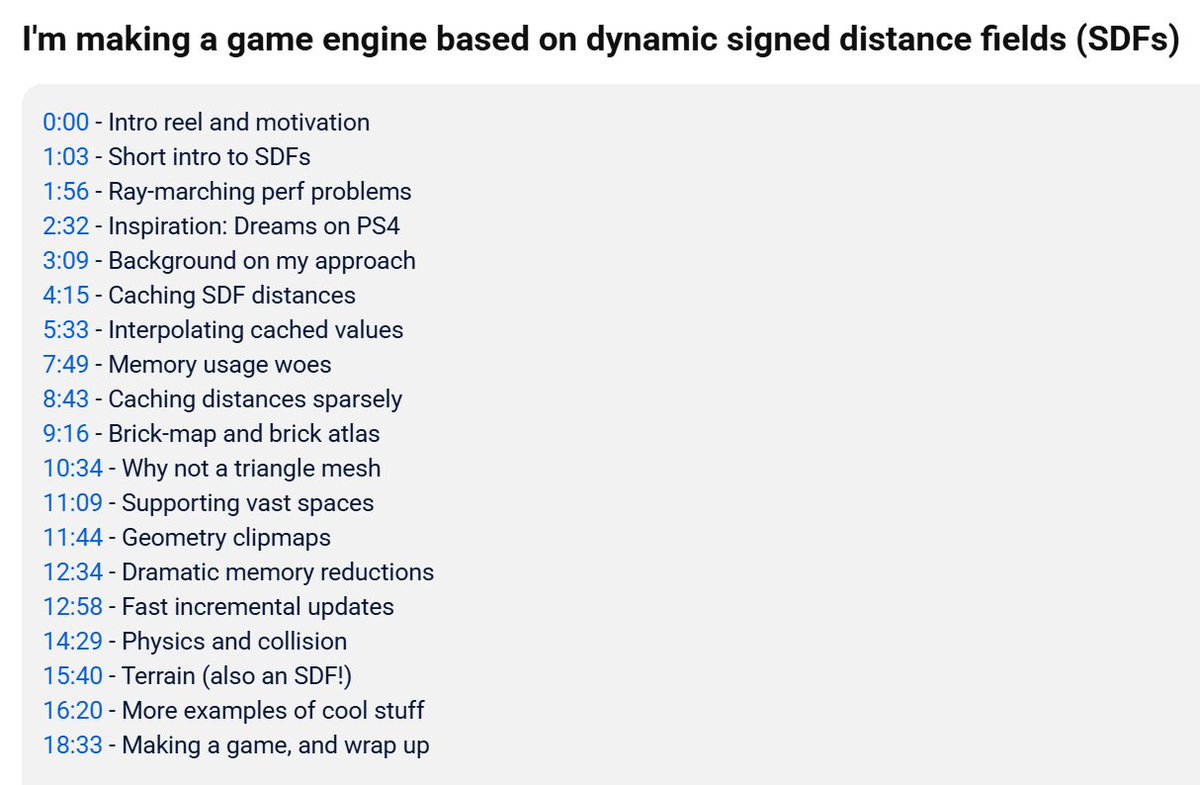
I just released my video about the engine (and game) I've been working on.
The engine is based on dynamic SDFs, and the video describes how it works and what it makes possible.
Link in the reply!
This is my first YouTube video and it took forever - please repost!
"Improving Direct Lighting Material Occlusion - Part 1", discussing micro-occlusion for direct lighting, Naughty Dog's and Activision approaches and alternatives https://t.co/sSf1PkkPhA
It's hard to find videos of SIGGRAPH "Advances in Real Time Rendering" talks, but many of them are freely available:
Go here, and click into "Courses" for the year you want, then one of the "Advances ..." sessions.
https://t.co/qp9OuvSKqi