"When everybody is swept away unthinkingly by what everybody else does and believes in, those who think are drawn out of hiding because their refusal to join is conspicuous and thereby becomes a kind of action."
Hannah Arendt
A classic doom post that cherry picks data without providing context. This is not how you read credit.
Oracle’s long bonds at 8.3% is not the debt market panicking. The 30-year Treasury is at 5.5% so this is a +230bps spread on a 30-year high duration BBB name. Calling 8.3% “the highest ever” without saying “and so is the long end of the Treasury curve relative to the last 15 years” is just selective marketing to prove a point.
Five year CDS at 220bps against the 5-year Treasury which is at 5.2% is the same story, expensive for Oracle not “rates don’t exist” and the comparison to one year ago is stark in a world where the 10-year was significantly lower, Oracle had not yet been cut to BBB-, and the market had not yet decided that Oracle was the proxy for “who funds the AI build” question.
Absolute yields move because the whole curve has moved. Credit risk is the spread, not the coupon or absolute yield. The broader investment grade market is still tight, on average about +80bps for the index and +100bps for BBB. This market is still hungry for yield and is simply discriminating against, instead of dumping, corporates.
Oracle trades wide of the BBB pack. That’s not the entire “debt market” and if the market truly panicked we’d see BBB as a cohort blowing out. Same for the “CDS exploded for AI names” when Alphabet, Microsoft, Amazon, Meta CDS have widened off very tight levels. They still sit nowhere near Oracle. The message should be viewed as Oracle’s balance sheet is the weakest of the hyperscaler complex, not AI credit is broken.
The Jupiter loans are project finance and construction loans, which are floating, privately held, and hard to syndicate after the S&P cut, local opposition, pipeline issues, and a force majeure notice. It is not a defaulted Oracle senior note. Oracle’s own fixed coupon bonds were already marked lower than that on a price basis because of duration. A floating loan at 90 cents can be a cleaner credit read, it is not flashing 60-cent distressed territory. Also the force majeure on a delayed campus is Oracle protecting itself on timing. Ugly for the project lenders but again not the same as Oracle missing a coupon.
Oracle is a BBB- AI infrastructure story with too much paper, too much duration, and too much OpenAI concentration. That is a spread story. It is not 2008.
He has been pledging Oracle stock for personal loans for years. The latest add (~$9.2bn / 67 million shares) is widely tied to the Paramount / WBD equity check, not a sudden “Oracle is insolvent so Larry is pawning the company.” Disclosure shows that 36% of his stake is pledged which is a margin and stock price risk for him if ORCL keeps falling. You can’t mix the founder’s personal securities-backed loans with corporate default risk unless you also want to mark every billionaire’s pledged-stock facility as a credit event.
Oracle credit is cheap versus its own IG rating and versus other tech IG. It is not cheap versus actual BB paper if you think the AI contracts slip, OpenAI concentration bites, or they need another $25bn when the window is ugly. It is not “the debt market is starting to panic.”
The debt market is charging Oracle a BBB-minus / BB-plus rent in a 5-handle Treasury world. That is uncomfortable for a company spending like a utility and rated like a software firm.
The presumption that the Fed raising short-term rates reduces inflation is predicated on the belief that higher rates reduce demand and investment.
But what if higher rates don’t reduce demand and investment because the demand for intelligence and energy is unaffected by higher rates because winning the race for super intelligence has a near infinite ROI and the demand for compute will remain incalculable.
Why won’t higher rates at this unique moment in history therefore lead to more inflation as interest costs are embedded in everything?
And the problem is compounded as the more the Fed raises rates, the more inflation we will have and the more the Fed will need to raise rates further and so on.
But what if the old models don’t apply to the current paradigm and the Fed is wrong?
I think the Fed might have just made a mistake. Am I right or am I wrong?
I love @zerohedge but you guys are sending $ price charts for a bond that trades on spread to treasuries. We were a large byr of Beignet when the deal was issued last year and monetized the investment over time at much tighter levels than where it’s trading now. We were also excited to support @Meta in their Sopapilla financing this summer. Both bonds are substantially tighter from issuance. The Beignet (Hyperion) priced at 260/10y and now trades at 220/10y. Most of the decline you are showing is simply a move in rates. There are likely plenty of problems to be found over time in the AI financing chain but I’m not sure this is one of them. I would focus on less built projects with weaker counterparties in NIMBY heavy jurisdictions if you want to go looking for canaries.
As an American returning from Uganda, I experienced the Ebola flight restrictions firsthand.
It wasn't just inconvenient for me. Airline staff and immigration had additional procedures to follow. It added about 2 hours of immigration processing plus another 10 hours of travel because of the limited U.S. entry airports (you can only travel to 1 of 4 airports).
These restrictions create real costs and friction for travelers, airlines and governments.
If the public-health risk warrants it, fine.
But Uganda and @MinofHealthUG also needs to recognize that continuing to communicate a need for Ebola emergency resources has direct consequences.
For Americans traveling to/from Uganda, this is a significant deterrent.
When I started on Fintwit I felt like my entire feed was really sharp anon accounts who were tweeting valuable equity research insights.
Not sure if I messed up the algo, or what, but it's entirely gone. Like a distant past.
JENSEN HUANG: “If you build a product or a service and you're not confident in its functionality, capability, or safety, then don't release it … The market forces are already there. We don't need any new laws. We don't need new regulations.”
Last month I wrote about how we can build a positive and safe future for everyone: https://t.co/eoLGVY8yad
Every lab has the responsibility and incentive to move at the pace required to train its models safely, and the ability to take its own actions to ensure that happens.
The reality is:
- People won't want to use agents that are misaligned with them and that don't do what they ask, so labs have a strong natural incentive to make their models more aligned.
There is a lot of debate about slowing progress on capabilities until alignment catches up. My view is that trust and alignment are quickly becoming the most important capabilities that will differentiate agents and models. Any lab that doesn't focus on alignment will fall behind.
- Labs face significant liability if their models cause harm, so they have a strong incentive to prevent this as well.
Meta delayed shipping Muse for several months to focus on safety and security. We didn't call for everyone else to do this before we would. We just did it as part of our day-to-day work because it was clearly the right thing for people and for us. I'm proud of the security foundations we've built.
- Engaging independent evaluators and advisors is industry best practice. MSL already does this today in several areas because it helps produce better work. Other labs can just do this too. In general, it would be helpful for there to be a larger and more diverse ecosystem of evaluators.
- Committing the significant majority of compute towards serving people rather than racing towards recursive self-improvement is one of the best ways to ensure we develop this technology safely. Meta has made this commitment and other labs can do this as well.
I believe the key to building a positive future for everyone is maintaining the right balance of power. This is within our power to do.
EA AI safetyism increasingly looks like Marxism-Leninism for the algorithmic age.
The old vanguard claimed privileged knowledge of the inevitable course of History. The new one claims privileged knowledge of the probabilistic course of Humanity.
Both use an elaborate intellectual framework to reach the same political conclusion: a small group of enlightened people must constrain everyone else for their own good.
That has never lead to anything except monumental human suffering.
Dario has written that we need to “pace the frontier,” and Sam has agreed. People may be surprised by my response: go ahead.
You guys are the frontier. By any reasonable metric — market share, revenue growth, model capability — the two of you have a duopoly on frontier intelligence. You’ve also claimed the lead is widening because of recursive self-improvement.
I don’t see what you see in the lab. If the unreleased models are scary enough that you think you should slow down, I support your decision to be responsible.
But stop pretending you need anyone else’s permission. Stop pretending antitrust law has to be suspended so you can form a cartel. Stop pretending you need a regulatory approval process that supersedes product liability. Stop pretending METR is independent when it is intertwined with Anthropic’s investors and staff. Stop pretending you need those same evaluators to police competitors who aren’t even at the frontier.
Most of all, stop pretending the motivation to slow down is purely altruistic. You face massive product-liability exposure if your products enable a truly damaging cyberattack. The market already punishes models that behave in unpredictable or unauthorized ways. After the Hugging Face episode, it is simply good business for OpenAI and Anthropic to trade some raw power for reliability and predictability. Call it alignment if you want. It is also just giving customers what they want.
Pacing the frontier would also create breathing room for a more intelligent conversation about regulation than Bernie Sanders’ “shut it all down.” China is very unlikely to join a global agreement, as you know, and that has to be taken into account as well.
So go ahead and pace the frontier. You are the ones setting it. The easiest way not to build superintelligence is for you to agree not to build it. Demanding your preferred regulatory framework as the price of that will look like blackmail of the public and the political system. So just do it.
If you do, you’ll buy goodwill for the next conversation. If you don’t, we’ll know this was just another bid for regulatory capture — or an election-season psyop.
Conceal the King's illness.
Conceal the identity of the supposed heir.
Plunge the kingdom into an unnecessary succession battle – as a result.
Yet, somehow come out of it as the victim.
Quite impressive, if you ask me.
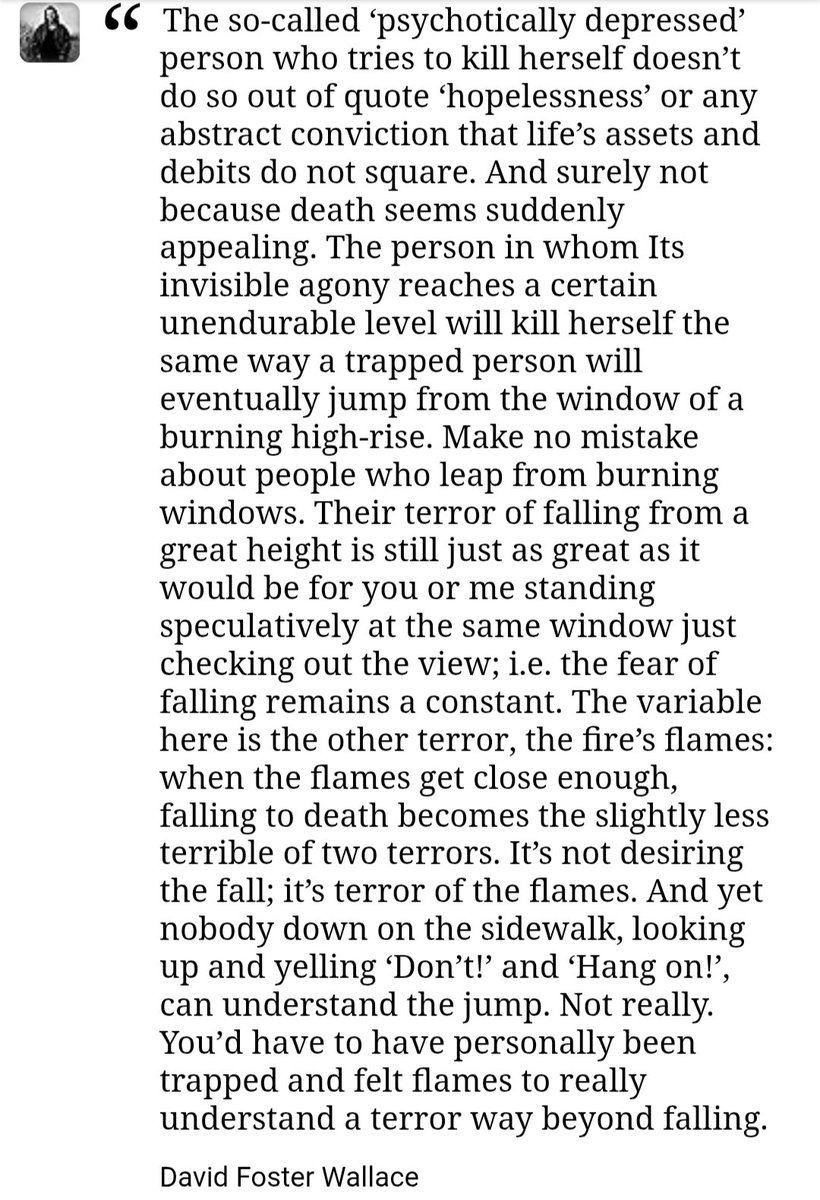
Whenever I read about the 9/11 jumpers, I always recall this David Foster Wallace passage.
None of us can possibly fathom what they experienced or the choice they had to make.
Today is the 25th anniversary of 9/11.
I will be posting little known stories of the incredible heroes behind that tragic day.
We all recognize the buildings.
We’ll see the towers over and over again. But those buildings were glass and steel. If they’d been empty, they wouldn’t have been the target.
The people were.
So today I want to share some of their stories.
Starting with Rick Rescorla, a man who lost his life but saved thousands of others including nearly all of Morgan Stanley’s 2,500 employees.
Rick ran security for Morgan Stanley in the South Tower.
After the 1993 World Trade Center bombing, he believed the buildings would be targeted again. So he made the employees practice getting out. Over and over.
People had meetings. Clients. Things to do.
He made them practice anyway.
On September 11, when the first plane hit the North Tower, the announcement in the South Tower told people to stay put.
Rick grabbed a bullhorn and started getting them out.
He was 62. A Vietnam veteran. He’d sung to his soldiers to keep them calm in combat.
Now he was singing in a stairwell full of terrified office workers, keeping them moving.
The second plane hit while his evacuation was already underway.
I keep coming back to that detail. By the time everyone understood what was happening, the people he was responsible for were already on their way out.
During the evacuation, he spoke to his wife, Susan.
He told her he had to get everyone out safely. And if something happened to him, he wanted her to know he’d never been happier.
“You made my life.”
Almost all of Morgan Stanley’s more than 2,500 people survived.
Rick could have left with them.
When a colleague told him to get out, he said, “As soon as I make sure everyone else is out.”
He went back up.
They never found his body.
Think about all the ordinary life that happened because of him. Parents coming home. Kids growing up with them. Birthdays, weddings, grandchildren.
And the fact that Susan never got another phone call.
Rick Rescorla. Know his name.
“Praeterea nullus populus vero sani capitis, quia quanto maior numerus, tanto minor intellectus.”
“Moreover no people seems to be of sound mind, because the greater the number, the less the understanding.”
Baldus, Commentary on Dig. 1.1.9 (quoted in Joseph Canning, The Political Thought of Baldus de Ubaldis)
Stanley Druckenmiller renders an unfavorable opinion of Treasury Secretary Scott Bessent's use of buybacks to defend against higher yields in a market that is functioning normally.
"I have spent five decades trading on a simple premise: Markets aggregate information no committee possesses, and prices are how that information reaches decision makers. The long-term Treasury yield is the most important price in the world. It is also the only fiscal disciplinarian the U.S. has left."
"Every basis point of artificial yield suppression is a subsidy to procrastination."
"Return buybacks to their stated purpose: small, scheduled, off-the-run liquidity operations announced at quarterly refundings, never off-cycle responses to yield levels. Term out the debt honestly and pay the price the market sets."
"If the 30-year must trade at 5.5% to clear, that isn’t a crisis. It is an invoice. Then do the only thing that durably lowers long-term yields: address the primary deficit."
https://t.co/Xe8Vi38WiI
At midnight on February 6th, earlier this year, the doorbell to our apartment rang. The doorbell was followed by a pounding on the door. I answered the door and a security person in our building handed me his phone. It was my oldest daughter Eloise. She had found my 26-year-old daughter unconscious on the floor of her apartment and had called 911. The EMT team was already there, but they did not know what was wrong with Lucy or to which hospital they would take her.
I threw on some clothes and jumped in an Uber heading east toward Brooklyn. (Lucy lived alone in Williamsburg.) On the way, I learned that they were taking her to Elmhurst, a City trauma hospital in Queens. I arrived about five minutes after the ambulance to join Eloise, Lucy’s mom, and a friend, and waited to learn what was wrong.
After about 15 minutes, I asked a nurse where she was. I looked over his shoulder to his computer. Next to her name, it said “non-responsive.” I walked into the emergency room and wandered around looking for her until I found her unconscious on a gurney surrounded by several doctors and nurses.
By about 2:30am with the results from a CAT scan, Lucy’s doctors had determined that she had a massive brain hemorrhage and would need an emergency hemicraniectomy to release the pressure on her brain and remove the blood from the hemorrhage. I called our wonderful friend and family doctor Eddie Fisher and explained what was going on. He woke up Josh Bederson, Chairman of Neurosurgery at Mount Sinai, to find out more about Zach Hickman, the neurosurgeon on call that night. Dr. Bederson said Hickman was an excellent surgeon, which was comforting as we had no choice.
The surgery to save Lucy’s life began around 3:15am and finished around 5:30am. It was successful.
The following day, I joined Lucy in an ambulance while she was being transferred to Mount Sinai on Madison Avenue. Later that day, we determined from Lucy’s Oura ring that her hemorrhage had occurred around 9am, which meant that more than 19 hours had passed from the time of the hemorrhage to the completion of the surgery to release the pressure on her brain (I only wish @ouraring had an alert for this kind of a medical event. Imagine it could call a family member if the wearer doesn’t cancel the alert).
I later learned that the standard of care is not to do surgery to save a patient with a large brain bleed if more than five hours have passed since the hemorrhage. Even when the surgery is done, I was told that the likely outcome for the patient is a few months in a nursing home and death from pneumonia.
When I met Lucy’s doctors, I did my best to inspire them: “Let’s see what can be accomplished if we give her the best care possible and we invest unlimited resources to restore her to life.” And I promised that whatever we learned we would make available to everyone.
Dr. Chris Kellner, her neurosurgeon, and Dr. David Putrino, Director of Rehabilitation Innovation for the Mount Sinai Health System have led Lucy’s care team since that day. Words cannot describe the remarkable and compassionate care that she has received beginning with the EMT team and then from nurses, doctors, therapists, and the army of people who have worked to save her and return her to life. To this day, we have a daily Zoom where we discuss her progress and make adjustments to her care. While her care and oversight have been incredible, the learnings for the Mount Sinai team have also been elucidating and will assist in the care of many others.
Lucy began in a bad place. She was in a coma for several weeks and then awoke not being able to breathe on her own, unable to walk, see or speak.
Over the last six months, she has recovered her cognition – she understands everything including her circumstance – is able to walk a hundred or more steps at a time with assistance, is making progress with sounds, vowels and consonants and the beginnings of speech, but she remains unable to see.
Each day, she makes a little progress, and daily progress compounds. Every day I tell her that she just needs to make a little progress and it won’t be long before she is back.
We remain optimistic that Lucy will return to normal function. It will likely take years, but I believe it is only a matter of time, hard work, and technological progress, along with some, and perhaps a lot, of divine intervention.
Many people have been praying for Lucy and we are incredibly grateful for the prayers and remarkable support she has received. Lucy’s friends have been with her every day since the beginning, and their presence and friendship have saved her life and helped to rebuild and maintain her spirit. And on a very positive note, Lucy’s challenge has brought together our entire modern family who have all been incredibly devoted to her care and recovery.
Lucy's vision and other faculties may require some form of brain computer interface, work that is underway at Neuralink, Precision Neuroscience, Science, Synchron, Nudge, and other companies in the space.
If you are going to have a devastating brain injury, now is the best time in history for that to happen. We are living in a world when you can be confident that the blind will soon see again. We are going to do everything we can to help make that happen, including by assisting existing companies in the space.
With respect to our promise to make Lucy’s care available to others, we have made good progress. In May, a real estate colleague made me aware of a 93% vacant, brand new, 400,000 square foot Class A+ purpose-built biotech facility on West End Avenue between 65th and 66th Streets that missed the market and was available for sale. The Pershing Square Foundation acquired the building 60 days later.
We also put under contract an adjoining 130,000 square foot building at 320 West 66th Street that is currently being used by Saturday Night Live for studio space. The building has 35-foot ceilings with massive column-free spaces that can be converted into superb rehabilitation facilities. We will close on the SNL building in December.
We are also acquiring an adjoining vacant lot with additional air rights. With just the existing zoning rights, we can add a 150,000 square feet for a total of 680,000 square feet, a lab footprint larger than Rockefeller University, and that’s without including the potential for an upzoning that would allow for substantially more buildable area on the site’s 3.4 acres with spectacular views of the Hudson.
Our goal is to build the world’s greatest brain research, rehabilitation, recovery, human optimization, and longevity institute. We have named it The Ackman Oxman Institute or the AOI for lack of a better name, but also to reinforce the point that Neri and I and our family are all-in on the mission.
The AOI will be patient-centric. It will not be an academic research institute that produces lots of papers, a Nobel Prize winner or two, but little if any results for patients. We will be laser-focused on cures, treatments, devices, rehabilitation and exercise equipment, and targeted and basic research with a goal of massively accelerating the time from idea to innovation to production to helping a patient.
While the AOI will be a non-profit, it will have highly commercial instincts. The AOI will have its own venture funding and will work to develop innovations to create companies that we will seed, assist, and spinout to ensure technologies, treatments, techniques, and drugs get to patients as promptly as possible.
On one 3.4 acre campus in what is still the greatest city in the world, we will do neurosurgery, neuroscience, rehabilitation, nutrition, BCI and device development, human trials, hyperbaric oxygen treatments, and life extension programs, and we will mandate and incentivize collaboration among the teams with no silos, politics, bureaucracy, or any other constraint that is inconsistent with the mission.
Mount Sinai will be an important partner and deservedly so, but it won’t be our only hospital or medical school partner as we don’t believe any institution has a monopoly on the best ideas or the best talent. We don’t believe in exclusive relationships because that is not in the best interest of patients.
Five years ago, we considered launching a brain institute inspired by Neri’s mom who sadly died from Alzheimer’s. We couldn’t make the math work as the real estate was too expensive and we believed it would be too difficult to recruit the best talent from universities to our effort.
Since then, the real estate became available at a 70% discount, universities became a much less attractive place to work due to politics outweighing meritocracy, protests that disrupt learning, the curse of antisemitism, and a decline in funding. Fortunately, during the same time, I made sufficient personal economic progress to make the AOI possible.
The advance of AI in the last few years will also enable us to greatly accelerate our mission. AI still has a lot to learn about human intelligence and the brain, and the AOI should be at the forefront of the interplay between the brain and AI.
Today, I am making a public filing disclosing a gift from Neri and me of ~$400 million or 10,000,000 shares of Pershing Square Inc. (PS) to the AOI. It is very early days for Pershing Square so these shares are intended to anchor the long-term work of the AOI as the shares compound over time while generating what we expect will be a growing stream of quarterly dividends to fund the Institute.
We will also be announcing an additional gift of similar and potentially greater size which won’t be in the form of Pershing Square stock to provide the AOI with the short- and intermediate-term runway necessary to enable it to achieve its goal of becoming a self-sustaining institute, which reinvests all of its revenues, royalties, and the economic rewards of company formation to advance the fields of brain health and human longevity.
Neri and I have chosen to anchor the funding of the AOI to maintain vision alignment and limit the need for the organization to focus on fundraising. We expect the AOI to be the best-resourced brain, rehab, recovery, and longevity institute in the world.
We are grateful to have been able to form a board which includes Dean Kamen (our generation’s Thomas Edison), George Yancopoulus (CEO of Regeneron), James Rothman (Nobel Laureate), Bernardo Sabatini (neuroscientist), Chris Kellner (neurosurgeon), Olivia Flatto (CEO Pershing Square Foundation), Neri Oxman, and myself.
We have recently identified a CEO who we expect to announce by October along with other key hires, and are beginning searches for a Chief Scientific Officer, a Chief AI/Technology Officer, a Chief Operating Officer, a Chief Financial Officer, and other key leadership roles.
If you find what we are building compelling and want to be part of the leadership team that creates and builds the AOI from a standing start, please send an email to: [email protected] with a short note as to why you believe you can help. Please include your best three ideas for the AOI along with a summary of your background and your most important accomplishments.
We promise strict confidentiality to those expressing interest in working with us.
We have learned from Lucy that the brain can recover from even catastrophic injury. There is so much more work to be done as the mind is a terrible thing to waste.
For details from my Pershing Square SEC filing see:
https://t.co/gZKafCw6Ia
So someone saves 10 million per month for 5 years.
Total savings. 600 million. They are given 732 million.
And you come and call that 22% RoI?
You really don’t want me reviewing this document in detail. It’s bad.
We recently (re)launched a number of websites. I will point out some features hat may be fun and useful. Thanks to @pjmauboussin for leading this effort!
"SBF, who spent much of his career maximizing expected value, was liquidated in 2022 by his own hand. Leopold Aschenbrenner, carrying on the work, was similarly liquidated in 2026. Now it is our turn to maximize EV. Perhaps it would be wise to approach the subject cautiously."